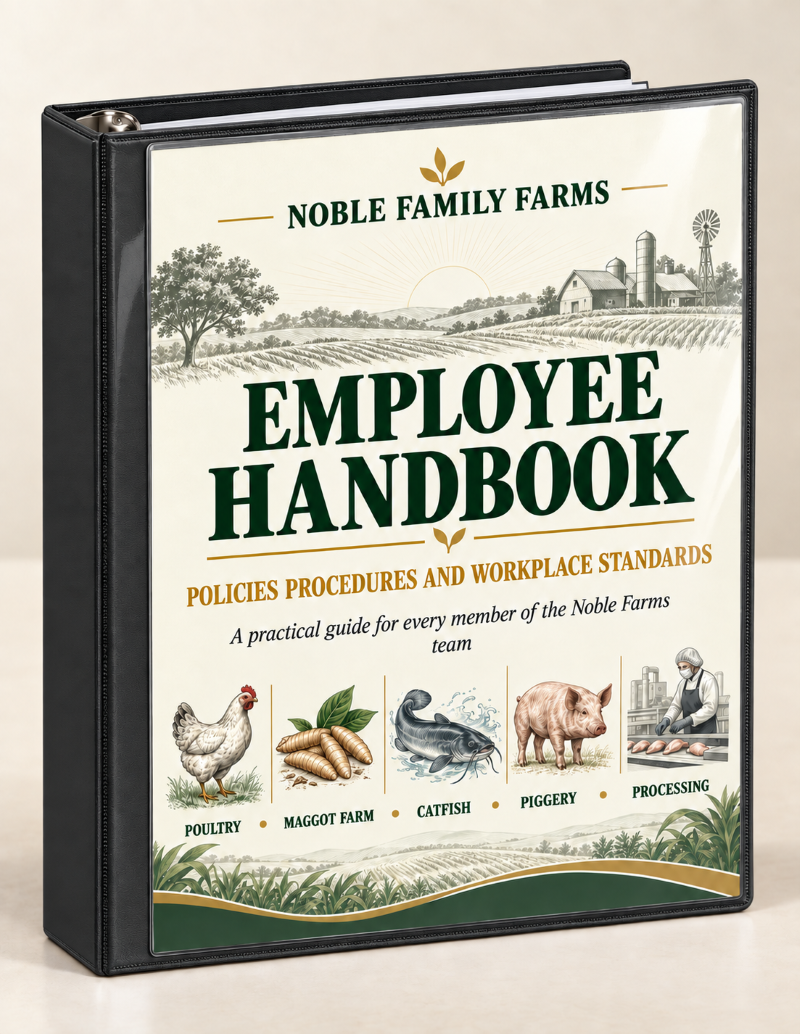
NOBLE FARMS
EMPLOYEE HANDBOOK
POLICIES PROCEDURES AND WORKPLACE STANDARDS
A practical guide for every member of the Noble Farms team
POULTRY• MAGGOT FARM •CATFISH • PIGGERY• PROCESSING
Table of Contents
The handbook is organized to help employees quickly find the policies, procedures, and expectations that apply across Noble Farms and within each operating unit.
01 Welcome to Noble Farms
Welcome Message •About Noble Farms • Mission, Vision and Core Values •Purpose of the Employee Handbook
02 Noble Farms Operations
Poultry Layers •Poultry Broilers • Maggot and Black Soldier Fly Farm •Catfish Hatchery and Nursery• Catfish Grow Out in Concrete Ponds •Catfish Grow Out in Earthen Ponds• Piggery •Processing Unit
03 Employment Policies
Employment Categories •Probation Period • Employee Records • Job Descriptions and Assignments • Resignation and Termination
04 Work Hours and Attendance
Work Schedules and Shifts •Break Periods • Weekend Rotation •Attendance and Punctuality • Absence and Call Off Procedures •Staff Living on the Farm • After Hours and As Needed Responsibilities
05 Employee Conduct and Professionalism
Respectful Workplace •Teamwork • Following Supervisor Instructions •Honesty and Integrity • Fighting Threats and Harassment •Alcohol and Drugs • Visitors• Personal Conduct
06 Roles Responsibilities and Accountability
Managers and Supervisors • Unit Leads •Farm Workers • Daily Assignments •Shift Handover • Reporting Problems •Accountability for Animals Equipment and Supplies
07 Animal Care and Welfare
Humane Treatment of Animals •Feeding and Watering • Daily Health Observation • Sick or Injured Animals • Mortality Reporting •Animal Handling
08 Poultry Unit Layers and Broilers
Brooding •Layer Management • Broiler Management •Feeding and Watering • Egg Collection and Handling •Vaccination and Medication • Cleaning and Biosecurity •Production and Mortality Records
09 Maggot and Black Soldier Fly Farm
Breeding and Egg Collection •Substrate Preparation • Larvae Production •Feeding • Harvesting• Processing and Drying •Hygiene and Sanitation • Production Records
10 Catfish Farm
Hatchery Operations •Broodstock and Spawning • Fry and Fingerling Management •Nursery Operations • Concrete Pond Management •Earthen Pond Management • Feeding• Water Quality •Harvesting • Mortality Management
11 Piggery
Feeding and Watering • Pen Management • Deep Litter and IMO Management •Breeding and Farrowing • Piglet Care• Health Monitoring •Cleaning and Waste Management
12 Processing Unit
Product Receiving •Processing Procedures • Personal Hygiene •Cleaning and Sanitation • Food Safety• Packaging and Labeling •Storage • Waste Disposal
13 Biosecurity and Disease Prevention
Farm Entry Procedures •Protective Clothing and Footbaths• Movement Between Farm Units •Quarantine • Cleaning and Disinfection •Disease Reporting • Visitor Control
14 Health Safety and Personal Protective Equipment
Required Personal Protective Equipment • Safe Animal Handling •Machinery and Equipment Safety• Chemical and Electrical Safety •First Aid • Workplace Injuries •Emergency Reporting
15 Equipment Tools and Farm Property
Proper Use of Equipment •Cleaning and Maintenance • Damage Reporting • Farm Vehicles and Fuel • Unauthorized Use • Loss or Theft
16 Feed Supplies and Inventory Control
Feed Receiving and Storage • Feed Issuing • Stock Records• Medication and Vaccine Storage • Inventory Counts •Prevention of Waste and Theft
17 Hygiene Sanitation and Housekeeping
Personal Hygiene • Work Area Cleanliness • Staff Rooms• Toilets and Common Areas •Waste Disposal • Pest Control
18 Records and Documentation
Daily Production Records •Feeding Records • Mortality Records •Medication Records • Egg Production Records • Hatchery Records • Harvest Records •Sales and Expense Records • Shift Handover Reports
19 Sales Cash and Product Control
Authorization to Sell •Recording Sales • Receipts• Cash Handling •Remittance • Product Release •Unauthorized Sales
20 Conflict of Interest
Personal Farming Activities • No Personal Birds or Animals on Farm Property• Personal Business During Work Hours •Unauthorized Use of Farm Feed or Supplies •Competing Business Interests
21 Staff Accommodation
Staff Living on Farm Property •Cleanliness • Visitors• Utilities •Conduct • Protection of Farm Property
22 Leave and Time Off
Annual Leave • Sick Leave •Emergency Leave • Permission to Leave the Farm •Shift Coverage
23 Performance and Training
Employee Orientation • Unit Specific Training • Standard Operating Procedures •Performance Expectations • Competency Checks •Performance Reviews
24 Discipline and Misconduct
Corrective Action •Warnings • Negligence• Animal Abuse •Theft • Falsification of Records •Unauthorized Absence • Insubordination •Suspension and Termination
25 Emergency Procedures
Fire •Disease Outbreak • Animal Escape• Power Failure •Water Failure • Workplace Injury •Security Emergencies
26 Security and Access Control
Farm Gates and Keys •Restricted Areas • Visitor Access •After Hours Access • Theft Prevention •Reporting Suspicious Activities
27 Communication and Reporting
Chain of Command •Daily Briefings • Shift Handover •Incident Reporting • Employee Complaints and Grievances
28 Employee Acknowledgment
Employee Handbook Acknowledgment • Agreement to Follow Farm Policies and Standard Operating Procedures • Employee Signature and Date •Management Signature and Date
Welcome to Noble Farms
Section 1 of the Noble Farms Employee Handbook
1.1 Welcome Message
Welcome to Noble Farms. We are pleased to have you as part of our team. Every employee contributes to the health of our animals, the quality of our products, the safety of our workplace, and the success of the farm.
Farm work requires commitment, teamwork, honesty, discipline, and careful attention to detail. Employees are expected to perform their duties responsibly, follow established procedures, protect farm property, maintain accurate records, and promptly report concerns.
We encourage every employee to learn, ask questions, support coworkers, and take pride in their work. Together, we can build a productive, safe, and respected agricultural enterprise.
1.2 About Noble Farms
Noble Family Farms operates simply as Noble Farms. The farm is located in Ondo City, Ondo State, Nigeria.
Noble Farms is an integrated agricultural enterprise with the following operations:
- Poultry farming, including layers and broilers
- Maggot and Black Soldier Fly production
- Catfish hatchery and nursery
- Catfish grow-out in concrete and earthen ponds
- Piggery
- Agricultural processing
Our integrated approach allows the operating units to support one another. By-products may be responsibly reused, animal waste may support sustainable production, and locally produced feed ingredients may help reduce waste and operating costs.
All employees must understand that the success of one unit can affect the entire farm. Poor sanitation, incomplete records, wasted feed, delayed reporting, or failure to follow biosecurity procedures in one area may create problems in other units.
1.3 Mission Vision and Core Values
Mission
Our mission is to produce safe, nutritious, and high-quality agricultural products through responsible farming, efficient resource management, humane animal care, innovation, and committed teamwork.
Vision
Our vision is to develop Noble Farms into a trusted and sustainable agricultural enterprise known for quality production, responsible farming practices, employment creation, and meaningful contributions to food security and community development.
Core Values
Integrity: We act honestly in our work, records, use of supplies, sales, cash handling, and communication.
Responsibility: We accept accountability for assigned animals, equipment, materials, records, and duties, and we report problems promptly.
Animal Welfare: We handle animals humanely and provide appropriate feed, water, shelter, sanitation, observation, and care.
Teamwork: We cooperate across shifts and operating units and provide clear handovers to prevent errors, losses, and harm.
Safety: We follow safety procedures, use required protective equipment, and report hazards, injuries, and emergencies immediately.
Quality: We complete every task carefully and protect product quality from production through processing, storage, and sale.
Biosecurity: We follow entry, sanitation, movement, quarantine, and disease-reporting procedures to protect the entire farm.
Stewardship: We use animals, feed, water, equipment, supplies, land, and other resources responsibly and prevent avoidable waste.
Continuous Improvement: We learn, accept constructive feedback, and seek practical ways to improve production, safety, and efficiency.
Respect: We treat coworkers, supervisors, customers, visitors, and community members with dignity.
1.4 Purpose of the Employee Handbook
This Employee Handbook explains the general policies, responsibilities, standards, and workplace expectations that apply at Noble Farms. It is intended to:
- Help employees understand Noble Farms and its operations
- Explain work schedules, attendance requirements, and reporting procedures
- Establish standards for conduct, honesty, teamwork, and professionalism
- Promote humane animal care and responsible production
- Provide guidance on safety, hygiene, sanitation, and biosecurity
- Protect farm equipment, feed, supplies, products, records, and other property
- Clarify expectations for staff who live on the farm
- Explain performance management and disciplinary procedures
- Promote consistent practices across departments and shifts
- Help employees understand where to report questions, concerns, incidents, or emergencies
This handbook provides general workplace guidance. It should be used together with each employee’s job description, assigned duties, supervisor instructions, training materials, and the Standard Operating Procedures for the applicable farm unit.
Employees are responsible for reading the handbook, asking questions when anything is unclear, and complying with all applicable policies and procedures. Management may revise the handbook when farm operations, legal requirements, safety needs, or organizational practices change.
Every employee will be required to sign an acknowledgment confirming that the handbook has been received, understood, and accepted as a condition of employment.
Noble Farms Operations
Section 2 of the Noble Farms Employee Handbook
Noble Farms operates as an integrated agricultural enterprise. Each operating unit has specific responsibilities, procedures, production targets, and recordkeeping requirements. All units work together to support the farm’s productivity, sustainability, safety, and profitability.
Employees may be assigned to a specific unit or asked to assist another unit when operational needs arise. Employees must work only within their training and follow the instructions of their supervisors and unit managers.
2.1 Poultry Layers
The Layers Unit raises chickens primarily for commercial egg production. The goal is to maintain healthy birds and achieve consistent production of clean, safe, and marketable eggs.
Employees assigned to this unit may be responsible for:
- Provide the correct type and quantity of feed
- Ensure continuous access to clean drinking water
- Collect eggs at scheduled times
- Sort, count, clean, and safely store eggs
- Monitor egg production, feed consumption, and water intake
- Observe birds for illness, injury, stress, or reduced production
- Follow vaccination and medication schedules
- Remove and report dead birds immediately
- Clean cages, pens, drinkers, feeders, and work areas
- Maintain accurate production, mortality, feed, and medication records
- Follow poultry biosecurity procedures
Important: Any unusual decline in egg production, feed intake, water intake, or bird activity must be reported immediately.
2.2 Poultry Broilers
The Broiler Unit raises chickens for meat production. The objective is to achieve healthy growth, efficient feed use, low mortality, and appropriate market weight within the planned production period.
Employees assigned to this unit may be responsible for:
- Prepare the brooding area before chicks arrive
- Maintain appropriate temperature, ventilation, lighting, and stocking density
- Provide age-appropriate feed and clean water
- Monitor chick distribution and behavior
- Observe birds for disease, injury, weakness, or heat stress
- Weigh sample birds and monitor growth
- Follow vaccination and medication schedules
- Remove and document mortality
- Maintain dry litter and clean equipment
- Prepare birds safely for harvesting or sale
- Record feed use, weight, mortality, treatment, and production information
Important: Rough handling, overcrowding, delayed feeding, water shortages, and failure to report sick birds are prohibited.
2.3 Maggot and Black Soldier Fly Farm
This unit produces larvae that may be used as an alternative protein source in animal feed. It also supports responsible organic-waste management and integrated farm production.
Employees assigned to this unit may be responsible for:
- Maintain breeding cages and adult fly populations
- Prepare suitable egg-laying materials
- Collect and handle eggs carefully
- Prepare approved substrates for larvae
- Monitor moisture, temperature, odor, and larval development
- Prevent contamination and pest infestation
- Harvest larvae and prepupae at the appropriate stage
- Wash, dry, process, weigh, and store harvested larvae
- Clean nets, trays, containers, tools, and work areas
- Record substrate use, egg collection, production, harvests, expenses, and losses
Important: Only approved materials may be used as substrate. Chemicals, plastics, glass, sharp objects, and other hazardous materials must not enter the production system.
2.4 Catfish Hatchery and Nursery
The Hatchery and Nursery Unit manages broodstock, spawning, egg incubation, fry production, and the growth of fry into healthy fingerlings. Young fish are highly sensitive, so employees must carefully manage water quality, hygiene, feeding, handling, and stocking density.
Employees assigned to this unit may be responsible for:
- Select and handle broodstock under supervision
- Prepare spawning and incubation equipment
- Support induced breeding procedures when trained and authorized
- Monitor fertilized eggs and remove dead or unfertilized eggs
- Maintain proper water flow, temperature, oxygen, and cleanliness
- Feed fry and fingerlings according to the approved schedule
- Grade fish to reduce cannibalism and uneven growth
- Monitor fish for abnormal behavior, disease, or mortality
- Clean tanks, bowls, nets, and hatchery equipment
- Count, weigh, transfer, and document fingerlings
- Maintain spawning, feeding, treatment, mortality, and sales records
Important: Sudden mortality, poor hatching, abnormal swimming, reduced feeding, or changes in water condition must be reported immediately.
2.5 Catfish Grow Out in Concrete Ponds
Concrete ponds are used to raise juvenile catfish to market size in a controlled environment. Successful production depends on appropriate stocking, feeding, water management, grading, and regular observation.
Employees assigned to this unit may be responsible for:
- Prepare and disinfect ponds before stocking
- Stock the correct number and size of fish
- Feed fish according to their size, number, and response
- Monitor feeding behavior and avoid overfeeding
- Check water quality, water level, flow, color, and odor
- Change or refresh water as directed
- Grade fish to manage size differences and cannibalism
- Remove and document dead or unhealthy fish
- Prevent fish escape and unauthorized harvesting
- Clean pond surroundings and drainage channels
- Record feed use, mortality, treatments, growth, transfers, and harvests
Important: Employees must not drain, stock, transfer, treat, or harvest fish without proper authorization.
2.6 Catfish Grow Out in Earthen Ponds
Earthen ponds are used for growing catfish under conditions that require close monitoring of the pond environment, water supply, security, and fish behavior.
Employees assigned to this unit may be responsible for:
- Prepare ponds before stocking
- Inspect pond banks, inlets, outlets, screens, and drainage systems
- Prevent erosion, leakage, flooding, and fish escape
- Feed fish at approved locations and scheduled times
- Monitor feeding response and signs of stress
- Check water level, color, odor, and general condition
- Control weeds, predators, and unauthorized access
- Sample fish to monitor growth
- Report unusual mortality or changes in fish behavior
- Support safe harvesting, sorting, weighing, and loading
- Maintain feeding, mortality, treatment, growth, and harvest records
Important: Pond gates, screens, drainage points, and water channels must be checked regularly, particularly during heavy rainfall.
2.7 Piggery
The Piggery Unit raises pigs for breeding, piglet production, grow-out, or sale. Employees must maintain high standards of animal welfare, feeding, sanitation, disease prevention, and recordkeeping.
Employees assigned to this unit may be responsible for:
- Provide the correct feed and clean water
- Clean feeders, drinkers, pens, and surrounding areas
- Maintain the deep-litter or Indigenous Microorganism system where applicable
- Observe pigs for illness, injury, aggression, or reduced appetite
- Support breeding and farrowing activities under supervision
- Care for sows and newborn piglets
- Separate pigs according to age, size, health, or production stage
- Report mortality, illness, injury, or abnormal behavior
- Maintain secure pens and prevent animal escape
- Assist with weighing, treatment, movement, and sale
- Record feed use, breeding, farrowing, treatment, growth, mortality, and sales
Important: Employees must approach and handle pigs calmly. Beating, kicking, dragging, starving, or otherwise abusing animals is strictly prohibited.
2.8 Processing Unit
The Processing Unit receives, prepares, processes, packages, stores, and releases approved farm products. Employees must protect food safety, product quality, cleanliness, and traceability throughout the process.
Employees assigned to this unit may be responsible for:
- Receive and inspect approved products
- Wear clean protective clothing and required personal protective equipment
- Wash hands and follow personal-hygiene requirements
- Clean and sanitize equipment, tools, surfaces, and processing areas
- Follow approved processing procedures
- Prevent contamination and cross-contamination
- Weigh, package, seal, and label products correctly
- Maintain proper storage temperatures
- Monitor cold rooms, freezers, and storage areas
- Separate waste from usable products
- Record quantities received, processed, stored, released, wasted, or sold
- Report equipment failure, contamination, spoilage, or unsafe conditions
Important: No product may be removed, sold, given away, or released without proper authorization and documentation.
2.9 Responsibilities Shared Across All Units
Regardless of assignment, every Noble Farms employee must:
- Report to work on time and remain at the assigned duty post
- Follow approved Standard Operating Procedures
- Complete duties carefully and within the required time
- Maintain accurate and truthful records
- Protect animals from abuse, neglect, unnecessary stress, and suffering
- Use feed, water, medication, fuel, and supplies responsibly
- Wear required personal protective equipment
- Maintain cleanliness and biosecurity
- Report illness, mortality, damage, shortages, hazards, or unusual events promptly
- Protect equipment, products, cash, records, and farm property
- Participate in shift handovers, meetings, training, and inspections
- Obtain authorization before moving animals or products between units
- Avoid unauthorized sales, harvesting, slaughter, or removal of farm property
- Cooperate respectfully with supervisors and coworkers
2.10 Movement Between Operating Units
Movement between units must be controlled to reduce the spread of disease and prevent contamination. Employees must:
- Enter only units where they are assigned or authorized to work
- Follow the approved order of movement between clean and higher-risk areas
- Change or disinfect footwear and protective clothing when required
- Use designated footbaths and handwashing stations
- Clean and disinfect shared tools before moving them between units
- Avoid moving sick animals or contaminated materials without authorization
- Report accidental exposure or biosecurity breaches immediately
Important: Employees must never move directly from a sick-animal or high-risk area into a clean production area without completing the required cleaning and disinfection procedures.
2.11 Unit Supervision and Reporting
Each operating unit will have a manager, supervisor, or designated unit lead responsible for assigning work, monitoring performance, checking records, and reporting to farm management.
Employees must promptly report:
- Animal illness, injury, unusual behavior, or mortality
- Reduced feeding, drinking, egg production, growth, or reproduction
- Water, electricity, ventilation, drainage, or temperature problems
- Equipment damage or malfunction
- Feed, medication, chemical, or supply shortages
- Theft, fraud, unauthorized sales, or suspicious activity
- Workplace injuries, hazards, or unsafe practices
- Product contamination, spoilage, or storage problems
- Errors, omissions, or inaccurate records
- Any condition that may threaten animals, employees, products, or farm operations
Important: Employees must not conceal problems or wait until the end of a shift to report an urgent concern. Early reporting allows management to respond quickly and reduce losses.
Employment Policies
Section 3 of the Noble Farms Employee Handbook
Noble Farms is committed to maintaining a dependable, productive, safe, and respectful workforce. Employment decisions will be based on operational needs, employee qualifications, conduct, attendance, performance, and compliance with farm policies.
Every employee is expected to understand the terms stated in the appointment letter, job description, this Employee Handbook, and applicable Standard Operating Procedures.
3.1 Employment Categories
Noble Farms may engage full-time, part-time, temporary or seasonal, casual or daily, contract, and farm-resident employees. Each employee’s category, schedule, pay arrangement, and other conditions will be stated in the appointment letter or contract.
Farm-resident employees remain subject to scheduled work hours, attendance rules, accommodation requirements, and supervisor instructions. Because they live on the property, they may be asked to respond to urgent situations outside normal hours when reasonably necessary, including animal escape, water or power failure, fire, flooding, disease concerns, or security emergencies.
- Full-time employees work the regular schedule established by Noble Farms.
- Part-time employees work fewer hours or days than the regular full-time schedule.
- Temporary or seasonal employees are engaged for a defined period, project, production cycle, harvest, or increased workload.
- Casual or daily workers are engaged when additional labor is needed; continued work is not guaranteed.
- Contract employees work under specific written terms for a defined service, position, project, or period.
- Farm-resident employees are provided accommodation on Noble Farms property and must comply with both employment and accommodation rules.
3.2 Appointment and Employment Documentation
Every employee should receive an appointment letter, contract, or written confirmation. Employees must review their documents and ask management to clarify anything they do not understand. No supervisor or employee may independently change salary, employment status, or other written terms without management authorization.
- Position or job title
- Employment category and start date
- Primary place of assignment
- Probationary period, where applicable
- Work schedule and salary or wage arrangement
- Reporting supervisor
- Notice requirements
- Other applicable terms and conditions
3.3 Probation Period
New employees may be placed on probation for the period stated in their appointment letter. Probation allows Noble Farms to assess suitability for continued employment. Employees must complete required orientation, training, and competency checks.
Successful completion is not automatic. Management may confirm the appointment, extend probation when permitted, reassign the employee, or end employment based on performance, conduct, attendance, operational needs, and written employment terms. Continued attendance after an expected probation end date does not by itself guarantee confirmation.
- Attendance and punctuality
- Ability to learn and follow instructions
- Quality and consistency of work
- Animal handling and welfare
- Safety and biosecurity compliance
- Honesty and record accuracy
- Care of equipment and supplies
- Communication, teamwork, and conduct
3.4 Employee Records
Noble Farms will maintain employment records for administration, payroll, supervision, training, safety, and legal compliance. Records will be handled as confidentially as reasonably possible and accessed only for legitimate business or legal purposes.
Employees must provide truthful information and promptly report changes to their address, phone number, emergency contact, next of kin, payment information, relevant medical restrictions, qualifications, or licenses. Falsifying employment information or records may result in discipline or termination.
- Application, curriculum vitae, and identification
- Appointment letter, contract, and job description
- Contact and emergency information
- Qualifications, certificates, and licenses
- Attendance, leave, training, and competency records
- Performance and disciplinary records
- Payroll, injury, incident, resignation, and termination records
3.5 Job Descriptions and Assignments
Each employee will have a job title, general responsibilities, and a primary place of assignment. A job description lists the main duties but may not include every reasonable task required for farm operations.
Employees must perform assigned duties carefully, follow instructions, and promptly tell their supervisor when a task is unclear or when they have not been trained to perform it safely. Employees must not exchange shifts, transfer duties, leave an assigned unit, or arrange their own reassignment without approval.
- Poultry Layers or Broilers
- Maggot and Black Soldier Fly Unit
- Catfish Hatchery, Nursery, Concrete Ponds, or Earthen Ponds
- Piggery or Processing Unit
- Feedmill, Storage, Maintenance, Security, Administration, or other support services
3.6 Reassignment Between Farm Units
An employee may have a primary place of assignment but may be temporarily or permanently reassigned to another unit based on the needs of Noble Farms. Reassignment is not necessarily disciplinary; it may be required to protect animal care, production, safety, security, or continuity of operations.
Employees must cooperate with reasonable reassignments. Before performing unfamiliar or higher-risk duties, employees must receive appropriate instructions, supervision, and protective equipment. Management will consider experience, physical ability, training, and safety.
- Staff shortages, absence, or leave
- Increased workload or changes in production
- Disease-control or biosecurity needs
- Harvesting or processing activities
- Training and employee development
- Employee skills, performance, or safety concerns
- Reorganization, temporary closure, or reduced activity in a unit
- Emergencies or other operational needs
3.7 Changes in Duties or Work Location
Noble Farms may reasonably modify an employee’s duties, reporting relationship, schedule, shift, or work location to meet operational needs. Significant or lasting changes will be communicated. Changes affecting written salary, employment category, or another essential contractual term should be properly documented.
3.8 Performance Expectations
Continued employment depends on satisfactory performance and conduct. Failure to meet expectations may lead to coaching, retraining, reassignment, warnings, suspension, or termination, depending on the circumstances.
- Report regularly and on time and remain at the assigned duty post
- Complete assigned work correctly and promptly
- Follow supervisor instructions and farm procedures
- Treat animals humanely
- Maintain accurate and truthful records
- Follow safety, sanitation, and biosecurity requirements
- Protect farm products, equipment, feed, supplies, and property
- Report problems, losses, mortality, damage, and emergencies promptly
- Cooperate respectfully and participate in required training
3.9 Resignation
An employee intending to resign must provide written notice according to the appointment letter, contract, or applicable requirements. The notice should state the employee’s name, position, submission date, intended final workday, and signature.
During the notice period, the employee must attend scheduled shifts, complete duties and records, provide an orderly handover, return farm property, and continue following farm policies. Leaving without notice, failing to return after leave, or remaining absent without communication may be treated as abandonment of employment.
3.10 Return of Farm Property
Before leaving employment, an employee must return all Noble Farms property. Farm-resident employees must vacate assigned accommodation and return the room, keys, furniture, equipment, and other items according to management instructions and the accommodation agreement.
- Keys, access devices, and identification cards
- Protective clothing and equipment
- Tools, machinery, phones, and electronic devices
- Farm records and documents
- Cash, receipts, and sales records
- Feed, medication, supplies, products, and other farm property
3.11 Termination of Employment
Employment may be terminated for performance, conduct, attendance, safety, operational, or other legitimate reasons. Depending on seriousness, management may use coaching, retraining, verbal or written warnings, final warnings, suspension, reassignment, or termination. This list is not exhaustive; comparable misconduct or circumstances may also justify action.
- Repeated poor performance or failure to improve after support or warnings
- Repeated lateness, unauthorized absence, abandonment of duty, or sleeping when active monitoring is required
- Refusal of reasonable and lawful instructions, serious insubordination, or disrespect
- Falsification of attendance, production, mortality, sales, expense, or other records
- Theft, diversion, concealment, fraud, bribery, or misuse of money, animals, products, feed, fuel, supplies, tools, or equipment
- Unauthorized sales, slaughter, harvesting, product release, or removal of farm property
- Raising personal birds or animals on Noble Farms property
- Using farm labor, feed, medication, equipment, or supplies for personal purposes without authorization
- Animal abuse, cruelty, deliberate neglect, or failure to provide required feed, water, treatment, or care
- Violation of biosecurity, hygiene, sanitation, food-safety, or disease-control procedures
- Concealing disease, mortality, contamination, damage, theft, or another serious incident
- Working under the influence of alcohol or illegal drugs, or possessing, using, distributing, or selling illegal drugs on farm property
- Fighting, assault, threats, bullying, harassment, sexual misconduct, or unauthorized weapons
- Deliberate damage, serious negligence, unauthorized equipment use, or creation of a serious safety risk
- Unauthorized disclosure of confidential farm or business information
- Loss of a qualification, license, or authorization required for the position
- Conduct that seriously harms Noble Farms’ operations, safety, property, reputation, or business interests
3.12 Gross Misconduct
Some conduct may justify suspension pending investigation or termination without every step of the normal disciplinary process, subject to the employee’s contract and applicable law.
- Theft, fraud, deliberate falsification, sabotage, or deliberate destruction
- Physical violence, credible threats, serious harassment, or sexual misconduct
- Serious animal abuse or deliberate neglect
- Deliberate contamination of feed, water, animals, or products
- Unauthorized sale, slaughter, harvesting, or removal of animals or products
- Serious biosecurity breach or concealment of a major disease, mortality, loss, or safety event
- Illegal drugs at work, serious impairment, or unauthorized weapons
- Serious insubordination or conduct creating an immediate and substantial danger
3.13 Investigation and Opportunity to Respond
Management may investigate by reviewing records, inspecting relevant areas, interviewing witnesses, checking available recordings or documents, and obtaining the employee’s explanation. The employee must cooperate honestly. Refusal to cooperate, destruction of evidence, witness interference, or false information may result in further discipline.
When appropriate, the employee will be informed of the concern and allowed to respond before a final decision. Noble Farms may suspend or reassign an employee during an investigation to protect people, animals, products, evidence, property, or operations. Investigative suspension does not by itself establish responsibility.
3.14 Notice and Final Employment Matters
Notice of termination, pay in place of notice, final wages, and other employment payments will be handled according to the employee’s appointment letter, contract, and applicable law. Separation does not remove responsibility to return property, account for funds or products, protect confidential information, or cooperate with a lawful investigation.
- Complete an exit interview
- Collect farm property and restrict access
- Review outstanding records, cash, stock, and assigned materials
- Arrange handover of duties
- Calculate approved payments or deductions
- Document the reason and effective date of separation
3.15 Operational Changes and Redundancy
Noble Farms may change staffing levels or discontinue a position because of restructuring, reduced production, financial conditions, technology, closure of a unit, seasonal changes, or other operational reasons. When employment ends for reasons unrelated to misconduct, the separation will be managed according to written employment terms and applicable requirements.
Work Hours and Attendance
Section 4 of the Noble Farms Employee Handbook
Noble Farms operates every day because animals require continuous feeding, water, monitoring, protection, and care. Reliable attendance, punctuality, proper shift coverage, and timely communication are essential conditions of employment.
Employees must follow the schedule assigned by management and remain responsible for their duties until the required handover is completed.
4.1 Work Schedules and Shifts
Noble Farms generally operates full-time schedules of five working days per week, including alternating weekends and additional work when reasonably required. Management may adjust an employee’s starting time, closing time, shift, workday, weekend rotation, or assigned unit to meet operational needs.
- Day shift: 8:00 a.m. to 5:00 p.m.
- Evening shift: 2:00 p.m. to 11:00 p.m.
- Another schedule approved by management
- Every other weekend or an assigned weekend rotation
- Additional or adjusted hours during emergencies, harvesting, processing, animal births, disease concerns, staffing shortages, or other operational needs
4.2 Reporting for Duty
Employees must follow the assigned schedule and remain responsible for their duties until the required handover is completed. Signing the attendance register for another employee, or asking another person to sign on one’s behalf, is prohibited.
- Arrive early enough to be ready at the scheduled starting time
- Sign the attendance register or use the approved system
- Report directly to the assigned unit or supervisor
- Wear required work clothing and protective equipment
- Review the previous shift’s handover and begin work promptly
- Remain at the assigned duty post unless authorized to leave
- Complete required records and give a clear handover before leaving
4.3 Break Periods
Employees may receive two 30-minute breaks during a full shift. Breaks must be coordinated so animal care, production, security, processing, and other essential duties continue without interruption. At least one responsible employee must remain in each active work area while another employee is on break.
- Obtain supervisor or unit-lead approval before a break
- Take breaks only at the approved time and location
- Stagger breaks with coworkers to maintain coverage
- Return promptly when the break ends
- Do not leave the farm during a break without permission
- Remain available when an emergency requires immediate assistance
- Do not combine breaks or use them to arrive late or leave early without approval
4.4 Weekend Rotation
Animal care and farm operations continue on weekends and public holidays. Employees may be scheduled every other weekend or according to another management-approved rotation. Weekend assignments must be interchanged according to the official schedule, not selected independently.
- Request any exchange in advance
- Identify a qualified employee willing to exchange
- Obtain supervisor approval before making the change
- Ensure the exchange does not leave a unit without coverage
- Record the approved change on the official schedule
- Understand that finding a replacement does not itself approve an exchange
4.5 Public Holidays and Special Production Periods
Noble Farms may remain operational during public holidays because animals still require feeding, water, health monitoring, and security. Management will determine staffing needs and communicate the schedule.
- Public holidays and weekends
- Harvesting, processing, delivery, or stocking periods
- Brooding, farrowing, spawning, or hatching activities
- Disease outbreaks
- Heavy rainfall, flooding, or severe weather
- Water, power, equipment, or security emergencies
4.6 Attendance and Punctuality
Regular attendance and punctuality are essential job requirements. Being physically present on farm property does not mean an employee has reported for duty; the employee must be at the assigned unit, prepared, and actively working. Repeated lateness, early departure, extended breaks, missing attendance entries, or unauthorized absence may result in discipline.
- Report for every scheduled shift and begin on time
- Remain at work for the entire shift
- Return from breaks promptly
- Notify the supervisor immediately when delayed
- Obtain permission before leaving the work area
- Complete attendance and handover records accurately
4.7 Absence and Call Off Procedures
An employee who cannot report for a scheduled shift must personally notify the supervisor or designated manager as soon as possible and, except in a genuine emergency, before the shift begins. Sending a message through a coworker is insufficient unless the employee is genuinely unable to communicate.
- Employee’s name and assigned unit
- Date and shift to be missed
- Reason for the absence
- Expected duration
- A reachable telephone number
- Urgent information about animals, equipment, records, or unfinished duties
- Reasonable updates when the absence lasts more than one shift
4.8 Emergency Absence
Noble Farms recognizes that unexpected illness, injury, family emergencies, transportation problems, or other serious situations may occur. The employee must communicate as soon as reasonably possible. If unable, a family member or responsible person may contact management. The employee must provide truthful information and reasonable updates.
4.9 Unexcused Absence
An unexcused absence may lead to a warning, suspension, loss of pay for time not worked, or termination, subject to written employment terms and applicable requirements.
- Failure to report for a scheduled shift or notify management
- Insufficient notice without a valid reason
- Leaving work without permission
- Failure to return after a break or approved leave
- False or misleading information about an absence
- Repeatedly missing weekend or holiday assignments
- Refusing an approved schedule without reasonable justification
- Failure to respond to reasonable contact attempts
4.10 Job Abandonment
An employee may be considered to have abandoned employment after failing to report for consecutive scheduled shifts or days without authorization, explanation, or communication. Management may attempt contact using the available telephone number or emergency contact. Job abandonment may be treated as voluntary resignation or grounds for termination.
4.11 Leaving the Farm During a Shift
Employees must not leave Noble Farms property during a scheduled shift without supervisor approval. Leaving without authorization may be treated as abandonment of duty.
- Explain the reason and obtain approval before leaving
- Ensure assigned duties are covered
- Complete a handover when necessary
- Record the departure and expected return time
- Notify the supervisor immediately if unable to return as agreed
4.12 Overtime and Additional Hours
Employees must not work overtime or additional hours without management authorization, except when immediate action is necessary to protect life, animals, products, equipment, or property. Emergency work must be reported and documented promptly. Employees may not remain unnecessarily or create extra hours without approval. Any payment, time off, or other arrangement will follow approved terms and applicable requirements.
4.13 Staff Living on the Farm
Farm-resident employees are employees provided with rooms on Noble Farms property. They generally work five days per week, from 8:00 a.m. to 5:00 p.m., or another assigned schedule, and may participate in alternating weekends. Living on the farm does not mean continuous duty; however, farm-resident employees are expected to rise to the occasion when urgent attention is reasonably required.
- Animal escape, sudden illness, mortality, or equipment failure affecting welfare
- Fire, flooding, severe weather, water failure, or electricity failure
- Farrowing, spawning, or hatching emergencies
- Security threats or another situation that may cause serious loss or harm
- Keep phones reasonably available and respond according to training and ability
- Routine work that can wait should not be treated as an after-hours emergency
4.14 Employees Living Outside the Farm
Employees living outside the farm must plan reliable transportation and arrive on time. Ordinary transportation delays do not automatically excuse repeated lateness. Employees may not leave early merely because transportation is available.
- 8:00 a.m. to 5:00 p.m.
- 2:00 p.m. to 11:00 p.m.
- Another approved shift based on operational needs
- Five working days per week
- Every other weekend or another approved weekend rotation
4.15 After Hours and As Needed Responsibilities
Certain farm activities cannot always be completed within fixed hours. Employees may occasionally be asked to work as needed when unexpected or time-sensitive conditions arise. They must respond reasonably based on urgency, role, training, location, and ability, and must not perform dangerous or unfamiliar work without proper instruction or equipment.
- Animal health emergencies
- Water, power, ventilation, or temperature problems
- Farrowing, hatching, spawning, or deliveries
- Animal escape, fire, flooding, theft, or security concerns
- Refrigeration or equipment failure affecting products
- Urgent harvesting or processing activities
- Another task that cannot safely wait
4.16 Shift Handover
Employees must not leave an active unit unattended. The incoming employee must review the handover, ask questions when necessary, and accept responsibility before the outgoing employee leaves.
- Sick, injured, missing, or monitored animals
- Feeding and watering completed or outstanding
- Mortality, unusual behavior, medication, or treatment
- Equipment, water, power, or security problems
- Low or unavailable supplies
- Products awaiting processing, storage, or release
- Outstanding cleaning, records, management instructions, or incident follow-up
4.17 Attendance Records
Attendance records must reflect the employee’s actual time and presence. Falsification, alteration, or signing for another person is serious misconduct.
- Daily attendance register
- Clock-in and clock-out record
- Shift schedule and break record
- Overtime or additional-hours authorization
- Leave or absence form
- Shift-exchange approval
- Unit handover record
4.18 Supervisor Responsibilities
Supervisors and unit managers must apply attendance rules consistently and promptly alert management when attendance problems threaten animal welfare, production, safety, or operations.
- Prepare and communicate work schedules
- Maintain adequate unit coverage and coordinate breaks
- Monitor attendance and punctuality
- Review call-offs and arrange replacements
- Approve or reject shift exchanges
- Document repeated attendance concerns
- Ensure proper handover
- Respond to emergencies and after-hours needs
Employee Conduct and Professionalism
Section 5 of the Noble Farms Employee Handbook
Every employee represents Noble Farms through their actions, communication, work quality, appearance, and treatment of people and animals. Employees must behave professionally, protect the farm’s interests, follow lawful instructions, and contribute to a safe and respectful workplace.
These expectations apply during working hours, while living on farm property, while representing Noble Farms outside the farm, and whenever personal conduct directly affects farm operations.
5.1 Respectful Workplace
Employees must treat coworkers, supervisors, customers, contractors, visitors, and community members with dignity and respect. Disagreement is not an excuse for disrespectful conduct.
- Speak respectfully and listen when others communicate
- Avoid insults, shouting, ridicule, humiliation, and harmful rumors
- Respect personal boundaries, property, beliefs, backgrounds, and work areas
- Address disagreements calmly and report serious concerns through the chain of command
5.2 Teamwork
Noble Farms operates as one integrated farm. Employees must cooperate because the actions of one person or unit can affect animals, products, coworkers, and the entire operation.
- Assist coworkers when reasonably requested
- Share important information during shift handover
- Maintain continuous coverage during breaks
- Complete duties without leaving unnecessary work for others
- Ask for help when a task cannot be completed safely
- Focus on solutions and avoid withholding information or obstructing others
5.3 Following Supervisor Instructions
Employees must follow reasonable and lawful instructions from supervisors, managers, and authorized unit leads. Employees who do not understand an instruction must ask for clarification.
- Daily assignments, animal care, sanitation, biosecurity, safety, schedules, records, equipment use, reassignment, and emergencies
- Immediately raise concerns about serious safety risks, animal abuse, food safety, biosecurity, missing training, medical restrictions, or apparently unlawful activity
- Respectfully raising a genuine concern is not insubordination; aggressive argument, walking away, deliberate refusal, or failure to complete a reasonable assignment may lead to discipline
5.4 Honesty and Integrity
Honesty is required in attendance, production, animal-care, inventory, sales, cash, expense, incident, sanitation, and biosecurity records. Employees must report honest mistakes promptly so they can be corrected.
- Do not falsify, alter, hide, or destroy records
- Do not conceal mortality, disease, damage, loss, or mistakes
- Do not steal or divert money, animals, products, feed, fuel, medication, tools, or supplies
- Do not conduct unauthorized sales or accept secret benefits
- Do not misstate weights, quantities, prices, quality, or time worked
- Do not provide false information or blame another employee
5.5 Conflict Resolution
Employees should resolve minor disagreements calmly and professionally while continuing essential duties.
- Avoid shouting, insults, threats, or physical confrontation
- Step away briefly when emotions are high
- Discuss the work issue privately and respectfully
- Do not spread rumors or involve unrelated employees
- Ask a supervisor to assist when needed
- Never stop animal care, abandon duty, damage property, or disrupt operations
5.6 Fighting and Physical Violence
Fighting, assault, intimidation, and violence are prohibited on farm property and during farm-related activity. Involved employees may be removed from duty, suspended, or terminated.
- Hitting, pushing, kicking, choking, throwing objects, or blocking movement
- Attempting or encouraging a fight
- Using a tool, weapon, or animal to threaten or harm
- Damaging property during an argument
- Retaliating against a person who reports violence
- Recording a fight for entertainment instead of seeking help
5.7 Threats and Intimidation
Threats are prohibited whether made in person, by phone, online, through another person, by words or gestures, directly or indirectly, or as a supposed joke. Credible threats, weapons, suspicious conduct, or possible violence must be reported immediately.
5.8 Harassment and Bullying
Noble Farms prohibits harassment, bullying, humiliation, unwanted sexual conduct, and repeated behavior that creates a hostile or unsafe workplace. Supervisors must not pressure employees into personal, romantic, financial, or sexual relationships.
- Repeated insults, mockery, name-calling, offensive jokes, or harmful rumors
- Unwanted sexual comments, advances, touching, pictures, videos, or messages
- Threatening employment consequences for refusing a personal or sexual request
- Targeting, excluding, humiliating, or retaliating against a coworker
- Abusing authority or harassing someone because of personal characteristics or background
- Report to a supervisor or higher management when the supervisor is involved
5.9 Alcohol and Illegal Drugs
Employees must report fit, alert, and able to work safely. Alcohol may not be consumed on Noble Farms property without express authorization for a specific occasion.
- Do not work under the influence of alcohol or illegal drugs
- Do not possess, use, distribute, manufacture, sell, or store illegal drugs on farm property
- Do not operate vehicles, machinery, equipment, or handle animals, food, chemicals, medication, or money while impaired
- An employee who appears impaired may be removed from duty while the situation is reviewed
5.10 Medication and Fitness for Duty
Employees using medication remain responsible for being fit for duty. An employee should privately notify management when medication or a health condition may affect safe driving, machinery use, animal handling, chemical use, alertness, heights, or physically demanding work. Unrelated private medical information need not be disclosed.
5.11 Smoking and Open Flames
Smoking, vaping, matches, lighters, candles, and unauthorized flames are prohibited in animal houses, feed and bedding storage, processing areas, fuel or chemical storage, offices, staff rooms, farm vehicles, and other fire-risk areas. Smoking is permitted only in designated areas during approved breaks.
5.12 Visitors
Employees must not bring or admit visitors without authorization. Unauthorized visitors may be required to leave immediately.
- Obtain approval and use the approved entry point
- Follow sign-in and biosecurity procedures
- Prevent access to restricted areas
- Do not allow visitors to handle, feed, photograph, or remove animals or products without approval
- Do not give visitors keys, codes, protective equipment, or farm documents
- Farm-resident employees must follow accommodation rules for visitors and overnight guests
5.13 Personal Relationships and Boundaries
Personal relationships must not interfere with work, safety, supervision, fairness, or farm operations.
- No sexual activity, romantic meetings, or disruptive personal conflict on farm property
- Do not allow a relationship to influence assignments, schedules, records, sales, or discipline
- Do not pressure, harass, or retaliate against a current or former partner
- Supervisors must maintain professional boundaries and disclose conflicts of interest
5.14 Personal Business and Conflict of Interest
Employees must not conduct personal business during work or use Noble Farms resources for personal gain without authorization.
- Do not raise personal birds, fish, pigs, or other animals on Noble Farms property
- Do not use farm feed, medication, water, electricity, labor, tools, vehicles, or equipment personally
- Do not compete using farm information or redirect customers, suppliers, or opportunities
- Do not sell personal products as Noble Farms products
- Do not receive undisclosed payments or privately buy or sell farm products
- Disclose any actual or potential conflict of interest
5.15 Mobile Phones and Personal Devices
Personal phone use must not interfere with work, safety, animal care, customer service, or production.
- Limit personal use to approved breaks except during emergencies
- Do not use phones while driving, operating machinery, handling animals, or using chemicals
- Obtain permission before photographing or recording operations
- Protect confidential information and follow instructions for restricted areas
- Repeated unauthorized use may result in discipline
5.16 Photography Social Media and Confidentiality
Employees must not publish confidential, misleading, harmful, or unauthorized information about Noble Farms.
- No unauthorized images of restricted areas, sick or dead animals, records, security systems, or private individuals
- Do not share production, price, customer, financial, disciplinary, or investigation information
- Do not falsely present personal statements as official Noble Farms communications
- Online conduct that creates safety, security, confidentiality, or serious business harm may lead to discipline
5.17 Personal Appearance and Hygiene
Employees must maintain a clean, safe, and work-appropriate appearance.
- Wear assigned work clothing and protective equipment
- Maintain personal cleanliness and follow handwashing requirements
- Keep hair and nails appropriate for processing and animal care
- Cover wounds as required and avoid loose clothing or jewelry around machinery
- Change contaminated clothing before entering clean areas
- Do not wear clothing displaying offensive words or images
5.18 Personal Conduct on Farm Property
Employees must behave responsibly on Noble Farms property, including outside scheduled hours. Farm-resident employees must remember that conduct in staff accommodation can affect the farm’s safety, security, and reputation.
- No disruptive gatherings, unauthorized gambling, fighting, threats, theft, or damage
- No unauthorized slaughter, harvesting, cooking, sale, or removal of farm products
- No entry into restricted areas or interference with animals, equipment, security, or production
- No prohibited substances, weapons, unauthorized visitors, illegal activities, or commercial use of accommodation
5.19 Cooperation with Investigations
Employees must cooperate honestly with authorized investigations and maintain reasonable confidentiality.
- Do not destroy, hide, or alter records or evidence
- Do not give false information, coordinate stories, pressure witnesses, or retaliate
- Do not refuse reasonable requests for relevant information or interfere with management’s review
5.20 Reporting Misconduct
Employees must honestly and promptly report serious concerns to a supervisor, unit manager, farm manager, or another designated manager. Knowingly making a false accusation may result in discipline.
- Theft, fraud, unauthorized sales, or removal of property
- Animal abuse or neglect
- Violence, threats, harassment, bullying, drugs, or unauthorized visitors
- Record falsification, biosecurity breaches, food-safety violations, or serious hazards
- Conflicts of interest or other serious handbook violations
5.21 Protection Against Retaliation
Noble Farms prohibits retaliation against anyone who honestly reports a concern, participates in an investigation, requests clarification, or raises a genuine safety, animal-welfare, biosecurity, or compliance issue.
- Threats, intimidation, harassment, harmful rumors, or deliberate isolation
- Unfair punishment or improper reduction of work opportunities
- Pressure to withdraw a report or interference with the employee’s work
- Suspected retaliation must be reported promptly
5.22 Violations of Conduct Standards
The response to misconduct will depend on seriousness, circumstances, work history, prior warnings, harm or risk created, and applicable employment requirements.
- Coaching, counseling, or retraining
- Verbal, written, or final warning
- Reassignment or suspension
- Removal from farm accommodation
- Termination of employment
- Referral to law enforcement or another authority when appropriate
Roles Responsibilities and Accountability
Section 6 of the Noble Farms Employee Handbook
Every employee at Noble Farms has a duty to protect the farm’s animals, products, people, equipment, supplies, records, and financial resources. Accountability means accepting responsibility, completing duties correctly, maintaining accurate records, reporting problems promptly, and giving a proper handover.
Employees must not assume that another person will complete a task unless responsibility has been clearly transferred and accepted.
6.1 Chain of Command
Employees normally report through Farm Management, the Farm or Operations Manager, managers and supervisors, Unit Leads, and farm workers or support staff. Serious or urgent concerns may be escalated directly to higher management.
- Escalate when the immediate supervisor is unavailable or involved
- Escalate urgent safety, animal-welfare, financial, security, or biosecurity risks
- Escalate when a serious concern is being ignored or concealed
- Following the chain of command does not prevent direct emergency reporting
6.2 Farm Management Responsibilities
Farm Management provides overall direction and establishes the standards required for safe, efficient, and responsible operations. Management may delegate duties but must ensure that appropriate systems, supervision, and controls remain in place.
- Establish policies and Standard Operating Procedures
- Approve staffing, schedules, assignments, purchases, sales, transfers, harvesting, and product releases
- Set production and performance expectations
- Provide appropriate tools, supplies, training, and protective equipment
- Review operational, personnel, financial, inventory, and production reports
- Monitor welfare, safety, food-safety, and biosecurity compliance
- Investigate serious incidents and make employment or disciplinary decisions
6.3 Managers and Supervisors
Managers and supervisors organize work, supervise employees, monitor production, verify records, and ensure farm policies are followed.
- Assign duties clearly and maintain adequate coverage
- Inspect units and verify feed, water, treatment, care, sanitation, and biosecurity
- Review production, mortality, treatment, inventory, sales, and attendance records
- Investigate unusual losses, shortages, mortality, damage, or production changes
- Monitor equipment use and identify training or performance needs
- Provide coaching, correction, feedback, and proper handover
- Report serious concerns to Farm Management
- Never order falsification, conceal problems, misuse farm resources, retaliate, or ignore safety and welfare violations
6.4 Unit Leads
A Unit Lead coordinates the daily activities of a specific operating area or shift but may not change salaries, sell products, remove animals, issue property for personal use, or make other management decisions unless authorized.
- Review the daily plan and assign duties
- Confirm attendance and duty-post coverage
- Monitor animal condition and employee performance
- Check feed, water, medication, tools, and supplies
- Ensure cleaning, sanitation, and required records are completed
- Report mortality, illness, shortages, failures, and unusual events
- Coordinate breaks, maintain access control, and provide complete handover
- Escalate unresolved or urgent concerns
6.5 Farm Workers
Farm workers must complete assigned duties carefully, safely, honestly, and on time. A worker must not leave a task incomplete without informing the Unit Lead or supervisor.
- Report on time and remain at the assigned area
- Follow instructions and Standard Operating Procedures
- Treat animals humanely and provide assigned care
- Use tools and protective equipment correctly
- Maintain sanitation, biosecurity, and accurate records
- Report mistakes, mortality, shortages, damage, and unusual conditions
- Protect property and participate in training, inspections, and handovers
- Ask questions and seek help before unsafe or unfamiliar work
6.6 Support Staff
Support staff may work in administration, sales, stores, security, transportation, maintenance, cleaning, processing, or other services. They must not approve their own transactions or bypass established controls.
- Maintain accurate records and protect confidential or financial information
- Secure cash, receipts, stock, keys, tools, and documents
- Report discrepancies, shortages, and suspicious activity
- Cooperate with production units and follow safety, hygiene, and biosecurity procedures
- Obtain authorization before releasing products, supplies, money, or property
6.7 Daily Assignments
Daily assignments may be communicated through a schedule, assignment sheet, production plan, shift briefing, authorized verbal instruction, approved WhatsApp or telephone message, or emergency direction.
- Responsible employee and assigned unit
- Task, required time, and frequency
- Equipment and supplies needed
- Record to be completed
- Person responsible for verification
- Special safety or biosecurity instructions
- Employees must review assignments and ask about unclear instructions
6.8 Completion of Assigned Duties
An employee remains responsible until the task is completed, documented, reported, verified when required, or formally transferred to another authorized employee. A task must never be marked complete when it is not.
- Report what remains incomplete and why
- Describe action already taken
- Identify assistance or supplies needed
- State whether animals, products, people, or property are at risk
- Explain what the next shift must address
6.9 Shift Handover
A complete handover is required whenever responsibility passes between employees or shifts. The incoming employee must review, ask questions, inspect when necessary, and accept responsibility before the outgoing employee leaves.
- Sick, injured, missing, aggressive, or monitored animals
- Feed, water, medication, treatment, births, deaths, transfers, spawning, hatching, or harvesting
- Production changes and unusual behavior
- Equipment, water, power, ventilation, drainage, or security problems
- Low supplies and products awaiting processing, storage, delivery, or release
- Outstanding cleaning, records, instructions, visitors, incidents, and follow-up
6.10 Reporting Problems
Employees must report problems promptly. They must not wait until the end of a shift when delay could cause harm or loss.
- Animal illness, injury, mortality, escape, or unusual behavior
- Reduced production, feeding, drinking, growth, or reproduction
- Water, feed, medication, contamination, spoilage, or treatment problems
- Equipment, vehicle, electrical, refrigeration, or structural failure
- Fire, flooding, severe weather, injury, disease, or biosecurity breach
- Theft, unauthorized sale, missing property, cash, receipt, inventory, or record discrepancy
- Unauthorized visitors, suspicious activity, or inadequate staff coverage
6.11 Reporting Methods and Escalation
Urgent concerns must first be reported verbally or by telephone, followed by written documentation. If the supervisor does not respond and the risk continues, the employee must escalate. Sending an unread message does not end responsibility for an urgent risk.
- Immediate verbal notification or telephone call
- Approved WhatsApp message
- Incident, maintenance, production, mortality, or handover report
- Another management-approved reporting method
6.12 Accountability for Animals
Employees assigned to animals must ensure appropriate care, humane handling, accurate documentation, and protection against escape, theft, abuse, and neglect.
- Provide scheduled feed, water, observation, treatment, and vaccination
- Maintain suitable housing, temperature, ventilation, sanitation, and stocking density
- Report illness, injury, mortality, and abnormal behavior
- Record feeding, treatment, mortality, production, and transfers
- Obtain authorization before moving, selling, slaughtering, harvesting, or releasing animals
- Animals must never be left without care because of breaks, absence, disagreement, incomplete handover, or assumptions
6.13 Accountability for Equipment and Tools
Employees are responsible for equipment and tools assigned to or used by them. Accountability for loss or damage will consider deliberate misuse, unauthorized use, concealment, serious negligence, normal wear, and whether the problem was promptly reported.
- Inspect before use and follow operating instructions
- Use only for the intended purpose with guards and protective equipment
- Clean and return items to the designated location
- Report loss, damage, or malfunction immediately
- Do not make unauthorized repairs or modifications
- Prevent unauthorized use and secure equipment when not in use
- Complete issue and return records when required
6.14 Accountability for Feed Medication and Supplies
Feed, medication, chemicals, fuel, packaging, and other supplies must be properly received, stored, issued, used, returned, and recorded. Employees must never invent quantities merely to complete a record.
- Use only approved quantities and follow mixing, feeding, medication, and application instructions
- Check expiry dates and product condition
- Prevent contamination, spoilage, pest damage, theft, and unauthorized use
- Secure storage and record quantities received, issued, used, returned, damaged, or discarded
- Report shortages or discrepancies and obtain approval before transfers
6.15 Accountability for Records
The person completing a record is responsible for its accuracy. A supervisory signature confirms a meaningful review and must not be added automatically.
- Record work at the time performed or as soon as reasonably possible
- Write clearly, date, sign or initial, and use actual observations or measurements
- Correct transparently without hiding the original entry
- Store records in the approved location and protect them from alteration or damage
- Do not sign for another person’s work unless the record identifies both performer and verifier
6.16 Accountability for Cash Sales and Products
Employees handling cash, receipts, sales, and products must follow approved financial and product controls. Farm money must not be borrowed or retained for personal reasons, and products must not be removed with an intention to pay later without written authorization.
- Obtain authorization, issue receipts, and record correct quantity, weight, price, and customer
- Remit money according to procedure and keep personal funds separate
- Secure cash and products and report discrepancies immediately
- Obtain approval for credit, discounts, refunds, or free products
- Maintain product-release and delivery records
- Participate honestly in counts and reconciliations
6.17 Verification and Supervisory Review
Supervisors and Unit Leads must verify important work. A supervisor who knowingly approves false, incomplete, or unverified information may share accountability with the person who created the record.
- Physical inspection and employee observation
- Animal, product, feed, and inventory counts
- Production, mortality, treatment, and equipment review
- Cash and receipt reconciliation
- Comparison of records with actual conditions
- Document verification when required
6.18 Mistakes and Corrective Action
Employees must report mistakes promptly and cooperate with corrective action. An honest mistake reported early will be considered differently from deliberate misconduct, repeated carelessness, falsification, or concealment.
- Stop work if continuing may cause harm
- Protect people, animals, products, and property
- Notify the supervisor and explain truthfully
- Follow instructions to correct or reduce harm
- Complete documentation and participate in retraining or review
- Help identify how recurrence can be prevented
6.19 Failure of Accountability
Failure of accountability may result in coaching, retraining, warning, reassignment, suspension, lawful recovery, termination, or referral to an appropriate authority, depending on seriousness and circumstances.
- Incomplete duties without reporting
- Failure to care for assigned animals
- Serious negligent loss or damage
- Inaccurate or false records or signatures
- Concealed mistakes, mortality, shortages, or losses
- Incomplete handover or ignored urgent problems
- Failure to secure animals, products, equipment, cash, or supplies
- Refusal to cooperate with inspections, audits, or investigations
6.20 Individual Accountability in Team Assignments
Shared responsibility does not remove individual accountability. Employees cannot rely on “everyone was responsible” or “I thought someone else would do it” when a duty was assigned or a serious problem was observed.
- Tasks personally assigned
- Accuracy of records completed
- Tools and supplies issued
- Problems observed and instructions received
- Information provided during handover
- Actions taken or not taken
Animal Care and Welfare
Section 7 of the Noble Farms Employee Handbook
Noble Farms is committed to the humane and responsible care of all animals under its control. Every employee who works with poultry, pigs, fish, or other living organisms must protect their health, safety, comfort, and welfare.
Animals depend on employees for appropriate feed, water, shelter, observation, handling, protection, and timely response to illness or injury. Abuse, neglect, unnecessary suffering, and deliberate failure to provide required care are prohibited.
7.1 General Duty of Care
Employees assigned to animals must provide appropriate care and must not assume another person completed a duty unless responsibility was clearly transferred and accepted.
- Provide scheduled feed, water, observation, treatment, and suitable housing
- Protect animals from extreme weather, predators, escape, abuse, and neglect
- Maintain ventilation, temperature, stocking density, water quality, cleanliness, and biosecurity
- Use equipment safely and maintain accurate care and production records
- Obtain authorization before moving, selling, harvesting, slaughtering, or releasing animals
7.2 Humane Treatment of Animals
All animals must be treated calmly and humanely. Witnessed abuse or deliberate neglect must be stopped when safe and reported immediately.
- No beating, kicking, striking, throwing, dropping, dragging, or excessive force
- Do not deny feed or water as punishment or leave sick animals to suffer
- Do not overcrowd, transport unsafely, use harmful unauthorized treatments, or force injured animals to move
- Do not permit unauthorized handling or use animals for fighting, entertainment, or personal purposes
- Do not expose animals to preventable weather, predator, feed, water, or environmental hazards
7.3 Species Appropriate Care
Care must reflect the species, age, size, health, and production stage, and must follow the unit Standard Operating Procedure.
- Chicks: temperature, lighting, feed, water, ventilation, and distribution
- Layers: consistent feeding, egg collection, lighting, sanitation, and production monitoring
- Broilers: stocking density, ventilation, dry litter, growth monitoring, and safe movement
- Fish: water quality, oxygen, stocking, feeding, grading, and careful handling
- Sows and piglets: safe farrowing, warmth, protection, observation, and timely care
- Black Soldier Fly production: approved substrate, suitable environment, sanitation, and contamination control
7.4 Feeding
Animals must receive the correct approved feed for their species, age, size, number, and production stage. Employees must not substitute, mix, reduce, or change feed without authorization.
- Confirm feed type and measure the approved quantity
- Feed at scheduled times and distribute for reasonable access
- Observe response and report reduced appetite or abnormal behavior
- Keep feeders clean and prevent spills, waste, pests, contamination, and spoilage
- Record feed issued and used and report shortages before stock runs out
7.5 Feed Quality and Storage
Feed must be stored in a clean, dry, secure, ventilated area and rotated appropriately. Suspected unsafe feed must be separated and reported, not given to animals without approval.
- Check for mold, odor, moisture, pests, contamination, damaged packaging, deterioration, foreign objects, and chemical exposure
- Use older approved stock before newer stock where appropriate
7.6 Watering
Animals must receive sufficient clean water. A shortage affecting animals is urgent and must be reported immediately.
- Check availability, pressure, flow, leaks, blockages, and contamination
- Clean drinkers, tanks, bowls, and water lines
- Report unusual water consumption and check backup arrangements
- Protect sources from chemicals, waste, and disease contamination
- In fish units, monitor level, flow, color, odor, temperature, and required water-quality indicators
7.7 Daily Health Observation
Employees must observe animals throughout the shift, not only during feeding, and compare current conditions with what is normal for the unit.
- Appetite, water intake, activity, movement, posture, balance, breathing, and body condition
- Eyes, nose, mouth, skin, feathers, fins, wounds, swelling, bleeding, discharge, or abnormal waste
- Isolation, aggression, unusual sounds or behavior, weight or growth changes
- Egg production, fish swimming and feeding response
- Heat, cold, overcrowding, ventilation, and mortality
7.8 Signs Requiring Immediate Reporting
Urgent concerns must be reported verbally or by telephone; a written message alone is insufficient when immediate action is needed.
- Sudden or unexplained mortality or multiple sick animals
- Difficulty breathing, severe injury or bleeding, seizures, paralysis, or loss of balance
- Inability to stand, walk, swim, eat, or drink
- Severe diarrhea, swelling, unusual discharge, suspected infection, poison, or contamination
- Sudden production decline, feed refusal, fish gasping, or extreme temperature stress
- Escape, dangerous aggression, or complications during farrowing, spawning, or hatching
7.9 Sick or Injured Animals
Sick or injured animals must be protected, reported, monitored, and cared for according to instructions. Employees must not independently diagnose, prescribe, change a dose, or start unauthorized treatment.
- Protect from further harm and notify the Unit Lead or supervisor
- Separate or isolate when instructed and safe
- Maintain feed, water, warmth, ventilation, and comfort
- Follow treatment instructions and avoid unnecessary handling
- Use designated equipment, monitor changes, document, and report deterioration
7.10 Isolation and Quarantine
Isolation and quarantine areas must be used only as directed. Animals must not return to the general population without authorization.
- Wear designated clothing and footwear and use required footbaths and handwashing
- Use separate tools, feeders, drinkers, nets, and equipment when provided
- Limit movement and care for lower-risk animals before isolated animals when instructed
- Clean and disinfect equipment, restrict visitors, maintain records, and report breaches
7.11 Medication and Treatment
Only trained and authorized employees may administer medication, vaccines, chemicals, or treatment.
- Confirm the correct animal or group, product, dose, route, time, and duration
- Check expiry and condition and use clean appropriate equipment
- Record immediately and report missed, incorrect, spilled, or refused treatment
- Store correctly, observe withdrawal periods, and report adverse reactions or lack of improvement
- Do not borrow, substitute, share between units, or use medication personally without authorization
7.12 Animal Handling and Movement
Handling must minimize fear, injury, stress, and escape.
- Plan the movement, prepare the destination, clear pathways, and use enough trained staff
- Use suitable crates, nets, boards, gates, or equipment and avoid overcrowding
- Count before and after movement, document transfers, and report injury, escape, or loss
- Support birds appropriately; do not carry by one wing, leg, or the neck
- Guide pigs calmly; do not strike or drag them
- Use wet nets or containers for fish and minimize time out of water
7.13 Loading and Transportation
Vehicles and containers must be clean, ventilated, secure, appropriately stocked, and suitable for weather and travel time. Sick, severely injured, weak, or unfit animals must not travel except for approved treatment or humane action.
- Check loading equipment, doors, cages, containers, water needs, animal fitness, and required records
7.14 Housing and Environmental Conditions
Animal housing must support health, safety, and comfort. Wet litter, blocked drainage, overcrowding, dangerous structures, poor ventilation, leaking drinkers, or damaged cages and pens must be corrected or reported.
- Monitor temperature, ventilation, lighting, stocking density, bedding, litter, and cleanliness
- Check drainage, water quality, feed and water access, structural condition, pest control, fire and electrical risks, security, and escape points
7.15 Mortality Reporting
Every death must be promptly reported and recorded. Employees must not hide, remove, discard, sell, cook, or give away dead animals without authorization.
- Date and time found and exact unit, pen, cage, tank, or pond
- Species, production stage, and number dead
- Observed signs, circumstances, known or suspected cause when authorized, and treatment history
- Action taken, reporter’s name or initials, supervisor review, and disposal method
7.16 Unusual or Increased Mortality
Increased, clustered, sudden, or unexplained mortality is urgent. Mortality must never be concealed to avoid blame or improve production figures.
- Notify management immediately and restrict unnecessary movement
- Preserve records and carcasses for examination when directed
- Isolate the area and use enhanced biosecurity
- Check feed, water, temperature, ventilation, and equipment
- Record numbers, locations, and times and assist with investigation and correction
7.17 Handling and Disposal of Dead Animals
Dead animals must be handled with appropriate protective equipment, removed promptly, secured, and disposed of only by an approved method.
- Prevent contact with live animals, feed, water, and products
- Use the designated container or location and prevent access by pests or unauthorized persons
- Clean and disinfect tools and surfaces and wash hands
- Complete required records
- Never dispose in ponds, drainage channels, water sources, public areas, or unauthorized locations
7.18 Emergency Humane Action
Only trained and authorized persons may perform euthanasia, emergency slaughter, or another humane intervention when authorized by management and guided appropriately.
- Use a species-appropriate method that minimizes pain and distress
- Perform safely, protect other animals and employees, and document the action
- Never attempt an unfamiliar or unauthorized killing method
7.19 Animal Counts and Reconciliation
Animal and production counts must be reconciled with records. Unexplained differences must be reported immediately, not altered to conceal mortality, escape, theft, unauthorized sale, or error.
- Birds received, transferred, sold, or dead and eggs collected or rejected
- Fish stocked, transferred, sampled, harvested, sold, or dead
- Pigs born, weaned, transferred, sold, or dead
- Broodstock and Black Soldier Fly eggs, larvae, prepupae, or production batches
7.20 Animal Welfare Records
Records must be accurate, timely, legible, and based on actual work and observations.
- Feeding, watering, observation, mortality, medication, vaccination, treatment, and isolation
- Temperature, ventilation, water quality, growth, weight, and egg production
- Spawning, hatching, farrowing, births, stocking, transfers, sales, and harvests
- Cleaning, disinfection, and incident reports
7.21 Visitors and Animal Contact
Visitors must not enter animal areas or handle animals without authorization. Employees must report unauthorized visitors.
- Follow entry, sign-in, protective clothing, footbath, and handwashing procedures
- Remain with an authorized employee when required
- Avoid unnecessary contact, feeding, photography, and isolation areas unless specifically authorized
7.22 Training and Competency
Employees must receive appropriate instruction before independently performing animal-care duties and must not work beyond their training or authorization.
- Species-specific handling, feeding, watering, and health observation
- Illness recognition, medication, vaccination, biosecurity, cleaning, and disinfection
- Mortality handling, loading, transportation, equipment use, emergency response, and humane euthanasia when applicable
7.23 Reporting Animal Welfare Concerns
Employees must report suspected abuse, neglect, unsafe housing, untreated illness, or inadequate care to the Unit Lead, supervisor, Farm Manager, Farm Management, or another designated responsible person. When the usual recipient is involved, report higher. Retaliation for an honest report is prohibited.
7.24 Violations
Animal abuse, deliberate neglect, concealed mortality, falsified records, unauthorized treatment, or intentional failure to provide required feed, water, or care may be serious or gross misconduct.
- Immediate correction or retraining
- Warning, removal from animal-care duties, or reassignment
- Suspension or termination
- Referral to an appropriate authority
Poultry Unit Layers and Broilers
Section 8 of the Noble Farms Employee Handbook
The Noble Farms Poultry Unit raises layers for egg production and broilers for meat production. Success requires careful preparation, regular feed and water, suitable temperature and ventilation, humane handling, strict biosecurity, accurate records, and prompt response to illness or mortality.
Employees must follow this handbook, approved poultry Standard Operating Procedures, vaccination and treatment instructions, and directions from authorized supervisors.
8.1 General Poultry Responsibilities
Poultry employees must follow this handbook, unit Standard Operating Procedures, and instructions from authorized supervisors.
- Report on time and follow entry and biosecurity procedures
- Observe birds, provide scheduled feed and water, and maintain suitable temperature, lighting, ventilation, stocking, and sanitation
- Collect and control eggs, report illness or mortality, and follow vaccination and treatment instructions
- Prevent escape, theft, abuse, and stress; maintain records; report equipment or supply problems; and complete handover
8.2 Poultry House Preparation
A poultry house or brooding area must be cleaned, disinfected, repaired, tested, supplied, and secured before a new flock arrives.
- Remove old litter and waste and control rodents and insects
- Clean feeders, drinkers, cages, pens, tools, and surfaces
- Repair roofs, doors, nets, cages, and equipment
- Test water, electricity, lighting, ventilation, fans, heaters, and backup systems
- Install clean litter, brooder guards, footbaths, and protective clothing
- Preheat when required and confirm feed, water, medication, and supplies
8.3 Receiving Day Old Chicks
Chicks must be verified, inspected, recorded, handled gently, and placed promptly in the prepared brooding area.
- Confirm source, delivery time, type, and number
- Record shortages, mortality on arrival, weakness, injury, or poor quality
- Provide water and starter feed according to procedure
- Observe distribution and behavior
- Never throw, drop, squeeze, overcrowd, or leave chicks in boxes unnecessarily
8.4 Brooding
Brooding requires close control of warmth, ventilation, light, feed, water, litter, stocking density, and chick behavior.
- Crowding near heat and loud distress may indicate chilling
- Moving far from heat, panting, spread wings, or reduced feeding may indicate excessive heat
- Uneven distribution may indicate drafts, cold spots, lighting, heat, or equipment problems
- Report weakness, piling, disease signs, or increased mortality promptly
8.5 Day and Night Brooding Checks
Young chicks require scheduled daytime, evening, and nighttime checks. A power, heater, water, weather, or security problem must be treated as urgent.
- Temperature and chick distribution
- Heater, electricity, and backup power
- Feed, water, drinkers, and feeders
- Litter moisture and ventilation
- Weak or trapped chicks and mortality
- Predator, security, and fire risks
8.6 Layer Management
The Layers Unit must maintain healthy birds and consistent production of clean, safe, marketable eggs.
- Provide approved layer feed, clean water, and the approved lighting programme
- Monitor body condition, flock uniformity, egg production, pecking, injury, stress, and overcrowding
- Collect and classify eggs and maintain clean cages, nests, feeders, and drinkers
- Follow vaccination and medication schedules and maintain feed, egg, mortality, and treatment records
- Prevent egg theft, breakage, consumption, and unauthorized sales
8.7 Transfer of Pullets to the Layer House
The receiving house must be clean, safe, supplied, lit, secure, and ready before transfer. Birds must be handled calmly, counted, documented, and closely observed afterward.
- Use clean suitable crates and enough trained workers
- Avoid overcrowding and prolonged waiting
- Record injuries, mortality, and final placement
- Report weak, injured, or non-feeding birds
8.8 Broiler Management
The Broiler Unit raises healthy birds efficiently to planned market weight while maintaining welfare and product quality.
- Provide age-appropriate feed, water, ventilation, temperature, dry litter, and suitable stocking density
- Monitor growth, uniformity, feeding response, illness, injury, and mortality
- Conduct sample weighing as directed and maintain accurate feed, weight, treatment, and mortality records
- Prepare birds humanely for sale or processing
- Do not withhold feed, overcrowd, falsify weight, or remove birds without authorization
8.9 Feeding
Poultry must receive the correct approved ration for flock type and production stage. Feed must not be changed, diluted, mixed, substituted, sold, borrowed, or transferred without authorization.
- Confirm type and approved quantity
- Feed on schedule and distribute evenly
- Observe response and prevent spillage
- Keep feeders clean and protect feed from water, pests, chemicals, and contamination
- Record feed received, issued, used, transferred, or wasted and report shortages early
8.10 Use of Maggot or Black Soldier Fly Larvae
Larvae may be used only under an approved feeding plan. Employees must not independently replace formulated feed or alter the authorized inclusion rate.
- Use clean, suitable, properly processed material
- Use and record the authorized quantity
- Prevent contamination during storage and feeding
- Observe bird acceptance and report spoilage, mold, odor, contamination, or refusal
8.11 Watering
Poultry must have reliable access to clean water. Interruption during hot weather or brooding is an emergency.
- Check water before feeding and throughout the shift
- Clean drinkers and lines and remove contamination
- Check leaks, blockages, pressure, and excessive flow
- Prevent wet litter and report unusual consumption
- Maintain backup water and record checks when required
8.12 Lighting
Lighting must follow the approved programme for flock age and production stage. Unauthorized or sudden changes may affect production and behavior.
- Operate lights on schedule
- Check bulbs, wiring, timers, backup systems, and even distribution
- Protect electrical equipment from water and report failures
- Record required checks
8.13 Ventilation and Temperature
Poultry houses require sufficient fresh air without harmful drafts. Problems must be promptly corrected or reported.
- Monitor temperature, air movement, humidity, ammonia, odor, dust, litter moisture, and weather
- Observe panting, crowding, and other bird responses
- Check fans and ventilation equipment
- Do not close the house so tightly that air quality becomes unsafe
8.14 Litter and Waste Management
Litter must remain reasonably dry, loose, and clean. Waste must go only to designated areas.
- Remove wet or heavily contaminated litter and correct leaks
- Prevent rain entry, add or replace litter as directed, and keep walkways clear
- Control flies, rodents, and odor and record cleaning when required
- Do not dump waste in water sources, drains, public areas, or unauthorized locations
8.15 Egg Collection
Eggs must be collected on schedule to reduce breakage, contamination, theft, and loss.
- Use clean hands, trays, and containers and handle carefully
- Separate cracked, dirty, leaking, or abnormal eggs
- Count and record by unit, flock, date, and collection period
- Move promptly to protected storage and report quality or production changes
- Do not throw, hide, eat, sell, or remove eggs without authorization
8.16 Egg Sorting and Handling
Eggs must be classified according to the approved procedure and unsuitable eggs kept separate from marketable eggs.
- Clean marketable, dirty, cracked, leaking or broken, small or abnormal, and rejected categories
- Approved cleaning must not damage shells or spread contamination
8.17 Egg Storage and Release
Storage must be clean, dry, secure, pest-free, protected from sunlight, chemicals, and strong odors, and organized for stock rotation.
- Count and reconcile before release
- No unauthorized sales, credit, discounts, personal use, altered quantities, or mixing personal eggs with Noble Farms eggs
- All releases require documentation
8.18 Vaccination
Only trained or authorized employees may vaccinate according to the approved schedule.
- Confirm vaccine, expiry, condition, flock, number, route, storage, equipment, and bird suitability
- Record date, product, batch, quantity, route, flock, and responsible persons
- Dispose or store remaining material properly, clean equipment, and monitor birds
- Report adverse reactions, errors, missed birds, or damaged product
- Do not substitute, mix, repeat, or administer without authorization
8.19 Medication and Treatment
Only trained and authorized employees may administer poultry medication or treatment.
- Confirm correct flock, medication, dose, route, time, duration, expiry, storage, and withdrawal period
- Document promptly and report missed doses, spills, mixing errors, reactions, or lack of improvement
- Do not use human medication, personal remedies, unapproved chemicals, or leftover products
8.20 Sick or Injured Birds
Sick or injured birds must be reported, protected, separated when directed, monitored, and treated only according to authorized instructions.
- Protect from pecking and further injury
- Provide suitable feed, water, warmth, ventilation, and isolation equipment
- Minimize handling and record observations and treatment
- Report deterioration or mortality
- Do not hide or sell sick birds without authorization
8.21 Poultry Mortality
Dead birds must be removed, reported, documented, secured, and disposed of by the approved method. Sudden or increased mortality is urgent.
- Record date, time, flock, age or stage, number, observed signs, circumstances, action, disposal, reporter, and supervisor review
- Do not sell, cook, consume, give away, hide, or discard dead birds without authorization
8.22 Cleaning and Disinfection
Cleaning must follow the approved routine, product, concentration, contact time, protective equipment, and documentation requirements.
- Clean houses, brooders, cages, pens, feeders, drinkers, trays, crates, tools, storage, footwear, clothing, and vehicles as assigned
- Remove organic material before disinfecting
- Prevent chemical contamination of birds, eggs, feed, and water and store chemicals securely
8.23 Poultry Biosecurity
Biosecurity protects every flock and must be followed at all times.
- Use approved entry points, designated clothing and footwear, footbaths, and hand hygiene
- Restrict visitors, wild birds, rodents, personal poultry, eggs, crates, and equipment
- Limit movement, disinfect shared equipment, and follow the approved flock sequence
- Care for younger or healthier flocks before higher-risk flocks when directed
- Report disease signs, quarantine needs, and outside-poultry exposure that creates risk
8.24 Movement Between Units
Employees must not move freely between poultry houses or other units without required authorization, clothing or footwear changes, handwashing, boot and equipment disinfection, and the correct work sequence. Suspected breaches must be reported immediately.
8.25 Pest and Predator Control
Signs of rodents, wild birds, snakes, lizards, insects, dogs, cats, damaged screens, holes, droppings, nests, or missing feed must be reported.
- Only trained and authorized employees may use pest-control products
- Baits and chemicals must not contaminate birds, feed, water, eggs, or products
8.26 Preparation for Sale or Processing
Bird sales or processing transfers require management authorization, correct counts, humane loading, suitable crates, withdrawal-period review, and complete release records.
- Remove feed only according to approved instructions
- Avoid overcrowding and record injury or mortality
- No unauthorized sale, slaughter, processing, removal, or giveaway
8.27 Production Records
Records must be based on actual counts, measurements, and observations.
- Flock source, placement, numbers, feed, water, temperature, ventilation, and lighting
- Vaccination, medication, weights, growth, eggs, mortality, transfers, sales, and processing
- Cleaning, disinfection, visitors, biosecurity incidents, failures, and corrective action
8.28 Feed and Egg Reconciliation
The Poultry Manager or Unit Lead must compare birds, feed, eggs, rejects, mortality, sales, transfers, and stock. Unexplained differences must be reported and investigated, never altered to hide losses, theft, errors, or poor performance.
8.29 Daily Shift Handover
The outgoing employee must remain until responsibility is accepted and must communicate all material flock and unit information.
- Flock condition, feed, water, brooder temperature, ventilation, and lighting
- Sick, injured, isolated, or dead birds and any treatment
- Egg collection status, shortages, failures, cleaning, visitors, biosecurity issues, and follow-up instructions
8.30 Emergency Reporting
Employees must report emergencies immediately and take safe action within their training while awaiting instructions.
- Fire, smoke, flooding, roof damage, serious injury, theft, predator entry, or bird escape
- Power, water, heater, fan, lighting, ventilation, or temperature failure
- Disease outbreak, increased mortality, or contaminated feed or water
- Any condition threatening birds, products, people, or property
8.31 Prohibited Practices
Serious violations may lead to retraining, warning, reassignment, suspension, termination, or referral to an appropriate authority.
- No abuse, deliberate neglect, feed or water deprivation, unauthorized treatment, hidden mortality, or false records
- No theft, consumption, unauthorized sale, personal birds, outside poultry equipment, or unauthorized visitors
- Do not bypass biosecurity, leave required monitoring unattended, or disable alarms, heaters, fans, timers, or safety equipment
Maggot and Black Soldier Fly Farm
Section 9 of the Noble Farms Employee Handbook
The Maggot and Black Soldier Fly Farm produces larvae as a sustainable protein source for poultry, fish, and pigs. Success requires controlled breeding, safe substrate preparation, careful production, hygienic harvesting and processing, secure storage, and accurate records.
Employees must follow this handbook, approved Black Soldier Fly Standard Operating Procedures, animal-feed safety requirements, and instructions from authorized supervisors.
9.1 Breeding and Colony Management
The breeding area must provide suitable conditions for healthy adult flies to mate and lay eggs.
- Maintain adequate lighting, ventilation, temperature, and humidity
- Provide clean drinking water without creating standing water
- Keep breeding cages secure and repair damaged netting promptly
- Remove dead flies, spoiled attractants, and waste regularly
- Protect the colony from ants, rodents, birds, lizards, pesticides, and other threats
- Do not remove breeding stock, eggs, or equipment without authorization
9.2 Egg Collection
Eggs must be collected carefully to prevent damage and maintain accurate production records.
- Provide approved egg-laying materials near suitable attractants
- Inspect egg traps according to schedule
- Collect eggs using clean, dry tools and containers
- Weigh or measure each batch and record the collection date and quantity
- Protect eggs from excessive heat, moisture, chemicals, and pests
- Transfer eggs promptly to the designated hatching area
- Report low production, discoloration, mould, unusual odour, or pest activity
9.3 Egg Incubation and Hatching
Eggs must be incubated under conditions that promote successful hatching.
- Place collected eggs above, not directly inside, the prepared starter feed
- Maintain suitable moisture, shade, ventilation, and temperature
- Label each batch with collection date, weight, source, and expected hatch date
- Check eggs and newly hatched larvae regularly
- Prevent eggs from drying out, becoming waterlogged, or contacting contaminated material
- Record hatch results and report poor hatch rates
9.4 Substrate Preparation
Only approved organic materials may be used to prepare larval feed.
- Reject materials contaminated with plastics, glass, metal, chemicals, pesticides, or other hazards
- Sort, crush, chop, grind, or mix ingredients as required
- Prepare substrate in the correct proportions and at the correct moisture level
- Do not use substrate that is excessively dry, watery, mouldy, or decomposed beyond approved limits
- Use clean equipment and prevent cross-contamination
- Record the type, source, quantity, and preparation date of each batch
- Obtain approval before introducing a new feed material
9.5 Larvae Production
Larvae must be managed to promote healthy growth and reduce losses.
- Place the correct quantity of eggs or young larvae in each production container or bed
- Avoid overcrowding and separate batches by age and production stage
- Maintain suitable shade, moisture, drainage, ventilation, and temperature
- Inspect beds daily for activity, feed condition, pests, odour, and excessive heat
- Protect larvae from flooding, direct sunlight, predators, and chemicals
- Report abnormal mortality, slow growth, escaping larvae, or unusual changes immediately
9.6 Feeding
Larvae must receive suitable feed in the correct quantity and at the required intervals.
- Follow the approved feeding schedule and ration
- Distribute feed evenly and check existing feed before adding more
- Avoid overfeeding, which may cause excessive heat, odour, flies, or spoilage
- Avoid underfeeding, which may reduce growth or cause premature migration
- Keep feeding tools clean and assigned to the BSF Unit
- Record the type and quantity of feed given to each batch
- Report rejected, spoiled, or contaminated feed
9.7 Moisture and Environmental Control
Employees must monitor the production environment throughout the larval cycle.
- Maintain adequate moisture without flooding the substrate
- Keep drainage channels open
- Protect production areas from heavy rain and direct sunlight
- Maintain adequate airflow while preventing pest entry
- Monitor excessive heat, foul odour, unusual larval movement, and drying substrate
- Take safe corrective action within training and report unresolved problems promptly
9.8 Harvesting
Larvae must be harvested at the approved stage and handled hygienically.
- Confirm the required size or age before harvesting
- Use approved screens, sieves, self-harvesting systems, or other authorized methods
- Separate larvae from residue without introducing contaminants
- Remove foreign materials and visibly unhealthy larvae
- Weigh and document every harvested batch
- Separate larvae intended for live feeding from those intended for processing
- Transfer larvae promptly to the feeding, processing, or storage area
- Do not sell, remove, consume, or give away larvae without authorization
9.9 Prepupae and Breeding Stock Selection
Larvae retained for colony replacement must be selected and protected according to the approved breeding plan.
- Select healthy prepupae and place them in clean, secure pupation containers
- Protect pupae from excessive moisture, heat, sunlight, pests, and physical damage
- Record the quantity retained for breeding
- Monitor emergence and transfer adult flies as directed
- Do not use all harvested larvae for animal feed when breeding stock is required
9.10 Processing and Drying
Larvae intended for processed animal feed must be handled according to approved procedures.
- Clean or rinse harvested larvae when required
- Apply the approved killing, blanching, boiling, roasting, or other treatment method
- Drain larvae properly before drying
- Use clean drying trays, racks, ovens, solar dryers, or other approved equipment
- Protect drying larvae from dust, rain, animals, insects, chemicals, and dirty surfaces
- Dry sufficiently to prevent mould, spoilage, and unpleasant odour
- Do not mix wet larvae with fully dried products
- Record processing date, quantity, method, drying time, and final weight
9.11 Storage and Product Handling
Processed larvae must be protected from moisture, pests, and contamination.
- Allow dried larvae to cool before packaging
- Use clean, dry, feed-grade containers and bags
- Label each package with product name, batch number, processing date, weight, and responsible employee
- Store in a cool, dry, secure, and well-ventilated area
- Keep products off the floor and away from walls, chemicals, water, and direct sunlight
- Follow first-in, first-out stock rotation
- Report damaged packaging, moisture, insects, mould, unusual odour, or deterioration
- Release products only with authorization and documentation
9.12 Hygiene and Sanitation
All employees must maintain high standards of personal and workplace hygiene.
- Wash hands before and after handling eggs, larvae, substrate, or processed products
- Wear assigned gloves, boots, overalls, masks, and other required PPE
- Clean and disinfect tools, trays, containers, work surfaces, and equipment on schedule
- Keep dirty substrate equipment separate from finished-product equipment
- Remove spills promptly and keep walkways and drains unobstructed
- Do not eat, drink, smoke, or store personal belongings in production areas
- Report cuts, illness, contamination, or sanitation failures
9.13 Waste and Residue Management
Residual substrate and frass must be handled responsibly.
- Collect residue from harvested beds promptly
- Transfer frass to the designated processing, composting, storage, or farm-use area
- Prevent runoff into water sources, ponds, animal housing, or neighbouring property
- Keep waste containers covered where required
- Control offensive odours, flies, rodents, and other pests
- Do not dump waste in unauthorized areas
- Record frass production, internal use, sales, or disposal as required
9.14 Pest and Predator Control
Employees must inspect the unit for ants, rodents, birds, reptiles, and other predators.
- Keep doors, cages, nets, screens, and covers secure
- Remove spilled feed and materials that attract pests
- Use only farm-approved pest-control products
- Prevent pesticides and chemicals from contacting eggs, larvae, substrate, or finished products
- Report infestations, damaged barriers, or suspected contamination immediately
9.15 Production Records
Complete and accurate records must be maintained for every production cycle.
- Egg collection source, date, quantity, incubation, and hatch results
- Substrate type, source, quantity, cost, and preparation date
- Batch identification, stocking date, feeding dates, quantities, and environmental observations
- Harvest date, fresh weight, breeding-stock quantity, processing method, drying time, and dried weight
- Mortality, spoilage, rejected batches, losses, frass production, and corrective actions
- Products issued to poultry, fish, pigs, or the feed mill
- Sales, stock balances, remittances, and the responsible employee
- Complete records when activities occur; falsification, concealment, or alteration is prohibited
9.16 Shift Handover and Problem Reporting
Outgoing employees must communicate all material production information to the incoming employee or Unit Lead.
- Batches requiring feeding, harvesting, drying, or transfer
- Eggs awaiting incubation or recently hatched larvae
- Equipment problems and power or water interruptions
- Excessive heat, moisture, odour, pests, contamination, or mortality
- Products awaiting weighing, packaging, storage, or delivery
- Incomplete assignments and required corrective actions
- Report urgent problems immediately; do not leave them for the next shift without notification
9.17 Prohibited Practices
Serious violations may lead to retraining, warning, reassignment, suspension, termination, or referral to an appropriate authority.
- Do not use unapproved or chemically contaminated substrate
- Do not apply pesticides near eggs, larvae, substrate, or processed products
- Do not mix spoiled products with acceptable products
- Do not falsify harvest weights, feed quantities, expenses, or production records
- Do not remove or sell eggs, larvae, prepupae, frass, feed, tools, or farm property without authorization
- Do not operate a personal BSF business using Noble Farms materials, premises, equipment, or working time
- Do not admit unauthorized visitors or ignore contamination, infestation, mortality, or equipment failure
Catfish Farm
Section 10 of the Noble Farms Employee Handbook
The Noble Farms Catfish Unit operates a hatchery, nursery, and grow-out system using concrete and earthen ponds. Success requires safe spawning and stocking, controlled feeding, suitable water quality, humane handling, secure harvesting, and accurate production records.
Employees must follow this handbook, approved Catfish Standard Operating Procedures, treatment instructions, biosecurity requirements, and directions from authorized supervisors.
10.1 General Catfish Unit Responsibilities
Employees must protect fish welfare, farm property, feed, supplies, and production information.
- Report on time and complete all assigned checks
- Follow instructions from the Catfish Manager, Unit Lead, or authorized supervisor
- Observe fish behaviour, feeding response, water condition, and equipment
- Keep ponds, tanks, walkways, drains, nets, tools, and work areas clean
- Maintain accurate stocking, feeding, treatment, mortality, harvest, and sales records
- Prevent theft, unauthorized harvesting, feed diversion, and avoidable losses
- Report problems immediately rather than waiting until the end of the shift
10.2 Hatchery Operations
The hatchery must remain clean, organized, secure, and ready for production.
- Clean and disinfect tanks, bowls, trays, nets, pipes, and equipment before use
- Confirm water, electricity, aeration, pumps, and backup systems are working
- Prepare incubation and hatching equipment according to procedure
- Keep chemicals, disinfectants, medication, and personal items away from eggs and fry
- Restrict entry to authorized personnel and clearly label every batch
- Prevent batches from mixing and report equipment, water, contamination, or mortality problems immediately
10.3 Broodstock Selection and Management
Broodstock must be healthy, mature, properly identified, and handled carefully.
- Select broodstock only under authorized direction
- Inspect for injury, deformity, weakness, disease signs, and reproductive readiness
- Separate males and females when instructed
- Provide suitable feed, water quality, stocking density, and holding conditions
- Minimize handling time and physical stress
- Record source, identification, sex, weight, condition, and date of use
- Do not remove, replace, sell, or use broodstock without authorization
10.4 Spawning and Hormone Administration
Only trained and authorized employees may induce and manage spawning.
- Confirm the correct broodstock, product, dose, route, time, and equipment
- Calculate and verify dosage before administration
- Handle needles, hormones, and materials safely
- Record product, batch, expiry, dose, time, fish identification, and responsible employee
- Maintain the required waiting period before stripping
- Protect injected fish from injury, escape, and excessive disturbance
- Report dosing errors, injury, unexpected reactions, or spawning failure immediately
10.5 Egg Collection and Fertilization
Eggs and milt must be collected and handled carefully to promote successful fertilization.
- Prepare clean, dry, approved collection equipment
- Handle broodstock gently during stripping
- Prevent water, blood, dirt, chemicals, or contaminants from entering eggs or milt
- Follow the approved fertilization and mixing procedure
- Record parent fish, date, time, egg quantity or weight, and responsible employees
- Transfer fertilized eggs promptly and report poor quality, low fertilization, or contamination
10.6 Egg Incubation and Hatching
Fertilized eggs must be incubated under stable and hygienic conditions.
- Place eggs according to the approved incubation method
- Maintain suitable water flow, temperature, oxygen, and cleanliness
- Remove dead, white, mouldy, or unfertilized eggs as directed
- Avoid excessive handling and sudden environmental changes
- Record incubation date, hatch date, estimated hatch rate, and losses
- Report fungal growth, poor hatching, equipment failure, or water-quality problems
10.7 Fry Management
Newly hatched fry require close observation and careful handling.
- Maintain suitable water depth, temperature, oxygen, and flow
- Protect fry from sunlight, predators, contamination, and sudden disturbance
- Begin feeding at the approved stage using the correct feed size, quantity, and frequency
- Remove waste, dead fry, and excess feed without harming healthy fry
- Observe swimming, feeding response, colour, growth, and mortality
- Avoid overcrowding, separate batches when directed, and record daily activity
10.8 Fingerling Management
Fingerlings must be managed to support healthy and uniform growth.
- Stock only the approved number
- Grade by size to reduce cannibalism and uneven growth
- Use suitable nets, bowls, and containers
- Avoid overcrowding, prolonged air exposure, and rough handling
- Feed according to size, weight, and production plan
- Observe feeding, injury, weakness, disease signs, and abnormal swimming
- Maintain accurate stocking, grading, feeding, transfer, and mortality records
10.9 Nursery Operations
The nursery prepares fry and fingerlings for transfer to grow-out ponds.
- Clean, disinfect, fill, and inspect nursery tanks or ponds before stocking
- Confirm water quality and equipment readiness
- Acclimatize fish and record the actual quantity stocked
- Maintain scheduled feeding, cleaning, water exchange, observation, and grading
- Prepare healthy, uniform fingerlings for transfer or sale
- Reconcile stocked fish, mortality, transfers, sales, and remaining stock
10.10 Stocking and Acclimatization
Fish must be stocked carefully to reduce shock, injury, and mortality.
- Confirm the pond, batch, size, number, source, and authorization
- Ensure the receiving pond is prepared and the water is suitable
- Acclimatize fish gradually before release
- Avoid unsuitable weather or extreme heat when directed
- Count or estimate using the approved method
- Observe after release and record date, time, pond, number, size, source, and responsible employees
10.11 Concrete Pond Management
Concrete ponds must support safe monitoring, feeding, cleaning, and harvesting.
- Inspect walls, floors, inlets, outlets, drains, covers, and screens
- Report cracks, leaks, blockages, exposed edges, and damaged fittings
- Maintain approved water levels and exchange schedules
- Remove waste and excess feed and prevent fish entering drains
- Keep walkways clean, dry, and unobstructed
- Restrict unauthorized access and maintain complete pond records
10.12 Earthen Pond Management
Earthen ponds require regular structural and environmental inspection.
- Inspect banks, dykes, inlet and outlet structures, screens, and drainage channels
- Report erosion, leakage, flooding, burrows, weak banks, or damaged screens
- Maintain approved water levels and prevent wild fish, predators, pollutants, and floodwater
- Control excessive vegetation according to procedure
- Monitor water colour, clarity, odour, fish activity, and surface behaviour
- Keep livestock, unauthorized persons, and harmful chemicals away
- Maintain safe access for feeding, inspection, and harvesting
10.13 Feeding
Fish must receive the correct feed for their size and production stage.
- Confirm the approved feed type, pellet size, quantity, and schedule
- Distribute feed evenly and observe response before adding more
- Adjust feeding only under the approved plan or authorized direction
- Avoid overfeeding and report poor response or sudden appetite changes
- Protect feed from rain, moisture, pests, chemicals, and contamination
- Record feed received, issued, used, transferred, damaged, or wasted
- Do not sell, borrow, replace, mix, or divert feed without authorization
10.14 Use of Maggot or Black Soldier Fly Larvae
Black Soldier Fly larvae may be used only under an approved feeding plan.
- Use clean, suitable, properly processed larvae
- Confirm the approved quantity and feeding method
- Prevent spoilage and contamination during storage and handling
- Record the quantity issued and ponds or fish groups fed
- Observe acceptance and report mould, odour, contamination, spoilage, or refusal
- Do not independently replace formulated feed or change the approved inclusion rate
10.15 Water Quality Management
Good water quality is essential to fish survival, growth, and feed utilization.
- Observe water colour, clarity, odour, temperature, and movement
- Check dissolved oxygen, pH, ammonia, and other required parameters on schedule
- Watch for gasping, clustering near inlets, jumping, abnormal swimming, or reduced feeding
- Maintain suitable depth, flow, aeration, and exchange
- Prevent chemicals, fuel, sewage, waste, pesticides, and dirty runoff entering ponds
- Record results and corrective actions
- Treat poor water quality, pump failure, or oxygen shortage as urgent
10.16 Pond Cleaning and Water Exchange
Cleaning and water exchange must be completed safely and according to instructions.
- Secure outlets and protective screens before draining
- Reduce water gradually and prevent fish entering pipes or waterways
- Remove settled waste, dead fish, and excess feed
- Use only approved cleaning products and methods
- Refill with suitable water and confirm conditions before normal feeding
- Record the date, pond, activity, observations, and responsible employees
10.17 Fish Health and Disease Observation
Employees must observe fish during feeding and routine checks and report warning signs promptly.
- Reduced or absent feeding response
- Gasping, abnormal swimming, spinning, weakness, or loss of balance
- Discoloration, sores, swelling, bleeding, or damaged fins
- Clustering near inlets or pond edges
- Poor growth, uneven size, or increased mortality
- Do not independently diagnose, medicate, or treat fish
10.18 Medication and Treatment
Only trained and authorized employees may administer medication or treatment.
- Confirm pond, fish group, product, dose, route, duration, and withdrawal period
- Check labels, expiry dates, storage conditions, and authorization
- Calculate and verify the required quantity and wear assigned PPE
- Record date, product, batch, quantity, reason, pond, and responsible employee
- Observe after treatment and report adverse reactions or lack of improvement
- Dispose of containers and unused products safely
- Do not use human medication, household chemicals, pesticides, or unapproved remedies
10.19 Grading and Transfer
Fish must be graded and transferred carefully to reduce cannibalism, injury, and stress.
- Prepare the receiving tank or pond before movement
- Use clean, suitable nets, bowls, containers, and transport equipment
- Handle gently and minimize time out of water
- Avoid overcrowding during holding or transport
- Count, weigh, or estimate by the approved method and separate by size and condition
- Record source, destination, number, average size, mortality, and responsible employees
- Observe transferred fish and report stress or mortality
10.20 Harvesting
Harvesting must be authorized, planned, humane, and properly documented.
- Confirm pond, date, destination, and approved quantity
- Prepare clean nets, containers, verified scales, water, and transport equipment
- Handle fish carefully and minimize injury and stress
- Separate marketable, undersized, injured, dead, or rejected fish
- Maintain hygiene during holding, weighing, and transportation
- Record quantity, weight, losses, destination, and responsible employees
- Reconcile harvest with sales, processing, transfers, and remaining stock
- Do not harvest, sell, remove, consume, or give away fish without authorization
10.21 Mortality Management
Dead fish must be removed promptly to protect water quality and healthy stock.
- Inspect for mortality during every scheduled check
- Count, weigh, or estimate dead fish according to procedure
- Record date, time, pond, fish stage, number, observed signs, and suspected cause
- Report sudden, increased, or unexplained mortality immediately
- Keep dead fish away from stock, feed, processing areas, and water sources
- Dispose by the approved method
- Do not sell, cook, consume, hide, give away, or conceal dead fish in records
10.22 Predator Pest and Escape Control
Ponds must be protected from predators, pests, escape, and theft.
- Inspect for birds, snakes, frogs, monitor lizards, rodents, and other predators
- Maintain nets, fences, screens, covers, and secure outlets
- Report damaged banks, overflow, flooding, or escape routes
- Use only approved pest-control methods and prevent pond contamination
- Report fish escapes or suspected theft immediately
- Assist with recovery only when safe and lawful
10.23 Equipment and Power Systems
Pumps, aerators, generators, pipes, and other essential equipment must be checked regularly.
- Use equipment only when trained and authorized
- Inspect before operation and keep electrical connections dry
- Report leaks, unusual noise, overheating, damaged cables, blockages, or reduced performance
- Maintain adequate fuel and approved backup arrangements
- Record inspections, servicing, breakdowns, and repairs
- Treat failure of water, pumping, or aeration equipment as an emergency
10.24 Biosecurity and Movement Between Ponds
Employees must prevent disease transmission between tanks, ponds, and farm units.
- Use designated boots, nets, containers, and equipment where required
- Clean and disinfect shared equipment before movement
- Work from younger or healthier groups to higher-risk groups when directed
- Restrict visitors and unauthorized movement
- Quarantine new or returning fish when required
- Report outside-farm contact or contaminated equipment
- Do not transfer fish, water, equipment, or treatment products without authorization
10.25 Production Records and Reconciliation
Records must reflect actual counts, measurements, and observations.
- Broodstock, spawning, fertilization, hatching, fry, and fingerling production
- Stocking, grading, transfers, pond inventories, feed, and water quality
- Medication, growth sampling, mortality, disposal, harvesting, and processing
- Sales, remittances, equipment failures, incidents, and corrective actions
- The Unit Lead must reconcile fish stock, feed, mortality, transfers, harvests, and sales
- Report and investigate unexplained differences; never alter records to hide losses or errors
10.26 Shift Handover and Emergency Reporting
Outgoing employees must communicate all material conditions and incomplete work.
- Fish behaviour, feeding response, water level, and water-quality concerns
- Sick, injured, isolated, or dead fish
- Pumps, aerators, generators, pipes, and electrical systems
- Pending feeding, treatment, grading, transfer, or harvesting
- Security, predators, flooding, leakage, or suspected escapes
- Report water or power failure, low oxygen, contamination, escape, theft, breakdown, or sudden mortality immediately
10.27 Prohibited Practices
Serious violations may lead to retraining, warning, reassignment, suspension, termination, or referral to an appropriate authority.
- Do not withhold feed or water without approved instructions
- Do not overcrowd, abuse, throw, or unnecessarily expose fish to air
- Do not use unauthorized medication, chemicals, hormones, or treatments
- Do not move, harvest, sell, consume, give away, or remove fish without authorization
- Do not falsify stocking, feeding, mortality, weight, harvest, sales, or water-quality records
- Do not divert feed, fuel, equipment, medication, or supplies
- Do not admit unauthorized visitors, disable essential equipment, or conceal disease, mortality, theft, or loss
Piggery
Section 11 of the Noble Farms Employee Handbook
The Noble Farms Piggery raises pigs for breeding and meat production using conventional pens and deep-litter or Indigenous Microorganism systems. Success requires proper feeding, watering, housing, breeding, health monitoring, sanitation, humane handling, and accurate records.
Employees must follow this handbook, approved Piggery Standard Operating Procedures, biosecurity and treatment instructions, and directions from authorized supervisors.
11.1 General Piggery Responsibilities
Employees must protect animal welfare, farm property, feed, supplies, and production information.
- Report on time and complete scheduled checks
- Follow authorized instructions and observe every pig
- Maintain clean pens, equipment, and accurate records
- Prevent abuse, theft, unauthorized sales, and avoidable losses
- Report urgent problems immediately
11.2 Feeding
Pigs must receive the correct feed for their age, weight, health, and production stage.
- Confirm feed type, quantity, and schedule
- Distribute feed fairly and identify pigs not eating
- Remove mouldy, wet, spoiled, or contaminated feed
- Avoid overfeeding and clean feeders as directed
- Do not change, sell, borrow, substitute, or divert feed without authorization
11.3 Use of Maggot or Black Soldier Fly Larvae
Larvae may be included only under an approved feeding plan.
- Use clean, suitable, properly processed larvae
- Confirm the authorized quantity and mixing method
- Prevent spoilage and record the quantity issued
- Observe acceptance and report diarrhoea, refusal, mould, odour, or contamination
- Do not independently replace formulated feed
11.4 Watering
Pigs must have dependable access to clean drinking water.
- Check water throughout the day
- Inspect and clean drinkers, troughs, pipes, tanks, and pumps
- Correct or report leaks, blockages, low pressure, and failures
- Prevent manure, chemicals, and runoff entering water
- Treat water interruption as urgent
11.5 Pen Management
Pens must be safe, secure, clean, and suitable for assigned pigs.
- Inspect walls, floors, gates, roofs, partitions, and fencing
- Report sharp objects, damage, leaks, and escape routes
- Avoid overcrowding and separate pigs as directed
- Provide shade, ventilation, warmth, and weather protection
- Keep walkways clear and pen identification accurate
11.6 Stocking and Introduction of New Pigs
New pigs must be received, inspected, recorded, and introduced safely.
- Confirm source, number, age, sex, weight, and authorization
- Inspect for injury, weakness, disease, and parasites
- Quarantine according to procedure
- Provide suitable feed, water, space, and observation
- Record arrival and report shortages, injuries, or mortality
11.7 Deep Litter and IMO Management
The deep-litter system must control moisture, odour, waste, pests, and animal comfort.
- Prepare approved litter at the required depth
- Apply IMO materials only as instructed
- Turn, loosen, or aerate litter on schedule
- Correct wet, compacted, overheated, or foul-smelling areas
- Prevent leaks, rain entry, pesticides, and unapproved materials
- Report persistent odour, flies, moisture, or system failure
11.8 Litter Material Storage and Control
Litter materials must remain clean, dry, and protected.
- Store under cover and protect from rain, rodents, termites, and chemicals
- Use the oldest suitable stock first
- Reject mouldy or contaminated materials
- Record receipts, issues, use, and balance
- Do not remove or sell materials without authorization
11.9 Breeding Stock Management
Boars, gilts, and sows must be healthy, mature, identified, and handled carefully.
- Maintain accurate identification and breeding history
- Observe condition, appetite, movement, temperament, and reproductive status
- Provide approved feed and suitable housing
- Do not breed sick, injured, immature, or unauthorized animals
- Report infertility, repeated failure, injury, or abnormal discharge
11.10 Heat Detection
Assigned employees must observe and record signs that a female is ready for breeding.
- Watch for restlessness, vulval changes, mucus, mounting, reduced appetite, and standing response
- Record date, time, signs, and observer
- Follow the approved breeding plan
- Report uncertain or abnormal findings
11.11 Mating and Breeding Records
Mating must be supervised, humane, and documented.
- Confirm the sow or gilt and assigned boar
- Use a safe, non-slip mating area
- Avoid force, beating, and unnecessary stress
- Record date, time, animals, method, and repeat service
- Monitor the expected farrowing period and report difficulties
11.12 Pregnant Sow Management
Pregnant sows require suitable care throughout gestation.
- Provide approved feed and clean water
- Monitor appetite, body condition, movement, discharge, and health
- Prevent fighting, overcrowding, and rough handling
- Follow vaccination, deworming, and treatment schedules
- Move to the farrowing area on time
- Report abortion, premature labour, illness, or injury
11.13 Farrowing Pen Preparation
The farrowing area must be ready before the expected delivery date.
- Clean and disinfect the pen and equipment
- Provide clean, dry bedding where appropriate
- Inspect gates, creep areas, heating, and water systems
- Remove hazards and prepare approved supplies
- Restrict unnecessary visitors and disturbances
11.14 Farrowing
Farrowing must be monitored calmly and problems reported promptly.
- Record start time, births, stillbirths, and abnormalities
- Keep the area clean, dry, and safe
- Assist only when trained and authorized
- Protect piglets from chilling and guide them to the udder
- Report prolonged labour, bleeding, retained piglets, weakness, or distress
- Never use excessive force or unapproved procedures
11.15 Newborn Piglet Care
Newborn piglets require immediate, gentle attention.
- Clear airways when necessary and dry piglets
- Treat the navel according to procedure
- Ensure prompt colostrum intake and protect from crushing
- Record required weights and identification
- Report deformity, weakness, injury, or failure to suckle
11.16 Piglet Processing and Routine Procedures
Only trained and authorized employees may perform routine procedures.
- Use clean equipment and approved timing and methods
- Confirm the correct piglet and procedure
- Minimize pain, stress, bleeding, and handling time
- Record the procedure and responsible employee
- Monitor and report complications
- Do not inject, castrate, identify, or perform other procedures without authorization
11.17 Nursing Sow and Litter Management
The sow and piglets must be monitored throughout lactation.
- Confirm the sow eats, drinks, stands, and nurses normally
- Inspect the udder and teats
- Monitor piglet growth, activity, and mortality
- Maintain a warm, dry creep area and prevent crushing
- Provide creep feed and water at the approved stage
- Record treatment, fostering, mortality, and corrective action
11.18 Weaning
Piglets must be weaned under the approved age, weight, and management plan.
- Confirm readiness and prepare a clean receiving pen
- Provide correct feed and clean water
- Group by size and condition where appropriate
- Minimize mixing, fighting, and stress
- Monitor diarrhoea, weakness, feeding, and mortality
- Record date, number, average weight, and destination
11.19 Grower and Finisher Management
Growers and finishers must be managed for healthy growth and efficient feed use.
- Provide appropriate feed, water, space, and ventilation
- Group pigs by size when directed
- Monitor growth, appetite, injury, lameness, and aggression
- Conduct approved sample weighing
- Maintain feed, weight, treatment, transfer, mortality, and sales records
- Prepare pigs humanely for sale or processing
11.20 Daily Health Monitoring
Every pig must be observed during feeding and routine checks.
- Watch for poor appetite, abnormal water intake, coughing, breathing difficulty, diarrhoea, weakness, wounds, lameness, skin problems, discharge, or behaviour change
- Report and document warning signs promptly
- Treat increased or unexplained mortality as urgent
11.21 Sick or Injured Pigs
Sick or injured pigs must be reported, protected, and managed under authorized instructions.
- Separate or isolate when directed
- Provide suitable feed, water, bedding, shade, ventilation, and warmth
- Protect weak pigs from aggression
- Record observations, treatment, and response
- Report deterioration or inability to stand, eat, or drink
- Do not hide, sell, slaughter, or transfer a sick pig without authorization
11.22 Medication Vaccination and Treatment
Only trained and authorized employees may administer medication, vaccines, injections, or treatment.
- Confirm pig, product, dose, route, time, duration, and withdrawal period
- Check expiry, storage, and authorization
- Use clean equipment and required PPE
- Record product, batch, dose, route, date, and administrator
- Store securely and dispose of sharps safely
- Do not use human medication or unapproved remedies
11.23 Mortality Management
Dead pigs and piglets must be reported, documented, secured, and properly disposed.
- Record date, time, pen, stage, identity, and observed signs
- Remove the carcass from live animals and protect it for examination when instructed
- Dispose by the approved method and disinfect the area
- Do not sell, consume, give away, hide, or improperly discard carcasses
- Report sudden or increased mortality immediately
11.24 Cleaning and Sanitation
Routine cleaning must prevent contamination and unnecessary stress.
- Clean feeders, drinkers, pens, walkways, tools, and equipment on schedule
- Remove manure, spilled feed, stagnant water, and rubbish
- Use approved products, concentrations, contact times, and PPE
- Prevent chemicals contaminating pigs, feed, or water
- Clean equipment between pens and complete records
11.25 Manure and Waste Management
Manure and waste must be handled responsibly.
- Move waste only to designated collection, composting, treatment, or disposal areas
- Prevent entry into water sources, fishponds, feed areas, roads, or neighbouring property
- Keep drains clear and control flies, rodents, odour, and runoff
- Separate hazardous waste
- Record manure use, sales, transfers, or disposal
11.26 Biosecurity
Piggery biosecurity requirements apply at all times.
- Use designated entry points, boots, clothing, footbaths, and hand hygiene
- Restrict visitors and quarantine new, returning, or sick pigs
- Disinfect equipment between pens
- Avoid unnecessary movement between animal units
- Prevent contact with outside pigs and contaminated vehicles or equipment
- Report exposure or breaches immediately
11.27 Animal Handling and Movement
Pigs must be handled calmly and humanely.
- Use approved boards, gates, races, crates, and equipment
- Move pigs at a safe pace without beating, kicking, dragging, or twisting
- Avoid overcrowding passages and vehicles
- Keep floors and loading areas non-slip
- Report injury, escape, aggression, or equipment failure
- Move animals only with authorization and records
11.28 Preparation for Sale or Processing
Sales and processing transfers require management authorization.
- Confirm animals, number, weight, destination, and approval
- Review treatment withdrawal periods
- Use verified scales and suitable transport
- Handle pigs humanely during weighing and loading
- Record weights, numbers, buyer, date, and employees
- Reconcile release with sales and payment records
11.29 Production Records and Reconciliation
Records must reflect actual counts, measurements, and observations.
- Record purchases, births, identification, breeding, farrowing, weaning, feed, treatment, health, mortality, weights, transfers, sales, and cleaning
- Reconcile animal numbers, feed, births, mortality, transfers, and sales
- Report and investigate unexplained differences
- Never alter records to conceal losses or errors
11.30 Shift Handover and Emergency Reporting
Outgoing employees must communicate material conditions and incomplete work.
- Identify sick, injured, isolated, or farrowing pigs and piglets needing attention
- Report feed, water, pen damage, escape risk, equipment, security, medication, and cleaning status
- Report mortality, missing animals, or suspected theft
- Treat fire, flooding, escape, water failure, difficult farrowing, outbreak, or sudden mortality as emergencies
11.31 Prohibited Practices
Serious violations may lead to retraining, warning, reassignment, suspension, termination, or referral to an authority.
- Do not beat, kick, drag, starve, overcrowd, or neglect pigs
- Do not use unauthorized medication, hormones, chemicals, breeding, movement, or slaughter
- Do not sell, consume, give away, or remove pigs without authorization
- Do not falsify records or divert farm supplies
- Do not keep personal pigs or operate a personal pig business on farm property
- Do not conceal disease, injury, mortality, theft, escape, or losses
Processing Unit
Section 12 of the Noble Farms Employee Handbook
The Noble Farms Processing Unit receives, processes, packages, stores, and releases poultry, fish, pork, eggs, and other approved farm products. Success requires food safety, personal hygiene, sanitation, traceability, humane handling, and accurate records.
Employees must follow this handbook, approved Processing Unit Standard Operating Procedures, food-safety requirements, and directions from authorized supervisors.
12.1 General Processing Unit Responsibilities
Employees must protect food safety, product quality, farm property, and production information.
- Report on time and follow approved procedures
- Wear required protective clothing and PPE
- Separate dirty, clean, raw, processed, and finished-product areas
- Protect products from contamination, theft, damage, and unauthorized removal
- Maintain accurate records and report problems immediately
12.2 Authorized Products
Only approved animals and farm products may enter the Processing Unit.
- Confirm type, source, quantity, condition, and authorization
- Hold unidentified or unauthorized products
- Keep personal and outside products out of the unit
- Prevent mixing with Noble Farms products
- Record accepted, rejected, returned, and quarantined products
12.3 Product Receiving
Incoming animals and products must be inspected and documented before acceptance.
- Confirm source, date, time, quantity, and condition
- Check transfer, harvest, treatment, and release records
- Verify counts or weights using functioning scales
- Inspect for damage, spoilage, contamination, pests, leakage, and temperature concerns
- Separate accepted, rejected, and held products and assign a batch number
12.4 Live Animal Receiving
Live poultry, fish, and pigs must be received and handled humanely.
- Confirm authorization, source, number, and condition
- Inspect for injury, illness, mortality, and stress
- Provide suitable shade, ventilation, water, and holding conditions
- Avoid overcrowding and rough handling
- Separate species and batches and record injury or mortality
12.5 Pre Processing Inspection
Animals and products must be assessed before processing.
- Check identification, condition, contamination, and production records
- Confirm treatment withdrawal periods where applicable
- Hold sick, dead, decomposed, contaminated, or unsuitable products
- Seek authorized guidance when suitability is uncertain
- Record rejection or hold decisions and never conceal concerns
12.6 Processing Authorization and Scheduling
Processing may begin only with management approval and functioning critical systems.
- Confirm product, batch, quantity, destination, and schedule
- Prepare work areas, equipment, packaging, water, and supplies
- Assign trained employees and separate species and batches
- Do not exceed safe processing capacity
- Stop if water, power, refrigeration, sanitation, or critical equipment fails
12.7 Humane Handling and Slaughter
Only trained and authorized employees may perform slaughter-related duties.
- Handle animals calmly and minimize pain, fear, injury, and waiting
- Use approved restraint, stunning, slaughter, and bleeding methods
- Confirm equipment is clean, functional, and suitable
- Confirm death before further processing
- Report ineffective procedures, equipment failure, injury, or welfare concerns
12.8 Poultry Processing
Poultry processing must follow the approved sequence and hygiene controls.
- Separate live-bird, slaughter, scalding, plucking, evisceration, washing, chilling, and packaging areas
- Control scalding and prevent digestive contamination
- Trim or reject affected portions as directed
- Wash and chill carcasses promptly
- Separate edible products from blood, feathers, offal, and waste
- Record received, processed, rejected, packaged, and lost quantities
12.9 Fish Processing
Fish must be processed promptly and hygienically.
- Confirm batch, condition, weight, and instructions
- Use clean water, knives, boards, tables, trays, and containers
- Protect fish from sunlight, dirt, insects, and excessive heat
- Prevent intestinal contents contaminating edible portions
- Wash and chill promptly and separate fresh, frozen, smoked, dried, rejected, and waste products
- Record yield and finished-product weight
12.10 Pork Processing
Pork processing must be performed only by trained and authorized employees.
- Confirm identification, health, weight, and withdrawal-period clearance
- Use humane slaughter and maintain dirty-to-clean separation
- Prevent hair, manure, blood, chemicals, and intestinal contents contaminating meat
- Inspect meat and organs and hold questionable products
- Chill, package, label, and store approved products promptly
- Record carcass weight, yield, rejects, and finished stock
12.11 Egg Handling and Processing
Eggs must be received, graded, packaged, and stored carefully.
- Confirm source, date, quantity, and condition
- Separate clean, dirty, cracked, leaking, broken, abnormal, and rejected eggs
- Use only approved cleaning methods
- Keep eggs away from raw meat, chemicals, waste, and strong odours
- Package and label by approved grade and record all movements and losses
12.12 Prevention of Cross Contamination
Raw and finished products must remain separated.
- Follow the approved product and employee movement pattern
- Use designated tools, tables, trays, aprons, gloves, and containers
- Clean and disinfect between products or batches
- Separate waste routes and prevent raw products dripping on finished products
- Store chemicals away from food and packaging
- Never place products on floors or dirty surfaces
12.13 Personal Hygiene
Employees must maintain high personal cleanliness.
- Wash hands at required times and after contamination risks
- Keep nails short and cover wounds with waterproof dressings
- Avoid touching the face, hair, phone, money, or personal items while handling food
- Use designated break areas
- Do not spit, smoke, eat, chew, or sleep in processing or storage areas
12.14 Protective Clothing and PPE
Employees must wear clean protective clothing suitable for assigned tasks.
- Use overalls or coats, aprons, hair restraints, gloves, masks, boots, and task-specific protection as required
- Change soiled, damaged, or contaminated PPE
- Keep processing clothing within designated work areas
- Store reusable PPE hygienically
12.15 Employee Health and Fitness for Work
Employees must report conditions that may affect food safety.
- Report vomiting, diarrhoea, fever, infection, uncovered wounds, persistent coughing, discharge, or communicable-disease exposure
- Accept temporary reassignment or restriction when directed
- Do not conceal illness to remain on food-handling duty
12.16 Equipment and Utensil Safety
Equipment may be used only by trained and authorized employees.
- Inspect knives, saws, grinders, pluckers, smokers, sealers, scales, and guards
- Keep hair, clothing, jewellery, and hands away from moving parts
- Use the correct tool and isolate equipment before cleaning or clearing blockages
- Report damage, overheating, leaks, blunt tools, or malfunction
- Never disable safety devices
12.17 Water and Ice Safety
Only clean, suitable water and ice may contact products or food-contact surfaces.
- Confirm supply before processing
- Protect tanks, pipes, hoses, ice, scoops, and containers from contamination
- Keep hose ends off floors and drains
- Report changes in colour, odour, taste, pressure, or supply
- Stop affected processing when safety is uncertain
- Never reuse contaminated processing water
12.18 Temperature Control
Perishable products must remain within approved temperature conditions.
- Check and record product, chiller, freezer, and cold-room temperatures
- Minimize time at room temperature and chill or freeze promptly
- Avoid overloading cold equipment and keep doors closed
- Report temperature changes, power failure, or equipment malfunction
- Hold affected products for evaluation
12.19 Cleaning and Sanitation
Food-contact surfaces and processing areas must be cleaned and disinfected on schedule.
- Remove products, waste, and organic matter first
- Use the approved sequence, chemical, concentration, contact time, and PPE
- Clean tables, tools, trays, containers, drains, walls, floors, equipment, and storage areas
- Protect food and packaging from chemicals
- Inspect before production resumes and complete records
12.20 Pre Operational Inspection
Processing must not begin until the unit is clean, supplied, and functional.
- Confirm areas are clean and free from waste and pests
- Verify equipment, water, electricity, drainage, ventilation, lighting, and refrigeration
- Confirm PPE, cleaning materials, labels, packaging, and waste containers
- Secure and label chemicals
- Correct significant deficiencies before starting
12.21 Cleaning During Operations
Cleanliness must be maintained throughout processing.
- Remove spills, blood, feathers, scales, offal, broken eggs, and waste promptly
- Keep floors reasonably dry and safe
- Clean contaminated tools and change PPE when required
- Prevent spray contacting exposed products
- Use designated edible-product and waste containers
- Stop when sanitation cannot be maintained
12.22 Pest Control
The unit must be protected from flies, rodents, cockroaches, birds, lizards, and other pests.
- Secure doors, windows, screens, drains, and waste containers
- Clean spills and remove waste promptly
- Report droppings, nests, damage, or dead pests
- Use only approved pest-control products
- Prevent bait or pesticide contacting products, equipment, or packaging
- Hold exposed products for assessment
12.23 Food Safety and Product Inspection
Products must be inspected throughout processing.
- Report unusual colour, texture, odour, contamination, foreign material, mould, decomposition, leakage, package damage, abnormal tissue, pests, chemical exposure, temperature abuse, or incorrect labels
- Identify, separate, and hold questionable products
- Do not mix them with acceptable products
12.24 Packaging
Packaging must protect products from contamination, damage, and deterioration.
- Use clean, suitable, approved materials
- Inspect bags, trays, cartons, wraps, bottles, and containers
- Keep materials dry and protected and avoid touching interiors
- Use the correct quantity or weight and seal securely
- Reject damaged, dirty, used, or unsuitable packaging
- Record products packaged and materials used
12.25 Labeling
Every package must carry required identification.
- Include Noble Farms, product name, quantity or weight, processing date, batch, storage instructions, and applicable use-by information
- Verify label accuracy before release
- Do not alter, replace, remove, or falsify labels without authorization
12.26 Finished Product Storage
Finished products must be stored securely under suitable conditions.
- Separate fresh, frozen, smoked, dried, raw, cooked, rejected, and returned products
- Keep products off floors and maintain approved temperatures
- Follow stock rotation
- Protect from moisture, chemicals, pests, sunlight, and strong odours
- Record all storage movements and report discrepancies
12.27 Cold Room Freezer and Refrigerator Management
Cold-storage equipment must be checked regularly.
- Record temperatures and keep doors and seals closed and clean
- Avoid blocking airflow or overloading shelves
- Separate raw and finished products
- Clean spills promptly
- Report ice buildup, leakage, noise, power failure, or inadequate cooling
- Follow the emergency plan during failure
12.28 Product Release and Dispatch
Products may leave only with authorization and documentation.
- Confirm product, batch, quantity, weight, customer, and destination
- Check packaging, labels, temperature, and condition
- Record release details and obtain required receipts or transfer notes
- Use clean, suitable transport and maintain cold conditions
- Reconcile dispatch with stock, sales, and payments
- Do not release unauthorized credit
12.29 Returned Rejected and Held Products
Returned, rejected, and questionable products must remain controlled.
- Identify and separate the product
- Record quantity, batch, reason, date, and responsible person
- Prevent sale, processing, or mixing
- Store appropriately pending a decision
- Follow authorized reprocessing, return, disposal, or destruction instructions
- Never remove a hold label without authorization
12.30 Waste Disposal
Processing waste must be separated, controlled, and removed safely.
- Use designated containers for blood, feathers, scales, offal, bones, trimmings, rejected food, broken eggs, packaging, chemicals, and sharps
- Keep containers covered where required
- Prevent waste contaminating products, water, drains, animal areas, roads, or neighbouring property
12.31 By Product Management
Approved by-products may be used or sold only with management authorization.
- Separate edible, inedible, recyclable, and reusable materials
- Store in clean, identified containers
- Record quantities produced, transferred, sold, or disposed
- Prevent personal use or removal
- Do not mix spoiled or contaminated waste with animal feed
12.32 Chemical Control
Cleaning chemicals, disinfectants, pesticides, and other chemicals must be controlled.
- Keep in original or properly labelled containers
- Store securely away from products and packaging
- Follow approved dilution, use, and PPE instructions
- Never use food or beverage containers
- Record use when required
- Report spills, missing labels, accidental contact, or suspected contamination
12.33 Traceability and Production Records
Records must connect incoming products to finished products and release.
- Record source, batch, receiving quantity, processing date, employees, yield, rejects, packaging, labels, storage, temperature, release, waste, cleaning, failures, and corrective actions
- Complete records when activities occur
- Do not falsify, conceal, or alter records
12.34 Stock and Yield Reconciliation
The Unit Lead must reconcile products and materials through every processing stage.
- Compare received, processed, finished, rejected, wasted, stored, released, sold, and remaining quantities
- Reconcile packaging materials used
- Report and investigate unexplained differences
- Never alter records to hide theft, loss, errors, or poor yield
12.35 Shift Handover
Outgoing employees must communicate all material information and incomplete work.
- Report received, processed, packaged, stored, and held products
- Describe processing, temperature, cleaning, repairs, discrepancies, contamination concerns, packaging, labels, and waste status
- Transfer responsibility clearly to the incoming employee or Unit Lead
12.36 Emergency Reporting
Emergencies must be reported immediately.
- Report power, water, refrigeration, freezer, or cold-room failure
- Report fire, flooding, chemical spill, serious injury, unsafe equipment, contamination, pests, sewage backup, theft, tampering, or temperature loss
- Take safe action within training while awaiting instructions
12.37 Prohibited Practices
Serious violations may lead to retraining, warning, reassignment, suspension, termination, or referral to an authority.
- Do not process unauthorized, sick, dead, decomposed, or contaminated products
- Do not use dirty equipment, unsafe water, or unsuitable packaging
- Do not mix rejected, held, returned, or spoiled products with acceptable stock
- Do not remove, consume, sell, exchange, or give away products without authorization
- Do not falsify weights, labels, temperatures, yields, sales, cleaning, or waste records
- Do not divert supplies, disable safety controls, or conceal contamination, illness, pests, failure, theft, or loss
Biosecurity and Disease Prevention
Section 13 of the Noble Farms Employee Handbook
Biosecurity is everyone’s responsibility. Employees, contractors, visitors, and managers must follow Noble Farms procedures to prevent disease from entering the farm or spreading among animals, units, people, equipment, and products.
These requirements apply at all farm entry points and throughout the poultry, piggery, catfish, maggot and Black Soldier Fly, hatchery, nursery, and processing operations. Employees must follow unit-specific Standard Operating Procedures and all directions issued during a suspected or confirmed outbreak.
13.1 Farm Entry Procedures
Access to Noble Farms must be controlled to protect animals, employees, products, and farm property.
- Enter only through designated gates and approved entry points.
- Report to the supervisor, security personnel, or Unit Lead upon arrival.
- Sign the employee or visitor entry register when required.
- Disclose recent contact with sick animals, livestock markets, slaughter facilities, other farms, or disease-affected locations.
- Do not bring unauthorized animals, animal products, feed, equipment, tools, or containers onto the farm.
- Wash or sanitize hands and complete required footwear disinfection before entering production areas.
- Employees showing signs of a contagious illness must report to management before beginning work.
- Park vehicles in designated areas. Vehicles may be disinfected before entering restricted zones.
13.2 Protective Clothing and Footbaths
Employees must wear the protective clothing assigned to their work unit.
- Wear designated coveralls, uniforms, boots, gloves, hair coverings, masks, and other required PPE.
- Keep farm clothing and footwear clean and in good condition.
- Do not wear unit-specific boots or clothing outside the designated production area.
- Do not share protective clothing unless it has been properly cleaned and disinfected.
- Step fully into footbaths when entering and leaving controlled areas. Remove visible dirt from boots first.
- Do not walk around or step over a footbath.
- Unit Leads must maintain approved disinfectant at the correct concentration and replace solution when dirty, diluted, expired, or scheduled.
- Report damaged PPE, empty footbaths, or unavailable disinfectant immediately.
13.3 Movement Between Farm Units
Movement between poultry, piggery, catfish, maggot and Black Soldier Fly, hatchery, nursery, and processing units must be limited.
- Remain in the assigned unit unless movement has been authorized.
- Complete work in healthy, younger, or more disease-sensitive groups before visiting higher-risk or sick-animal areas.
- Follow the farm’s approved movement order for the day.
- Change or disinfect boots, clothing, gloves, tools, and equipment before entering another unit.
- Wash or sanitize hands between animal groups and farm units.
- Do not carry manure, litter, pond water, blood, waste, feed residue, equipment, or dirty containers between units.
- Use unit-specific tools whenever possible and report accidental entry into a restricted or quarantine area.
- Management may temporarily restrict movement during a suspected or confirmed disease outbreak.
13.4 Quarantine
New, returning, sick, exposed, or potentially infected animals must be separated from the general population.
- Place affected animals in the designated quarantine or isolation area and clearly identify the restricted location.
- Do not move animals into or out of quarantine without authorization.
- Assign separate feeding, watering, cleaning, and treatment equipment.
- Care for quarantined animals after attending to healthy animals whenever possible.
- Wear designated PPE and disinfect before leaving the quarantine area.
- Record animal identification, source, arrival date, symptoms, treatments, mortalities, and release date.
- Report worsening symptoms, unusual behavior, reduced feeding, or additional illness immediately.
- Release animals only after approval from management or the responsible animal-health professional.
13.5 Cleaning and Disinfection
Cleaning removes dirt and organic material; disinfection reduces harmful organisms. Both steps are required.
- Follow the approved cleaning schedule for pens, poultry houses, brooders, cages, ponds, tanks, hatchery areas, processing rooms, vehicles, tools, feeders, and drinkers.
- Remove animals and products when required, then remove manure, litter, feed residue, blood, scales, feathers, offal, sludge, and other organic matter.
- Wash surfaces with approved detergent and water.
- Apply approved disinfectant at the correct concentration and allow the required contact time.
- Never mix chemicals unless specifically instructed. Allow cleaned areas and equipment to dry when required.
- Keep clean equipment separate from dirty equipment and record cleaning and disinfection accurately.
- Report unavailable chemicals, defective equipment, blocked drains, or sanitation failures.
- Never use chemicals near animals, feed, water, eggs, or processed products in a manner that may cause contamination.
13.6 Disease Reporting
Employees must immediately report any sign of illness, unusual mortality, or sudden production change.
- Report sudden or unexplained deaths, increased mortality, reduced feed or water intake, weakness, isolation, abnormal movement, or unusual behavior.
- Report coughing, sneezing, nasal discharge, breathing difficulty, swollen heads, diarrhea, vomiting, skin lesions, lameness, wounds, or fever.
- Report reduced egg production, abnormal eggs, poor shell quality, fish gasping, abnormal swimming, discoloration, sores, or unusual pond mortality.
- Report abortions, stillbirths, difficult farrowing, reproductive problems, unusual odour, water-quality changes, pest activity, or suspected contamination.
- Notify the Unit Lead or manager immediately; avoid moving affected animals unless instructed.
- Isolate the affected area and restrict access when safe to do so.
- Do not treat, sell, slaughter, process, consume, or dispose of affected animals without authorization.
- Preserve accurate records, cooperate with disease-control measures, and never conceal disease signs or falsify records.
13.7 Visitor Control
Visitors may enter production areas only when their presence is necessary and authorized.
- All visitors must report at the designated entry point, sign the visitor register, and state the purpose of the visit.
- Visitors must disclose recent contact with other farms, sick animals, livestock markets, slaughterhouses, or disease-affected areas.
- Management may deny or postpone entry based on disease risk.
- Visitors must be accompanied by an authorized employee and follow protective clothing, hand-hygiene, footwear, and footbath requirements.
- Visitors must remain within approved areas and follow the designated route.
- Unauthorized photography, animal handling, feeding, product removal, or equipment use is prohibited.
- Children and personal pets are not permitted in production areas unless specifically authorized.
- Visitor vehicles and equipment may be restricted, cleaned, or disinfected. Nonessential visits may be suspended during an outbreak.
13.8 Compliance and Accountability
Every employee must protect Noble Farms by following biosecurity instructions consistently.
- Unit Leads must monitor compliance and maintain required supplies and records.
- Employees must immediately correct or report missing PPE, ineffective footbaths, sanitation failures, unauthorized movement, or visitor violations.
- Deliberate noncompliance, concealment of disease, unauthorized animal movement, or falsification of biosecurity records may result in warning, reassignment, suspension, termination, or referral to the appropriate authority.
Health Safety and Personal Protective Equipment
Section 14 of the Noble Farms Employee Handbook
Noble Farms is committed to maintaining a safe and healthy workplace. Every employee must follow safety procedures, wear assigned personal protective equipment, report hazards promptly, and avoid conduct that could endanger people, animals, products, or property.
Safety requirements apply in every farm unit, work area, vehicle, accommodation area, and during every assigned duty. Employees must follow this handbook, unit-specific Standard Operating Procedures, equipment instructions, and directions from authorized supervisors.
14.1 General Safety Responsibilities
Every employee is responsible for helping prevent workplace injuries and accidents.
- Follow safety instructions, warning signs, Standard Operating Procedures, and supervisor directions
- Inspect the work area before beginning a task
- Use only equipment, tools, chemicals, and vehicles for which training and authorization have been received
- Keep walkways, exits, stairs, work areas, and emergency equipment accessible
- Clean spills and remove trip hazards promptly
- Use safe lifting techniques and request assistance with heavy or awkward loads
- Do not run, fight, engage in horseplay, or perform dangerous practical jokes
- Never work while impaired by alcohol, illegal drugs, medication, illness, or extreme fatigue
- Stop work and notify the Unit Lead when a condition presents an immediate danger
- Report hazards, near misses, unsafe behavior, damaged equipment, and injuries promptly
14.2 Required Personal Protective Equipment
Employees must wear PPE appropriate to their assigned unit and task.
- Required PPE may include farm uniforms, coveralls, coats, aprons, rubber boots, safety footwear, gloves, hair or beard coverings, masks, respirators, goggles, face shields, hearing protection, hard hats, cut-resistant gloves, waterproof clothing, reflective vests, or life jackets
- Inspect PPE before use and wear it correctly throughout the task
- Keep reusable PPE clean and store it in designated areas
- Replace disposable PPE when soiled, damaged, or contaminated
- Never share PPE unless it has been properly cleaned and disinfected
- Keep farm PPE within the designated work area
- Report missing, damaged, poorly fitting, or unsuitable PPE
- Never alter PPE or remove safety components
- PPE does not replace safe work procedures
14.3 Safe Animal Handling
Animals must be handled calmly, humanely, and according to the employee’s training.
- Observe animal behavior and surroundings before approaching
- Avoid sudden movements, loud noises, hitting, kicking, dragging, or unnecessary force
- Use approved gates, boards, nets, crates, restraints, transfer equipment, and handling tools
- Maintain a safe escape route when working with large or aggressive animals
- Do not enter a pen, pond, cage, or enclosure when unsafe
- Use the required number of trained employees for transfers, restraint, treatment, loading, or unloading
- Wear assigned PPE and keep away from mouths, hooves, tusks, claws, wings, tails, and crushing points
- Use additional care around breeding animals, mothers with young, sick animals, and unfamiliar animals
- Wash and disinfect after handling animals
- Report bites, scratches, kicks, crushing incidents, allergic reactions, or body-fluid exposure immediately
14.4 Poultry Handling Safety
Employees working with layers, broilers, chicks, or adult birds must use safe handling practices.
- Hold birds securely without squeezing, throwing, or carrying them by one wing, leg, or the neck
- Control dust and maintain adequate ventilation
- Wear respiratory, eye, and hand protection when required
- Use caution around cages, sharp wire, heaters, gas equipment, feeders, and electrical lines
- Avoid overcrowding crates or handling birds during extreme heat
- Report excessive dust, ammonia odour, heat stress, unusual aggression, or respiratory symptoms
14.5 Catfish and Pond Safety
Employees must take special precautions in hatcheries, nurseries, concrete ponds, and earthen ponds.
- Wear non-slip boots and assigned water-safety equipment
- Use designated walkways and avoid unstable or slippery pond edges
- Never work alone near deep water when assistance is required
- Keep electrical equipment and damaged cords away from water
- Use nets, pumps, aerators, hoses, and harvesting equipment correctly
- Do not enter ponds, tanks, or confined water structures without authorization
- Report damaged pond walls, slippery surfaces, water leaks, unstable banks, or exposed electrical connections
- Take additional precautions during rain, flooding, darkness, harvesting, or low visibility
14.6 Piggery Safety
Employees working in the piggery must protect themselves and handle pigs humanely.
- Use gates, sorting boards, and approved handling equipment
- Avoid entering overcrowded pens or separating fighting pigs without assistance
- Exercise additional caution with boars, pregnant sows, and sows with piglets
- Keep floors, ramps, and passages reasonably clean and dry
- Use proper lifting methods when handling piglets, feed bags, equipment, or litter materials
- Report aggressive animals, damaged gates, sharp pen fixtures, unsafe flooring, or excessive gas and odour buildup
14.7 Maggot and Black Soldier Fly Unit Safety
Employees must protect themselves from biological, chemical, and equipment hazards in this unit.
- Wear gloves, boots, protective clothing, masks, and eye protection as assigned
- Avoid direct contact with decomposing substrates, wastewater, dust, and processing residue
- Use tools rather than bare hands when mixing or transferring substrates
- Wash exposed skin thoroughly after work
- Keep processing and drying equipment guarded and maintained
- Control slippery surfaces, excessive moisture, odour, flies, rodents, and waste accumulation
- Report cuts, rashes, breathing problems, chemical exposure, or suspected infection
14.8 Machinery and Equipment Safety
Only trained and authorized employees may operate machinery and powered equipment.
- Inspect equipment before use and confirm guards, covers, switches, alarms, and emergency stops function
- Keep hands, hair, jewelry, loose clothing, and tools away from moving parts
- Operate equipment only at the approved capacity
- Shut down and isolate the energy source before cleaning, adjusting, repairing, or clearing a blockage
- Never reach into operating equipment
- Use the correct tool and keep unauthorized persons away
- Report unusual noise, vibration, smell, smoke, leakage, overheating, or damage
- Tag defective equipment and prevent use until repaired
- Never bypass, remove, or disable a safety guard or control
14.9 Hand Tools and Sharp Objects
Knives, needles, hooks, blades, syringes, scissors, and other sharp tools must be controlled carefully.
- Use the correct tool and inspect it before use
- Cut away from the body and maintain a safe distance from others
- Keep knives and blades sharp, clean, and securely stored
- Do not carry sharp tools loosely in clothing or leave them unattended
- Pass tools handle-first when safe
- Dispose of needles and sharps immediately in approved puncture-resistant containers
- Never recap, bend, break, or reuse needles unless an approved procedure requires it
- Report cuts, punctures, and needlestick injuries immediately
14.10 Chemical Safety
Only trained and authorized employees may handle disinfectants, detergents, pesticides, fuels, lubricants, medications, vaccines, and water-treatment chemicals.
- Read labels and follow approved mixing, dilution, use, storage, and disposal instructions
- Wear required gloves, goggles, masks, aprons, boots, or respirators
- Keep chemicals in original or properly labeled containers
- Never place chemicals in food, beverage, feed, or unmarked containers
- Never mix chemicals unless specifically authorized
- Use adequate ventilation when required
- Keep chemicals away from animals, feed, water, eggs, food products, flames, and incompatible substances
- Secure chemical storage against unauthorized access
- Report spills, leaks, damaged containers, missing labels, or accidental exposure
- Follow emergency instructions for inhalation, ingestion, skin contact, or eye contact
14.11 Electrical Safety
Electricity presents increased risk around water, wet floors, metal equipment, and outdoor operations.
- Only qualified and authorized persons may install or repair electrical systems
- Inspect plugs, cords, outlets, switches, and equipment before use
- Do not use exposed wires, damaged cords, loose plugs, or defective outlets
- Keep electrical connections dry and elevated where required
- Do not handle electrical equipment with wet hands
- Use approved grounding and circuit protection and do not overload outlets
- Switch off and isolate power before cleaning or servicing equipment
- Keep people away from fallen wires, sparking equipment, or flooded electrical areas
- Report shocks, burning smells, smoke, sparks, repeated tripping, overheating, or power fluctuations
- During an electrical emergency, disconnect power when safe and obtain emergency assistance
14.12 Fire Prevention
Employees must help prevent fires and keep evacuation routes accessible.
- Store fuel, gas cylinders, chemicals, litter, packaging, and combustible materials safely
- Keep ignition sources away from fuel, dust, gas, and flammable materials
- Do not smoke outside designated areas
- Inspect heaters, brooders, wiring, generators, and processing equipment regularly
- Keep fire extinguishers visible and accessible
- Know the location of exits, assembly points, alarms, and firefighting equipment
- Never block emergency routes or use firefighting equipment for another purpose
- Report smoke, burning odour, fuel leakage, overheated equipment, or unsafe wiring immediately
14.13 Safe Lifting and Manual Handling
Employees must use safe methods when moving feed, animals, products, equipment, and supplies.
- Assess the weight, size, stability, and route before lifting
- Use carts, wheelbarrows, trolleys, hoists, or other lifting aids when available
- Request assistance with heavy, bulky, moving, or unstable loads
- Keep the load close to the body and lift with the legs
- Avoid twisting while lifting or carrying
- Ensure the route is clear and do not carry a load that obstructs vision
- Stop and request assistance if pain, weakness, or unsafe conditions develop
14.14 Slips Trips and Falls
Work areas must be kept orderly to reduce falls.
- Clean water, oil, feed, blood, manure, litter, chemicals, and other spills promptly
- Keep hoses, cords, tools, sacks, and equipment away from walkways
- Wear footwear with appropriate traction
- Use handrails and approved ladders
- Never stand on buckets, crates, chairs, pond walls, or unstable objects
- Secure ladders and maintain three points of contact
- Use adequate lighting during evening and night work
- Report broken steps, holes, uneven ground, slippery surfaces, or missing guards
14.15 Heat Sun and Weather Exposure
Outdoor and high-temperature work must be managed carefully.
- Drink safe water regularly and take approved breaks in shaded or ventilated areas
- Wear suitable clothing, head protection, and sunscreen when required
- Increase monitoring during extreme heat, storms, heavy rain, or poor air quality
- Report dizziness, weakness, confusion, headache, nausea, excessive sweating, or fainting
- Stop outdoor work and move to safety during lightning, severe wind, flooding, or dangerous weather
- Supervisors may adjust assignments, schedules, or work intensity based on conditions
14.16 First Aid
First-aid supplies must remain accessible, stocked, and used appropriately.
- Know the location of first-aid kits, eyewash supplies, emergency equipment, and contact numbers
- Provide assistance only within the limits of training
- Wear gloves or barriers when contact with blood or body fluids is possible
- Call for trained help or emergency services when an injury is serious
- Do not move a seriously injured person unless there is immediate danger
- Flush chemical exposure as directed by product instructions
- Clean and cover minor wounds promptly and report all treatment
- Notify management when supplies are used, expired, damaged, or missing
- First aid does not replace medical evaluation when further treatment is needed
14.17 Workplace Injuries and Exposure
All injuries and occupational exposures must be reported immediately, regardless of severity.
- Report cuts, punctures, needlesticks, bites, scratches, kicks, crushing injuries, falls, strains, sprains, burns, and eye injuries
- Report chemical contact, inhalation, ingestion, electrical shocks, breathing difficulty, allergic reactions, heat illness, or sudden sickness
- Report exposure to blood, manure, wastewater, body fluids, dust, smoke, or suspected infectious material
- Stop work and move to a safe location
- Notify the Unit Lead or manager and receive first aid or medical evaluation as directed
- Preserve the scene and equipment when an investigation is required
- Complete the required incident report and follow medical restrictions
- Never conceal an injury or pressure another employee not to report
14.18 Near Misses and Unsafe Conditions
A near miss could have caused injury, disease, damage, contamination, or loss but did not.
- Report near misses promptly and identify the location, equipment, task, and persons involved
- Stop use of unsafe equipment when authorized
- Warn others and restrict access to an immediate hazard
- Cooperate with investigations and corrective actions
- Reporting a near miss helps prevent future injuries and is expected of every employee
14.19 Emergency Reporting
Emergencies must be reported immediately through the established chain of command.
- Emergencies include serious injury, sudden illness, fire, explosion, smoke, electrical shock, fallen lines, chemical spill, poisoning, gas leakage, animal escape or attack, drowning, machinery entrapment, disease outbreak, unusual mortality, flooding, severe weather, structural damage, violence, theft, unauthorized entry, or failure of critical systems
- Call emergency services when required and notify the Unit Lead and management
- State your name, location, type of emergency, number of affected persons, and immediate hazards
- Follow evacuation, isolation, shutdown, or shelter instructions
- Assist only within the limits of training
- Keep access routes clear for emergency responders
- Do not spread unverified information, take unauthorized photographs, or make public statements
14.20 Accident Investigation and Corrective Action
Noble Farms may investigate injuries, near misses, equipment failures, and unsafe conditions.
- Employees must cooperate and provide accurate information
- Do not alter or remove connected equipment, records, photographs, or materials without authorization
- Management will identify causes and assign corrective actions
- Corrective action may include repairs, retraining, procedure changes, additional PPE, reassignment, or discipline
- Retaliation against an employee for reporting a genuine safety concern is prohibited
14.21 Safety Violations
Failure to follow health and safety requirements may lead to corrective action.
- Serious violations include refusing required PPE, operating equipment without authorization, removing guards, disabling controls, working under the influence, fighting, horseplay, deliberately unsafe conduct, improper handling of animals, chemicals, or electricity, concealing an injury or hazard, falsifying records, or ignoring emergency instructions
- Depending on severity, corrective action may include retraining, warning, reassignment, suspension, termination, or referral to the appropriate authority
Equipment Tools and Farm Property
Section 15 of the Noble Farms Employee Handbook
Noble Farms provides equipment, tools, vehicles, facilities, supplies, and other property to support farm operations. Employees must use these resources responsibly, safely, efficiently, and only for authorized farm activities.
All Noble Farms property must be protected from damage, waste, misuse, unauthorized removal, loss, and theft. Employees must follow this handbook, applicable Standard Operating Procedures, manufacturer instructions, and supervisor directions.
15.1 Employee Responsibility
Employees are responsible for farm property assigned to them or placed under their control.
- Use equipment and tools only for their intended purpose
- Follow operating instructions, Standard Operating Procedures, and supervisor directions
- Inspect assigned items before and after use
- Keep tools, equipment, keys, and supplies secure
- Return shared items to designated storage locations
- Report defects, damage, loss, or missing items immediately
- Prevent unauthorized persons from using farm property
- Do not abandon equipment, tools, or supplies in work areas
- Sign for property when required
- Never conceal damage, misuse, loss, or theft
15.2 Authorized Equipment Operators
Only trained, competent, and authorized employees may operate specialized equipment.
- Specialized equipment includes feed mills, grinders, mixers, crushers, conveyors, incubators, brooders, heaters, pumps, aerators, generators, processing equipment, tractors, motorcycles, farm vehicles, and mechanical lifting equipment
- Complete required training before operating equipment
- Demonstrate competence when requested
- Follow equipment-specific safety procedures
- Never allow an untrained person to operate equipment
- Obtain authorization before changing settings or operating methods
- Stop operation when conditions become unsafe
15.3 Inspection Before Use
Employees must inspect equipment and tools before beginning work.
- Check for loose, broken, worn, or missing parts
- Check guards, safety covers, cords, plugs, switches, handles, blades, wheels, ropes, and fasteners
- Look for fuel, water, oil, chemical, or hydraulic leaks
- Report unusual noise, vibration, smell, smoke, or overheating
- Confirm scales, gauges, timers, meters, and temperature displays are accurate
- Check cleanliness and contamination risks
- Confirm adequate fuel, lubricant, water, and other operating supplies
- Do not use defective equipment until it is assessed and authorized for service
15.4 Proper Use of Equipment
Equipment must be operated according to manufacturer instructions and Noble Farms procedures.
- Use the correct equipment for the task
- Stay within approved speed, weight, volume, pressure, temperature, and capacity limits
- Keep guards, emergency stops, alarms, and protective devices functional
- Keep hands, hair, jewelry, loose clothing, and tools away from moving parts
- Maintain safe clearance and keep unauthorized persons and animals away
- Do not leave operating equipment unattended unless permitted
- Shut down properly after use
- Never bypass safety features or modify equipment without approval
- Stop immediately if a serious fault or risk develops
15.5 Proper Use of Hand Tools
Hand tools must be appropriate for the task and kept in safe condition.
- Use the correct knife, shovel, rake, hammer, spanner, screwdriver, hoe, net, brush, or other tool
- Inspect handles, blades, joints, and fasteners before use
- Carry and use sharp tools safely and cut away from the body
- Do not place tools where they may fall, cause a trip, or injure someone
- Never throw tools to another employee
- Clean and return tools after use
- Store sharp tools, needles, and blades securely
- Dispose of broken blades and sharps in approved containers
- Do not use makeshift tools when approved tools are available
15.6 Cleaning After Use
Equipment and tools must be cleaned after use according to unit requirements.
- Disconnect, switch off, and isolate equipment before cleaning
- Remove feed, manure, litter, blood, feathers, scales, grease, mud, substrate, and other residue
- Use approved cleaning tools, detergents, disinfectants, and PPE
- Prevent water from entering motors, control panels, outlets, bearings, or sensitive components
- Allow equipment to dry when required
- Keep clean equipment separate from dirty equipment
- Do not return contaminated tools to storage
- Record cleaning when required
- Report equipment that cannot be cleaned adequately
15.7 Preventive Maintenance
Routine maintenance prevents breakdowns, injuries, interruptions, and unnecessary expense.
- Follow daily, weekly, monthly, and seasonal maintenance schedules
- Check oil, lubricant, filters, belts, chains, bearings, tires, batteries, blades, hoses, and fasteners
- Clean ventilation openings and prevent dust buildup
- Calibrate scales, thermometers, meters, timers, and measuring devices as required
- Replace worn parts before failure
- Keep maintenance records current
- Use approved replacement parts
- Complete repairs only when trained and authorized
- Notify management when technical assistance is required
- Do not postpone critical maintenance without authorization
15.8 Equipment Shutdown and Isolation
Equipment must be safely shut down before cleaning, servicing, adjustment, or blockage removal.
- Follow the approved shutdown procedure
- Disconnect electrical power, fuel, water, pressure, and other energy sources
- Allow moving parts to stop completely
- Secure equipment against accidental restart
- Display an Out of Service or warning notice when required
- Do not remove another person’s safety tag without authorization
- Restore guards before testing
- Keep employees away during testing and restart
15.9 Damage and Malfunction Reporting
All equipment damage and malfunctions must be reported promptly.
- Report broken, bent, cracked, loose, or missing parts
- Report electrical faults, shocks, leaks, smoke, heat, odour, unusual noise, or vibration
- Report failure of guards, alarms, switches, brakes, lights, or emergency stops
- Report inaccurate readings, vehicle accidents, repeated breakdowns, or damage from animals, weather, flooding, fire, pests, or unauthorized persons
- Stop use when continued operation may cause injury or additional damage
- Notify the Unit Lead or manager and identify the item as out of service
- Record the problem and explain accurately when and how it occurred
- Never conceal damage or continue using unsafe equipment
15.10 Repairs and Alterations
Only trained and authorized persons may repair, adjust, rewire, weld, or alter farm equipment.
- Obtain approval before repairs
- Use correct parts, tools, and PPE
- Follow electrical and mechanical isolation procedures
- Do not create temporary unsafe repairs
- Do not remove guards or alter equipment capacity
- Test repaired equipment safely before service
- Record the repair, parts, date, and responsible person
- Report equipment that remains unsafe or unreliable
15.11 Equipment and Tool Register
Management may maintain a register of significant farm equipment and tools.
- Records may include item name, identification or serial number, assigned unit, condition, purchase date, responsible employee, inspections, maintenance, repairs, transfers, loss, damage, disposal, and replacement
- Employees must cooperate with inventory checks and provide assigned items when requested
15.12 Issuing and Returning Equipment
Shared or portable equipment may be controlled through a sign-out system.
- Record employee name, item, identification number, date, time, condition, and work location
- Inspect the item when receiving it
- Do not transfer an assigned item without authorization
- Return the item by the required time
- Clean it before return
- Report damage, missing parts, or operating problems
- Allow the receiving employee or Unit Lead to inspect it
- Report unreturned items promptly
15.13 Storage of Equipment and Tools
Equipment and tools must be stored securely and orderly.
- Return items to designated locations
- Lock storage rooms, cabinets, fuel areas, and restricted spaces when required
- Keep tools off walkways, floors, pond edges, animal pens, and vehicle routes
- Protect items from rain, sunlight, moisture, chemicals, pests, and animals
- Store sharp, heavy, electrical, and chemical-related equipment safely
- Keep clean tools separate from contaminated tools
- Arrange items for easy location and counting
- Do not take keys or tools off the farm without authorization
15.14 Farm Vehicles
Only licensed, trained, and authorized employees may operate farm vehicles.
- Inspect tires, brakes, lights, mirrors, horn, fluids, fuel, battery, and visible damage
- Wear seat belts where provided and obey speed limits and traffic laws
- Drive carefully around employees, animals, ponds, buildings, equipment, and visitors
- Do not carry unauthorized passengers or overload the vehicle
- Secure animals, products, equipment, and supplies
- Keep vehicles clean and remove waste after use
- Record mileage, destinations, fuel use, and assignments when required
- Park safely and return keys to the designated person or location
15.15 Prohibited Vehicle Conduct
Farm vehicles must never be used in an unsafe, dishonest, or unauthorized manner.
- Do not drive without authorization or the required licence
- Do not drive while impaired by alcohol, illegal drugs, medication, illness, or fatigue
- Do not use a phone while driving unless safely parked
- Do not speed, race, drive recklessly, or perform dangerous maneuvers
- Do not use farm vehicles for personal errands without authorization
- Do not carry unauthorized persons, animals, goods, or illegal materials
- Do not remove parts, fuel, batteries, tires, or tools
- Do not allow another person to use an assigned vehicle without approval
- Never falsify mileage, trip, fuel, maintenance, or vehicle records
15.16 Vehicle Accidents and Breakdowns
Vehicle accidents, collisions, and breakdowns must be reported immediately.
- Stop safely and use hazard lights when available
- Check for injuries and request emergency help when necessary
- Protect the scene without placing yourself in danger
- Notify management or the Unit Lead
- Do not admit fault, negotiate payment, or make unauthorized promises for Noble Farms
- Record location, time, vehicles, persons, damage, and witnesses
- Take photographs only when safe and authorized
- Do not leave vehicles, animals, products, or property unsecured
- Complete the required incident report
- Do not arrange repairs or towing without authorization unless immediate action is required
15.17 Fuel Control
Fuel is a controlled farm resource and must be received, stored, issued, and used responsibly.
- Store petrol, diesel, oil, and gas in approved labeled containers
- Keep fuel away from flames, sparks, heat, feed, animals, water, and food products
- Restrict access to authorized employees
- Record fuel received, issued, transferred, and remaining
- Record the vehicle, generator, pump, or equipment receiving fuel
- Measure fuel accurately
- Keep containers closed and storage secure
- Clean and report spills immediately
- Do not smoke near fuel
- Never remove fuel for personal use, sale, exchange, or gift
15.18 Keys Access Cards and Security Devices
Keys, access cards, locks, remotes, passwords, and security devices are farm property.
- Keep assigned items secure
- Do not copy, lend, transfer, or label keys in a way that creates risk
- Return access items when requested, reassigned, suspended, or separated from employment
- Report missing keys or compromised information immediately
- Do not enter restricted areas without authorization
- Do not disable locks, alarms, cameras, gates, or security systems
- Employees may be accountable for property accessed with assigned devices
15.19 Mobile Phones Computers and Communication Equipment
Farm-owned communication and information equipment must be used primarily for authorized work.
- Protect devices from water, dust, impact, animals, and unauthorized access
- Use assigned passwords and keep them confidential
- Do not install unauthorized software or connect unknown devices
- Do not access illegal, offensive, or inappropriate content
- Protect employee, customer, production, financial, and business information
- Do not delete or alter records without authorization
- Return devices, chargers, accessories, and records when requested
- Report loss, damage, hacking, or unauthorized access immediately
15.20 Buildings Facilities and Utilities
Employees must protect farm buildings, fences, gates, pens, ponds, tanks, drainage, water, electrical systems, and other facilities.
- Use facilities only for their intended purpose
- Keep doors, gates, windows, and storage areas secure
- Report cracks, leaks, blockages, broken locks, exposed wiring, damaged fences, unstable pond walls, or other defects
- Do not make alterations, drill holes, install fixtures, or change wiring without authorization
- Avoid unnecessary use of water, electricity, fuel, and utilities
- Switch off lights, taps, pumps, fans, heaters, and equipment when no longer required unless continuous operation is necessary
- Do not tamper with meters, controls, pipes, locks, cameras, or safety devices
15.21 Farm Supplies and Consumable Property
Feed, medications, vaccines, chemicals, packaging, spare parts, uniforms, and office supplies are farm property.
- Use only the quantity required for authorized work
- Follow receiving, issuing, storage, and recording procedures
- Prevent waste, spoilage, contamination, and expiry
- Do not remove supplies from an assigned unit without approval
- Return unused materials when required
- Report damaged, expired, missing, or contaminated supplies
- Do not use farm supplies for personal animals, businesses, or private projects
15.22 Personal Use of Farm Property
Farm property must not be used for personal benefit without management authorization.
- Do not borrow equipment, vehicles, tools, fuel, feed, medications, supplies, or products without approval
- Do not use facilities for unauthorized farming or business
- Do not consume utilities excessively or use farm labor for private projects
- Do not take farm equipment or supplies home
- Do not sell, rent, exchange, lend, or give away farm property
- Do not use farm vehicles for private transportation or commercial activity
- Permission for one occasion does not create permanent authorization
15.23 Unauthorized Removal of Property
No employee may remove farm property without approval and proper documentation.
- Controlled property includes animals, fish, birds, pigs, eggs, larvae, feed, meat, processed products, tools, equipment, spare parts, fuel, chemicals, medications, building materials, containers, records, data, keys, phones, computers, waste, by-products, manure, litter, and recyclable materials
- Property intended for disposal remains Noble Farms property until management authorizes removal
15.24 Loss or Missing Property
Missing equipment, tools, supplies, products, keys, or records must be reported immediately.
- Report the description, identification number, quantity, last known location, date and time last seen, responsible employee, persons with access, circumstances, and actions taken to locate or secure the item
- Cooperate with searches, inventory reviews, and investigations
15.25 Theft Fraud and Diversion
Theft, attempted theft, fraud, and diversion of farm property are serious misconduct.
- Do not take property without permission or assist another person to remove it
- Do not hide products, tools, fuel, feed, money, or supplies
- Do not create false shortages, damage reports, receipts, or records
- Do not manipulate weights, counts, fuel readings, or inventory balances
- Do not substitute lower-quality items and retain farm property
- Do not sell farm products or receive personal payment without authorization
- Do not use waste or rejected products for personal benefit without approval
- Do not conceal theft or knowingly benefit from stolen property
- Report suspected theft to management immediately
15.26 Searches and Investigations
Where permitted by applicable law and farm policy, Noble Farms may investigate missing or misused property.
- Investigations may review inventory, issue, return, production, fuel, vehicle, and sales records
- Management may inspect farm work areas, storage areas, vehicles, lockers, or assigned property
- Authorized security-camera recordings may be reviewed
- Employees and witnesses may be interviewed
- Physical counts may be compared with recorded balances
- Suspected criminal activity may be reported to the appropriate authority
- Employees must cooperate honestly and must not destroy, alter, or conceal evidence
15.27 Employee Property
Employees are responsible for securing personal belongings brought onto the farm.
- Bring only necessary personal items
- Store belongings in designated areas
- Do not leave money, phones, or valuables unattended
- Clearly separate personal items from farm property
- Use personal tools only with approval
- Noble Farms is not responsible for personal property lost or damaged through employee negligence except as required by law
- Report suspected theft promptly
15.28 Return of Farm Property
Employees must return all Noble Farms property when requested or when employment ends.
- Return keys, access devices, uniforms, PPE, phones, computers, chargers, tools, equipment, vehicles, documents, records, passwords, identification cards, confidential information, supplies, products, and money
- Returned property must be inspected and documented
- Failure to return property may result in lawful recovery action, discipline, or referral to the appropriate authority
15.29 Accountability and Corrective Action
Employees may be held accountable for negligent, reckless, dishonest, or unauthorized handling of farm property.
- Corrective action may include coaching, retraining, warning, operating restrictions, reassignment, suspension, termination, lawful recovery of property or losses, or referral to law enforcement
- Normal wear, unavoidable breakdown, and accidental damage reported promptly and honestly will be reviewed based on the facts
- Concealment, falsification, reckless use, unauthorized removal, and theft are serious violations
Feed Supplies and Inventory Control
Section 16 of the Noble Farms Employee Handbook
Reliable inventory control ensures that every Noble Farms unit has the right feed and supplies when needed while protecting animal health, product quality, farm finances, and uninterrupted operations.
All employees who receive, store, issue, use, count, transfer, or dispose of inventory must maintain accurate records, preserve traceability, prevent waste, and report every discrepancy promptly.
16.1 General Inventory Responsibilities
Feed, medications, vaccines, supplies, and inventory are valuable Noble Farms resources and must be controlled from receipt through use or disposal.
- Use stock only for authorized farm work
- Follow approved receiving, storage, issuing, counting, and recording procedures
- Protect stock from contamination, damage, spoilage, expiry, waste, loss, and theft
- Keep storage areas orderly and secure
- Report shortages, excesses, damaged goods, and suspicious activity immediately
- Never conceal or alter an inventory problem
16.2 Authorized Inventory Personnel
Only employees authorized by management may receive, issue, transfer, adjust, or dispose of controlled stock.
- Unit Leads must identify authorized store personnel
- Keys and access devices must not be shared
- Employees may collect stock only for an approved assignment
- No employee may approve their own unauthorized issue or adjustment
- Temporary access must be documented and supervised
16.3 Approved Purchases and Deliveries
Inventory may be accepted only when it relates to an approved purchase, transfer, or management instruction.
- Confirm the supplier, delivery note, purchase authorization, item description, quantity, and destination
- Do not accept unexplained substitutions or additional goods without approval
- Separate personal purchases from farm deliveries
- Refer pricing, credit, or supplier disputes to management
- Keep all supporting documents
16.4 Feed Receiving
Every feed delivery must be inspected before it enters farm stock.
- Confirm feed type, brand, formulation, batch or lot number, manufacture date, expiry or best-before date, bag size, and quantity
- Count bags and verify bulk-feed measurements
- Inspect bags for tears, wetness, mold, insects, contamination, or tampering
- Reject or isolate unacceptable feed
- Record delivery date, supplier, unit, receiver, and condition
- Report discrepancies before signing the delivery document
16.5 Weighing and Quantity Verification
Quantities must be verified with suitable and accurate equipment.
- Use calibrated scales or approved measurement methods
- Check a reasonable sample of bags when weight is uncertain
- Record actual quantities rather than estimates
- Do not manipulate scales, readings, bag counts, or delivery records
- Report defective weighing equipment
- Have significant discrepancies witnessed and documented
16.6 Feed Sampling and Quality Checks
Management may require samples or quality checks before feed is released for use.
- Use clean sampling tools and containers
- Label samples with feed type, supplier, batch, and date
- Check appearance, smell, texture, temperature, moisture, pests, foreign material, and mold
- Keep questionable feed separate and marked On Hold
- Do not feed suspect material until authorized
- Retain samples when required for investigation
16.7 Feed Storage
Feed must be stored in a clean, dry, ventilated, secure area that prevents deterioration and contamination.
- Place bags on pallets and away from walls
- Protect feed from rain, leaks, direct sunlight, excessive heat, chemicals, pests, animals, and dirty equipment
- Stack bags safely and within approved height limits
- Keep different feed types, batches, and units clearly separated and labeled
- Keep aisles clear for inspection and counting
- Close and secure stores after access
16.8 Stock Rotation
Feed and other dated stock must be used in the correct order.
- Apply First Expire First Out and, where dates are equal, First In First Out
- Mark receipt dates clearly
- Place older usable stock where it will be issued first
- Do not mix batches in a way that destroys traceability
- Review short-dated items regularly
- Report stock that may expire before use
16.9 Feed Issuing
Feed may be issued only against an approved request, ration plan, production need, or supervisor instruction.
- Confirm the receiving unit, animal group, feed type, quantity, date, and employee collecting it
- Measure and count accurately
- Record the issue at the time it occurs
- Obtain the required signature or acknowledgment
- Do not issue stock on verbal instructions when written authorization is required
- Return unused sealed stock through the approved process
16.10 Daily Feed Use
Employees must use issued feed carefully and record actual consumption.
- Follow the approved ration and feeding schedule
- Use the correct feed for the species, age, and production stage
- Measure portions accurately
- Prevent spillage, rain damage, contamination, and access by pests or unauthorized animals
- Record feed used, remaining, returned, or lost
- Report unusual consumption, refusal, or wastage promptly
16.11 Feed Transfers Between Units
Feed must not be moved between poultry, fish, piggery, maggot, processing, or other units without authorization.
- Record the sending unit, receiving unit, feed type, batch, quantity, date, reason, and approving employee
- Confirm receipt at the destination
- Update both unit balances
- Protect feed during transport
- Do not use transfers to hide shortages or unauthorized issues
16.12 Other Farm Supplies
Farm supplies include bedding, disinfectants, chemicals, packaging, fuel-related items, spare parts, PPE, tools, containers, office materials, and production consumables.
- Receive and issue supplies according to their level of risk and value
- Store incompatible materials separately
- Label opened containers
- Return reusable items
- Report low stock before operations are affected
- Do not divert supplies to personal work or private businesses
16.13 Receiving General Supplies
All supplies must be checked against the approved order or transfer document.
- Verify description, specification, size, quantity, condition, batch or serial number, and expiry date where applicable
- Identify damaged, incomplete, substituted, or counterfeit-looking goods
- Keep rejected items separate
- Record the receiver and date
- Forward documents to the responsible office or manager
16.14 Medication and Vaccine Receiving
Medications and vaccines require immediate and careful verification.
- Confirm product name, strength, dosage form, quantity, batch number, manufacturer, expiry date, and package integrity
- Verify that cold-chain products arrived within the required temperature range
- Record delivery temperature when required
- Move products promptly to approved storage
- Quarantine damaged, warm, frozen, leaking, unlabelled, expired, or unauthorized products
- Report concerns to management or the responsible animal-health professional
16.15 Medication and Vaccine Storage
Animal-health products must be stored exactly as directed on the label and by the responsible professional.
- Keep refrigerated products in a dedicated monitored refrigerator
- Maintain required temperature records
- Protect products from sunlight, moisture, heat, freezing, pests, food, and unauthorized access
- Separate species or unit stock where necessary
- Keep labels readable and original containers closed
- Separate expired, recalled, returned, or damaged products
- Never store personal food in a medicine refrigerator
16.16 Medication and Vaccine Issuing
Medications and vaccines may be issued only for authorized treatment, prevention, or vaccination activities.
- Confirm the product, species, animal group, purpose, quantity, batch, expiry, issuing employee, receiver, and approval
- Issue the smallest appropriate quantity
- Record the issue immediately
- Provide required storage and handling instructions
- Return unused viable stock promptly
- Never issue farm medicine for personal animals or outside sale
16.17 Medication Inventory Reconciliation
Medication records must be compared with physical balances and treatment records.
- Account for quantities received, issued, administered, returned, wasted, broken, expired, and remaining
- Investigate unexplained differences
- Record opened multidose containers where required
- Keep controlled or high-risk products under enhanced supervision
- Do not fabricate treatment records to explain missing stock
16.18 Cold Chain Management
Vaccines and other temperature-sensitive products must remain within their specified temperature range.
- Monitor and record refrigerator temperature at required intervals
- Use approved cool boxes and conditioned ice packs during transport
- Minimize door opening
- Do not place products directly against freezing surfaces unless permitted
- Report power failures and temperature excursions immediately
- Mark affected stock On Hold until management determines whether it remains usable
16.19 Chemical and Cleaning Supply Inventory
Chemicals and sanitation supplies must be controlled to prevent injury, contamination, and misuse.
- Keep products in original labelled containers
- Store away from feed, medicines, animals, and food products
- Separate incompatible chemicals
- Maintain safety information where required
- Issue measured quantities for assigned work
- Record concentrated or high-risk products
- Never transfer chemicals into drink or food containers
16.20 Packaging Material Control
Packaging, labels, seals, cartons, and containers must be clean, protected, and traceable.
- Store materials away from moisture, pests, chemicals, dust, and contamination
- Issue only approved packaging for the intended product
- Control labels and date or batch markings
- Record damaged, obsolete, or misprinted materials
- Prevent unauthorized use of Noble Farms branded packaging
- Return unused materials where required
16.21 Stock Records
Inventory records must provide an accurate and timely history of every controlled item.
- Record opening balance, receipts, issues, transfers, returns, adjustments, losses, disposal, and closing balance
- Include item description, unit of measure, batch or lot, dates, quantities, source or destination, and responsible employees
- Make entries at the time of the transaction
- Use consistent units
- Keep paper and electronic records secure and available for review
16.22 Record Corrections
Errors must be corrected transparently without hiding the original entry.
- Do not erase, overwrite, remove pages, or use correction methods that conceal information
- Draw a single line through a paper error, enter the correction, and add initials and date
- Use approved adjustment functions for electronic records
- State the reason for significant corrections
- Obtain authorization where required
- Never backdate or falsify an entry
16.23 Supporting Documents
Inventory transactions must be supported by the required evidence.
- Documents may include purchase orders, delivery notes, invoices, goods-received records, issue vouchers, transfer notes, treatment records, return notes, damage reports, disposal approvals, and count sheets
- Match documents to the relevant stock entry
- Keep signatures legible
- Submit records on time
- Do not destroy or remove documents without authorization
16.24 Routine Inventory Counts
Physical counts must be completed at the frequency set by management.
- Count feed, medicines, vaccines, chemicals, packaging, and other controlled supplies
- Use two people or independent verification when required
- Count sealed and opened stock separately
- Check batches, expiry dates, condition, and storage compliance
- Record actual quantities
- Compare the count with the stock record
- Sign and date count sheets
16.25 Surprise Counts and Audits
Management may conduct unannounced stock counts and record reviews.
- Provide access to stores, records, keys, issue documents, and assigned stock
- Do not move, issue, hide, or replace items during a count without permission
- Answer questions honestly
- Preserve relevant documents and camera records
- Cooperate with internal or external reviewers
- Report attempted interference
16.26 Inventory Discrepancies
Every unexplained shortage, surplus, wrong item, or record difference must be reported and investigated.
- Recount and confirm units of measure
- Review receipts, issues, transfers, returns, production use, mortality, treatment, disposal, and timing differences
- Check calculation and data-entry errors
- Identify damaged or unrecorded stock
- Document findings and approved adjustments
- Do not force records to match a physical count without explanation
16.27 Damaged Contaminated or Expired Stock
Unusable or questionable stock must be isolated from usable inventory.
- Label the item clearly as Damaged, Expired, Recalled, Rejected, or On Hold
- Record item, quantity, batch, reason, date, and responsible employee
- Prevent accidental issue or use
- Notify the Unit Lead or manager
- Follow supplier-return, professional, environmental, and legal requirements
- Never feed, sell, give away, or reuse rejected stock without authorization
16.28 Disposal and Destruction
Inventory may be disposed of only with management approval and by an approved method.
- Verify and record the item, quantity, batch, condition, reason, method, date, authorization, and witnesses
- Prevent recovery or unauthorized reuse
- Use safe procedures for medicines, vaccines, chemicals, sharps, feed, packaging, and contaminated materials
- Protect people, animals, soil, and water
- Update the stock balance
- Keep disposal evidence
16.29 Storage Area Security
Stores, refrigerators, and controlled-stock areas must remain secure.
- Limit access to named employees
- Keep doors, windows, cages, and locks in good condition
- Control keys and access codes
- Maintain visitor or access logs when required
- Do not leave stores open or unattended
- Report missing keys, damaged locks, forced entry, or unauthorized access immediately
- Conduct secure shift handover
16.30 Pest and Environmental Control
Storage conditions must be monitored to protect inventory quality.
- Inspect for rodents, insects, birds, mold, leaks, humidity, heat, dust, and flooding
- Keep the area clean and remove waste
- Seal entry points and use approved pest-control measures
- Monitor refrigerators and ventilation equipment
- Move stock safely when conditions threaten it
- Record corrective action
- Do not contaminate feed or supplies during pest control
16.31 Prevention of Waste
Every employee must help reduce avoidable stock losses without compromising animal welfare, safety, or product quality.
- Plan issues according to actual need
- Measure accurately
- Close bags and containers after use
- Protect materials during transport and work
- Use older suitable stock first
- Return unused viable stock
- Report leaks, spills, torn bags, overfeeding, poor storage, equipment faults, and repeated excess issues
- Never reuse unsafe or contaminated material merely to reduce recorded waste
16.32 Prevention of Theft and Diversion
Noble Farms has zero tolerance for theft, attempted theft, unauthorized sale, or diversion of inventory.
- Do not remove, sell, exchange, lend, give away, hide, or consume farm stock without authorization
- Do not issue feed or medicine for personal animals
- Do not manipulate weights, counts, receipts, signatures, batch details, or balances
- Do not create false damage, spoilage, treatment, or disposal records
- Do not assist unauthorized persons
- Report suspected theft or diversion promptly
16.33 Prohibited Inventory Practices
Employees must not bypass inventory controls for convenience or personal benefit.
- No unrecorded receipt, issue, transfer, return, adjustment, or disposal
- No sharing of store keys or passwords
- No substitution of lower-quality items while retaining approved stock
- No relabelling to hide expiry or identity
- No mixing of rejected and usable stock
- No personal storage in farm inventory areas
- No unauthorized credit, borrowing, or promise of stock
- No retaliation against an employee who reports a genuine concern
16.34 Shift Handover
Employees responsible for stock must complete a clear handover at the end of duty.
- State opening and closing balances where required
- List receipts, issues, transfers, returns, pending deliveries, low stock, short-dated items, damaged goods, On Hold stock, temperature concerns, and unresolved discrepancies
- Transfer keys and documents securely
- Obtain acknowledgment from the incoming employee
- Escalate urgent risks before leaving
16.35 Accountability and Corrective Action
Failure to follow inventory controls may result in corrective or disciplinary action.
- Management will consider the seriousness of the conduct, the employee's responsibility, actual or potential loss, animal or food-safety risk, honesty, reporting speed, and prior record
- Action may include coaching, retraining, warning, restricted access, reassignment, suspension, termination, lawful recovery, or referral to the appropriate authority
- Normal unavoidable loss reported accurately will be reviewed on its facts
- Theft, falsification, concealment, deliberate contamination, and unauthorized sale are serious misconduct
Hygiene Sanitation and Housekeeping
Section 17 of the Noble Farms Employee Handbook
Noble Farms requires high standards of personal hygiene, sanitation, and housekeeping to protect employees, animals, feed, equipment, products, and visitors from injury, contamination, pests, and disease.
These requirements apply to all production units, staff accommodation, storage and processing areas, offices, toilets, vehicles, walkways, kitchens, and common areas.
17.1 Employee Responsibility
Every employee is responsible for keeping assigned work areas clean, safe, and orderly.
- Complete cleaning duties at the required time
- Follow unit-specific cleaning and disinfection procedures
- Use approved products, equipment, and PPE
- Clean spills and unsafe conditions promptly
- Return cleaning materials to designated storage
- Report sanitation, drainage, water, sewage, and pest problems immediately
- Never falsify cleaning records
17.2 Personal Hygiene
Employees must maintain good personal hygiene while working at Noble Farms.
- Bathe regularly and report in clean clothing
- Keep hands, fingernails, hair, and footwear clean
- Keep fingernails short when handling animals, feed, eggs, medicines, or food products
- Cover cuts and wounds with clean waterproof dressings
- Avoid substances that may affect animals or products
- Report any health condition that may create a contamination risk
17.3 Handwashing
Employees must wash their hands thoroughly whenever contamination may occur.
- Wash before work and before handling feed, medicines, eggs, packaging, or processed products
- Wash after using the toilet or handling animals, manure, litter, mortalities, waste, chemicals, or dirty equipment
- Wash after coughing, sneezing, smoking, eating, drinking, or removing gloves
- Wash when moving from dirty to clean areas
- Use soap, clean water, proper scrubbing, rinsing, and hygienic drying
- Remember that gloves do not replace handwashing
17.4 Work Clothing and Footwear
Employees must wear clean and appropriate clothing for assigned duties.
- Wear designated uniforms, coveralls, aprons, boots, hair coverings, and PPE
- Keep work clothing separate from personal clothing
- Change clothing that becomes excessively dirty or contaminated
- Clean and disinfect boots according to unit procedures
- Do not wear processing clothing in animal, pond, or accommodation areas
- Store clean and dirty clothing separately
17.5 Illness and Fitness for Work
Employees must report symptoms that may affect workplace hygiene or product safety.
- Report vomiting, diarrhea, fever, severe respiratory symptoms, infected wounds, rashes, eye or ear infections, or suspected communicable disease
- Do not conceal an illness that may contaminate animals, feed, water, or products
- Cooperate with temporary work restrictions or reassignment
- Resume restricted duties only when authorized
17.6 Eating Drinking and Smoking
Eating, drinking, chewing gum, smoking, and vaping are permitted only in designated areas.
- Do not eat or drink in animal pens, feed stores, hatcheries, chemical stores, or processing areas
- Do not store personal food with feed, medicines, vaccines, chemicals, or products
- Do not smoke near animals, feed, fuel, litter, or processing areas
- Remove food remains, bottles, and wrappers
- Do not spit or urinate in farm work areas
17.7 Work Area Cleanliness
Every unit must remain clean, organized, and safe.
- Remove manure, litter, feed spills, substrate, sludge, fish waste, blood, feathers, and residue as required
- Keep floors, walkways, drains, platforms, pond edges, and entrances clear
- Return tools and equipment after use
- Separate clean and contaminated equipment
- Prevent standing water and blocked drainage
- Remove sharp objects and trip hazards
- Report damaged surfaces, leaks, and unsafe structures
17.8 Cleaning Schedules
Each farm unit must follow an approved cleaning schedule.
- Schedules must identify areas, frequency, method, approved products, PPE, responsible employees, inspection, and records
- Complete daily, weekly, monthly, batch-end, and emergency cleaning as assigned
- Report any task that cannot be completed
- Supervisors must verify required work
17.9 Cleaning Equipment
Cleaning equipment must be suitable for its designated location and task.
- Use labelled or color-coded tools where required
- Do not move contaminated brushes, brooms, buckets, or hoses into clean areas
- Clean and disinfect reusable equipment
- Store tools so they drain and dry
- Replace damaged or contaminated equipment
- Keep processing-unit tools separate
- Report missing or defective equipment
17.10 Cleaning Chemicals
Only approved cleaning and disinfection products may be used.
- Follow label instructions and approved dilution rates
- Wear required PPE
- Label working containers clearly
- Keep chemicals away from feed, medicines, animals, packaging, and food
- Never mix chemicals unless specifically authorized
- Never use drink or food containers for chemicals
- Secure chemical stores
- Report leaks, spills, exposure, or incorrect use immediately
17.11 Cleaning and Disinfection
Cleaning and disinfection must be completed in the correct sequence.
- Remove animals, products, feed, tools, and loose material where applicable
- Remove dirt and organic matter before washing
- Wash and rinse as required
- Apply approved disinfectant at the correct concentration
- Maintain the required contact time
- Allow the area to dry
- Return animals or products only when authorized
- Never use disinfectant as a substitute for cleaning
17.12 Poultry House Sanitation
Poultry areas must be cleaned to reduce disease, pests, ammonia, and contamination.
- Remove mortalities promptly
- Clean feed and water equipment
- Remove spilled or wet feed
- Manage litter moisture and ammonia
- Clean egg collection and storage areas
- Remove dust and feathers
- Complete between-flock cleaning and disinfection
- Follow downtime and restocking instructions
17.13 Catfish Unit Sanitation
Hatchery, nursery, pond, and harvesting areas must remain orderly and sanitary.
- Remove dead fish promptly
- Clean tanks, basins, nets, grading equipment, and containers
- Prevent feed accumulation
- Keep drainage channels open
- Prevent dirty water from entering clean hatchery areas
- Separate or disinfect equipment between ponds
- Dispose of sludge and fish waste properly
- Keep pond edges safe
17.14 Piggery Sanitation
Pig pens and surrounding areas must be cleaned to protect animal health and employee safety.
- Remove waste and excessively wet material
- Clean feeding and watering equipment
- Maintain deep-litter and IMO systems according to procedure
- Prevent blocked drains and excessive odor
- Remove mortalities and afterbirth promptly
- Clean farrowing and piglet areas carefully
- Keep walkways dry
- Control flies and rodents
17.15 Maggot and Black Soldier Fly Unit Sanitation
Sanitation must support production without damaging the biological process.
- Use only approved substrates
- Prevent uncontrolled decomposition and offensive odors
- Clean trays, containers, tools, sieves, and harvesting equipment
- Remove rejected substrate and residue
- Prevent housefly and rodent infestation
- Separate breeding, feeding, harvesting, and drying areas
- Keep larvae and substrate out of walkways and drains
17.16 Processing Unit Sanitation
The Processing Unit requires enhanced hygiene and sanitation controls.
- Follow entry, handwashing, clothing, and footwear procedures
- Clean and sanitize food-contact surfaces before and after use
- Prevent cross-contamination between raw and finished products
- Keep tools and equipment sanitary
- Remove waste promptly
- Protect packaging and finished products
- Record pre-operational and post-operational cleaning
- Report sanitation failures before processing continues
17.17 Feed Store and Supply Room Cleanliness
Feed and supply stores must remain clean, dry, organized, and secure.
- Sweep and clean spills promptly
- Keep feed on pallets and away from walls
- Remove torn bags and spilled feed
- Keep aisles clear
- Inspect for pests, mold, leaks, and moisture
- Separate chemicals from feed and animal-health products
- Secure storage areas
- Do not store personal belongings or food
17.18 Staff Rooms
Employees living or resting on farm property must keep staff rooms clean and orderly.
- Keep beds, floors, windows, and storage areas clean
- Place clothing and belongings in designated locations
- Dispose of waste properly
- Keep food covered and wash dishes promptly
- Keep contaminated boots and equipment out of sleeping areas
- Keep exits clear
- Report damage, electrical hazards, leaks, and pests
- Do not keep unauthorized animals
17.19 Staff Room Inspections
Management may reasonably inspect staff accommodation and shared facilities for cleanliness, safety, and protection of farm property.
- Inspections may address waste, food storage, pests, property damage, unauthorized animals or visitors, electrical and fire hazards, blocked exits, contaminated clothing, and general housekeeping
- Employee privacy must be respected appropriately
- Identified concerns must be corrected promptly
17.20 Toilets
Toilets must remain clean, functional, private, and adequately supplied.
- Flush after use
- Use approved waste receptacles
- Clean floors, walls, doors, handles, and fixtures
- Maintain soap, water, and hand-drying supplies
- Do not store farm products, feed, medicines, or tools in toilets
- Report blockages, leaks, sewage problems, or missing supplies
- Never discard chemicals, sharps, or animal waste in toilets
17.21 Common Areas
Dining spaces, offices, corridors, entrances, rest areas, and other shared spaces must remain clean and safe.
- Clean up after use
- Wash and store dishes
- Keep walkways and exits clear
- Dispose of waste correctly
- Protect shared furniture and equipment
- Avoid excessive noise and disorder
- Report spills, damage, pests, or unsafe conditions
- Respect other employees
17.22 Kitchen and Food Storage Areas
Cooking and food-storage facilities must be used hygienically.
- Keep surfaces, utensils, and appliances clean
- Separate raw and cooked food
- Refrigerate perishables promptly
- Dispose of spoiled food
- Label personal food when required
- Never store chemicals, medicines, vaccines, feed, or samples with food
- Control pests
- Switch off cooking equipment safely
17.23 Waste Separation
Waste must be separated according to its type and risk.
- Separate general waste, manure and litter, mortalities, fish sludge, processing waste, substrate residue, sharps, medical waste, chemical containers, hazardous waste, damaged feed, packaging, recyclables, wastewater, and sewage
- Use only designated containers or locations
- Ask a supervisor when classification is uncertain
17.24 Waste Collection and Storage
Waste must be contained and stored to prevent contamination, odor, pests, injury, and unauthorized removal.
- Use suitable covered and labelled containers
- Do not allow bins to overflow
- Keep waste away from feed, animals, water sources, processing, and accommodation
- Clean reusable containers
- Report leaking or damaged bins
- Restrict access to hazardous waste
- Remove waste on schedule
17.25 Animal Mortality Disposal
Dead birds, fish, pigs, larvae, and other animal remains must be handled promptly and safely.
- Wear required PPE
- Record mortalities before disposal
- Use approved containers or locations
- Prevent access by pests and unauthorized persons
- Use approved burial, incineration, rendering, composting, or other methods
- Do not sell, consume, give away, or remove mortalities
- Clean and disinfect afterward
- Report unusual mortality immediately
17.26 Sharps and Medical Waste
Needles, blades, broken vaccine bottles, syringes, and other sharps require controlled disposal.
- Place sharps immediately in puncture-resistant containers
- Do not recap, bend, break, or carry loose needles
- Do not place sharps in ordinary bins
- Keep containers upright and secure
- Replace before overfilling
- Report needlestick injuries immediately
- Use an approved disposal method
17.27 Wastewater and Drainage
Wastewater must be managed without contaminating animals, feed, products, soil, wells, ponds, or neighboring property.
- Keep drains and channels clear
- Do not discharge blood, chemicals, medicines, oils, or concentrated disinfectants without authorization
- Report sewage leaks, overflow, blocked drainage, and flooding
- Prevent dirty water from entering clean areas
- Use approved drainage systems
- Protect water sources from runoff
17.28 Pest Prevention
Good housekeeping is the first line of pest control.
- Clean feed spills promptly
- Keep food and feed containers closed
- Remove waste and standing water
- Control vegetation around buildings
- Seal openings where practical
- Keep doors and windows closed or screened
- Store materials for easy inspection
- Report droppings, nests, gnaw marks, insects, or unusual activity
- Do not feed stray animals or pests
17.29 Pest Control Measures
Only approved pest-control methods may be used.
- Place traps and bait stations only in authorized locations
- Keep pesticides away from animals, feed, medicines, packaging, and food
- Follow labels and safety requirements
- Record pest-control activities
- Do not interfere with traps or bait stations
- Remove dead pests promptly
- Report ineffective controls
- Use licensed services when required
17.30 Stray and Unauthorized Animals
Unauthorized animals are prohibited from production, storage, processing, kitchen, and accommodation areas.
- Do not bring personal animals onto the farm without approval
- Keep dogs, cats, and other animals out of feed stores and processing areas
- Report strays promptly
- Do not handle aggressive animals without support
- Protect farm animals, feed, and products from contamination
17.31 Spills and Immediate Cleanup
Feed, water, chemicals, fuel, manure, blood, biological material, and other spills must be addressed promptly.
- Protect people and animals
- Wear required PPE
- Stop the source when safe
- Contain the spill
- Use approved cleanup and disposal methods
- Prevent entry into drains, ponds, soil, or water sources
- Report hazardous, large, or repeated spills
- Complete required records
17.32 Cleaning Records
Required cleaning and sanitation records must be complete, accurate, and timely.
- Record date, time, area or equipment, method, chemical and concentration, responsible employee, supervisor verification, problems, and corrective action
- Complete entries when work occurs
- Never sign for cleaning that was not completed
- Keep records available for review
17.33 Inspection and Corrective Action
Unit Leads and supervisors must inspect work areas regularly.
- Correct problems immediately when possible
- Restrict unsafe or contaminated areas
- Protect animals, feed, products, and employees
- Identify the cause
- Repeat cleaning or disinfection when necessary
- Repair damaged facilities or equipment
- Retrain employees when required
- Document and escalate repeated or serious violations
17.34 Shift Handover
Employees must communicate unresolved hygiene and housekeeping concerns at shift change.
- Identify completed and outstanding cleaning
- Report spills, blocked drains, waste awaiting removal, pest activity, low supplies, damaged equipment, toilet or water problems, restricted areas, and urgent sanitation risks
- Transfer responsibility clearly
- Escalate urgent matters before leaving
17.35 Accountability and Discipline
Failure to maintain hygiene, sanitation, and housekeeping standards may result in corrective or disciplinary action.
- Violations include refusing cleaning duties, falsifying records, deliberate contamination, improper disposal, repeated unsanitary accommodation, unauthorized chemical use, or ignoring serious risks
- Action may include coaching, retraining, warning, reassignment, suspension, termination, or referral to the appropriate authority
- Management will consider seriousness, risk, intent, reporting, and prior conduct
Records and Documentation
Section 18 of the Noble Farms Employee Handbook
Reliable records are essential to the daily management of Noble Farms. They provide evidence of animal care, production, feeding, health interventions, inventory, harvesting, processing, sales, expenses, and the transfer of responsibility between shifts.
Employees must document work honestly and promptly. When a record shows a problem, the responsible employee must report it and management must ensure that appropriate corrective action is completed.
18.1 Purpose and Scope
Accurate records allow Noble Farms to monitor production, protect animal health, control costs, trace products, and hold employees accountable.
- This section applies to paper forms, registers, logbooks, spreadsheets, photographs, electronic messages, and approved digital systems.
- Every employee must complete the records assigned to their position or shift.
- Unit Leads and supervisors must review records and act on unusual findings.
18.2 General Recordkeeping Standards
All farm records must be accurate, complete, legible, timely, and based on actual observations or transactions.
- Enter information at the time the activity occurs or as soon as reasonably possible afterward.
- Use the approved form, unit, date format, and measurement method.
- Write clearly and include all required quantities, explanations, initials, and signatures.
- Never estimate, invent, backdate, conceal, or alter information to make performance appear better.
18.3 Responsibility and Ownership
Noble Farms owns records created or received in the course of farm work.
- Employees are responsible for entries they make and records placed in their custody.
- Unit Leads must confirm that required records are available, current, and properly stored.
- Managers must review summaries, investigate discrepancies, and verify corrective actions.
- Farm records must not be removed, copied, shared, or used for personal business without authorization.
18.4 Daily Production Records
Each production unit must document its daily output, inputs, losses, and important operating conditions.
- Record the unit, location, date, shift, opening stock, additions, transfers, output, losses, and closing stock.
- Include relevant counts or weights for birds, eggs, fish, pigs, larvae, feed, and processed products.
- Explain unusual changes, low production, equipment failure, delayed work, or other exceptions.
- The responsible employee and reviewing supervisor must sign or initial the record.
18.5 Poultry Production Records
Layer and broiler records must support flock management and performance review.
- Record flock identity, age, opening and closing bird counts, feed and water information, and daily mortality.
- For layers, record total eggs, cracked or dirty eggs, rejects, trays or crates, and eggs transferred or sold.
- For broilers, record body-weight samples, growth observations, feed use, culls, and harvest or transfer information.
- Record temperature, ventilation, litter, lighting, and other observations when required by the unit procedure.
18.6 Feeding Records
Feed records must show what was received, issued, offered, consumed, returned, wasted, or remaining.
- Record the date, unit, animal group or batch, feed type, quantity, feeding time, and employee responsible.
- Use the correct scale, scoop, bag weight, or approved measurement method.
- Record supplements, larvae, premixes, and other approved feed ingredients separately when required.
- Report feed refusal, abnormal consumption, shortages, spoilage, contamination, and unexplained variance promptly.
18.7 Feed Conversion and Performance
Where required, supervisors must use production and feeding records to evaluate efficiency.
- Calculate feed conversion, growth, lay percentage, survival, or other approved performance indicators.
- Use verified opening and closing counts and accurate feed quantities.
- Investigate results that fall outside expected ranges.
- Document management decisions and corrective actions arising from the review.
18.8 Mortality Records
Every animal mortality must be recorded promptly before disposal.
- Record the date, time, unit, species, batch or pen, number, estimated age or weight, and person reporting.
- State the known or suspected cause when available; do not present an unconfirmed cause as fact.
- Record unusual signs, post-mortem findings, samples collected, treatment history, and veterinary advice when applicable.
- Escalate sudden, repeated, or unusual mortality immediately and reconcile totals with the production record.
18.9 Medication and Treatment Records
All medicines, vaccines, chemicals used as treatments, and health interventions must be documented.
- Record the animal group, diagnosis or reason, product name, batch or lot number, dose, route, date, time, and duration.
- Identify the person who authorized, prepared, and administered the product.
- Record withdrawal periods, treatment response, adverse reactions, missed doses, wastage, and remaining stock.
- Never administer or document an unapproved treatment or use another employee’s signature.
18.10 Vaccine and Cold Chain Records
Vaccination records must demonstrate correct product handling and administration.
- Record the vaccine name, manufacturer, lot number, expiry date, quantity used, target group, date, time, route, and administrator.
- Record refrigerator or storage temperature as required.
- Document dilution, opened-vial time, unused doses, breakage, and disposal.
- Report temperature excursions, expired products, incorrect storage, or administration errors immediately.
18.11 Egg Production Records
Egg records must account for production from collection through storage, sale, processing, or rejection.
- Record collection time, house or flock, total eggs, good eggs, cracked eggs, dirty eggs, undersized eggs, and other rejects.
- Record trays or crates issued, filled, transferred, returned, sold, or damaged.
- Reconcile eggs collected with eggs stored, processed, transferred, and sold.
- Report unexplained breakage, missing stock, quality problems, or falling production.
18.12 Hatchery Records
Hatchery documentation must allow each batch to be traced from broodstock or egg source through fry or chick output.
- Record broodstock identification, spawning or egg-setting date, quantities, treatment, fertilization, and hatch results.
- Record water quality, incubation conditions, hatch date, deformities, mortality, and movement to nursery.
- Identify batch numbers consistently on containers, tanks, and records.
- Calculate and review fertilization, hatch, survival, and rejection rates.
18.13 Catfish Nursery and Pond Records
Fish records must reflect stocking, feeding, water conditions, grading, movement, treatment, and harvest.
- Record pond or tank identification, source, stocking date, quantity, size or weight, and density.
- Record daily feed, water-quality results, mortalities, behavior, sampling, grading, and transfers.
- Record pond preparation, water exchange, equipment problems, predator losses, and corrective action.
- Maintain separate records for concrete ponds and earthen ponds.
18.14 Piggery Records
Piggery records must support individual or group health, feeding, breeding, and production management.
- Record animal or pen identification, arrivals, transfers, weights, feed, health observations, treatments, mortality, and sales.
- For breeding stock, record heat detection, service, pregnancy checks, expected farrowing, farrowing results, and weaning.
- Record piglet births, stillbirths, fostering, processing, vaccination, treatment, growth, and losses.
- Document deep-litter or IMO maintenance and any sanitation or environmental concerns.
18.15 Maggot and Black Soldier Fly Records
The BSF unit must track inputs, biological stages, output, losses, and processing.
- Record egg or breeding stock, batch dates, substrate type and weight, feeding, environmental observations, and larval development.
- Record fresh larvae, prepupae, residue, dried product, rejected material, and mortality or batch failure.
- Record drying time, temperature, moisture checks, packaging, storage, and transfers.
- Identify contamination, odor, pest, substrate, or equipment problems and the action taken.
18.16 Harvest Records
Harvest records must show what was removed from production and where it went.
- Record the date, unit, pond, pen, flock, or batch; product; count; gross and net weight; grade; and destination.
- Identify the employees who counted, weighed, witnessed, transported, and received the harvest.
- Record rejected, damaged, dead-on-arrival, lost, sampled, or retained quantities separately.
- Reconcile harvest totals with stock, processing, sales, transfer, and remittance records.
18.17 Processing Records
Processing documentation must demonstrate product traceability, hygiene, yield, and control.
- Record source, receiving date and time, batch number, quantity, condition, processing start and finish, and employees involved.
- Record pre-operational inspection, sanitation checks, temperatures, weights, yield, packaging, labels, storage, waste, and rejects.
- Keep raw and finished-product quantities traceable to the same batch.
- Stop and report any missing traceability, food-safety, equipment, or sanitation information.
18.18 Sales Records
Every sale must be authorized and fully documented.
- Record the date, customer, product, quantity, unit price, total amount, payment method, receipt or invoice number, and employee responsible.
- Record credit sales only with approval and include the due date and balance.
- Record discounts, returns, damaged products, samples, and promotional issues separately and with authorization.
- Reconcile product released with the receipt, payment, remittance, and remaining stock.
18.19 Expense Records
Farm expenses must be supported by approval and evidence of the transaction.
- Record the date, supplier, item or service, quantity, unit cost, total cost, purpose, payment method, and approving person.
- Attach or reference receipts, invoices, delivery notes, quotations, or other supporting documents.
- Record advances, refunds, change, unpaid balances, and items returned.
- Personal purchases must never be entered as farm expenses.
18.20 Cash and Remittance Documentation
Employees receiving money or farm products must account for them without delay.
- Issue an approved receipt and maintain sequential receipt numbers.
- Record cash, transfer, mobile payment, credit, and other methods separately.
- Submit money and supporting documents within the required timeframe and obtain confirmation of remittance.
- Do not borrow, exchange, delay, combine, or use farm funds for any personal purpose.
18.21 Inventory and Stock Records
Stock records must account for feed, medicines, vaccines, chemicals, packaging, fuel, tools, spare parts, and finished products.
- Record receipts, issues, returns, transfers, damage, expiry, disposal, and balance after each transaction.
- Use item descriptions, units, batch or lot numbers, expiry dates, and storage locations consistently.
- Complete scheduled physical counts and compare them with the recorded balance.
- Report shortages, overages, unexplained usage, damaged seals, or suspected diversion immediately.
18.22 Equipment and Maintenance Records
Records must be maintained for important farm machinery, vehicles, generators, pumps, incubators, aerators, freezers, and other equipment.
- Record identification, operating hours, inspections, servicing, repairs, parts, fuel or lubricant, breakdowns, and downtime.
- Document defects and remove unsafe equipment from use when required.
- Identify the person completing the work and the person confirming return to service.
- Retain warranties, manuals, service reports, and supplier information where applicable.
18.23 Water Quality and Environmental Records
Required water and environmental checks must be recorded consistently.
- Record the unit, location, date, time, parameter, result, method or instrument, and employee responsible.
- Include temperature, dissolved oxygen, pH, ammonia, water level, humidity, ventilation, or other required conditions.
- Record instrument calibration or verification where applicable.
- Report results outside approved limits and document the response and follow-up reading.
18.24 Shift Handover Reports
Each outgoing shift must give the incoming shift a clear and accurate account of current operations.
- Record animal counts, feeding completed or due, mortality, treatments, production, equipment status, visitors, deliveries, and outstanding work.
- Identify sick animals, restricted areas, low stock, security concerns, water or power problems, and urgent follow-up.
- The outgoing and incoming employees must review and acknowledge the handover.
- Urgent matters must be reported directly to the Unit Lead or manager and not left only in the logbook.
18.25 Incident and Exception Reports
Any event outside normal operations must be reported and documented.
- Examples include injury, escape, theft, fire, flood, power failure, contamination, medication error, disease signs, equipment failure, missing stock, and unauthorized sale.
- Record what happened, when and where it happened, who was involved, immediate action, witnesses, loss or injury, and persons notified.
- State observed facts and clearly identify information received from others.
- Do not delay reporting while waiting for all details; update the report as verified information becomes available.
18.26 Corrections to Records
Errors must be corrected transparently so the original entry remains understandable.
- For paper records, draw one line through the incorrect entry, write the correction, and add initials and date.
- Do not erase, use correction fluid, remove pages, overwrite figures, or destroy an incorrect record.
- For electronic records, use the approved correction or amendment method and preserve the audit history.
- Explain corrections that materially affect stock, money, treatment, mortality, production, or sales.
18.27 Signatures and Approvals
A signature, initial, password, or electronic approval confirms personal responsibility for the entry.
- Use only your own approved signature, initials, account, or access credentials.
- Never pre-sign blank forms or sign for work not personally completed or verified.
- Supervisory approval does not remove the responsibility of the employee who made the original entry.
- Lost credentials, suspected misuse, or unauthorized access must be reported immediately.
18.28 Record Review and Reconciliation
Supervisors must routinely compare related records and investigate inconsistencies.
- Compare opening and closing stock, feed issued and used, production and sales, mortality and disposal, harvest and processing, and receipts and remittances.
- Check calculations, missing entries, unusual trends, repeated corrections, and unexplained variances.
- Document the review, findings, corrective action, responsible person, and completion date.
- Escalate suspected theft, fraud, falsification, disease, food-safety risk, or serious operational failure.
18.29 Storage Retention and Confidentiality
Records must be protected from loss, damage, unauthorized access, and premature destruction.
- Store paper records in designated, clean, dry, and secure locations.
- Use approved folders, filenames, backups, passwords, and access controls for electronic records.
- Keep employee, customer, supplier, financial, and animal-health information confidential.
- Retain and dispose of records only according to Noble Farms requirements and applicable law.
18.30 Audits and Access to Records
Management may inspect records to verify compliance, performance, inventory, animal care, food safety, and financial control.
- Employees must provide requested records promptly and cooperate with authorized reviews.
- Records must remain organized and available to approved auditors, veterinarians, regulators, or advisers when authorized.
- Missing or incomplete records must be reported, reconstructed only from reliable evidence, and clearly identified as reconstructed.
- Corrective actions from an audit must be assigned, documented, and followed to completion.
18.31 Falsification and Disciplinary Action
Falsifying, concealing, destroying, or misusing records is serious misconduct.
- Examples include false counts, invented treatments, altered receipts, hidden mortality, duplicate claims, unauthorized signatures, missing sales, and deliberate destruction.
- Corrective action may include coaching, retraining, warning, reassignment, suspension, termination, recovery of losses, or referral to the appropriate authority.
- Management will consider the seriousness, risk, intent, financial or animal-welfare impact, cooperation, and prior conduct.
- Employees who discover an error or suspected falsification must report it promptly.
Sales Cash and Product Control
Section 19 of the Noble Farms Employee Handbook
Noble Farms requires every sale, payment, remittance, and product movement to be authorized, accurately recorded, and independently verifiable. These controls protect farm income and inventory while ensuring that employees and customers are treated fairly.
No employee may sell, release, exchange, give away, or remove farm products outside the approved process. Missing information, unexplained differences, and suspected misconduct must be reported immediately.
19.1 Purpose and Scope
These controls protect Noble Farms products, income, records, customers, and employees from loss, error, theft, fraud, and unauthorized transactions.
- Apply these rules to every farm unit, product, service, payment method, transfer, sample, return, and credit transaction
- Treat animals, eggs, fish, larvae, feed, processed goods, by-products, waste with value, and farm services as controlled items
- Follow these requirements whether a transaction occurs on the farm, off site, by phone, or electronically
- Report suspected loss or misconduct promptly
19.2 Separation of Duties
Sales duties must be divided where practical so that one person does not control the entire transaction.
- Separate authorization, product counting, release, receipt preparation, payment collection, remittance, and reconciliation
- Use a second employee as witness for major harvests, bulk sales, or sensitive releases
- Supervisors must review exceptions when staffing makes full separation impossible
- No employee may approve their own discount, refund, credit, write-off, or stock adjustment
19.3 Authorization to Sell
Only employees expressly authorized by management may negotiate, confirm, or complete a sale.
- Authorization may be limited by product, unit, quantity, value, customer, location, or time period
- Employees must follow approved prices and terms
- Refer inquiries outside personal authority to the Unit Lead or manager
- Authorization may be withdrawn or changed at any time
19.4 Approved Products and Availability
A product may be offered only after its identity, quantity, ownership, quality, and availability have been confirmed.
- Confirm that stock is available and not reserved, quarantined, under treatment, within a withdrawal period, rejected, or otherwise restricted
- Use the correct product description, grade, size, count, or weight
- Do not promise future output without approval
- Never sell dead, spoiled, contaminated, stolen, or unapproved products
19.5 Prices and Price Changes
Employees must use the current price approved by management.
- Display or maintain an approved price list where appropriate
- Confirm whether prices are per animal, kilogram, crate, tray, bag, batch, or service
- Do not change a price, add a charge, or waive a charge without authorization
- Record the reason and approval for any permitted price adjustment
19.6 Quotations and Customer Commitments
Only authorized employees may issue quotations or make commitments on behalf of Noble Farms.
- Use approved quotation formats and reference numbers
- State the product, quantity, grade, price, validity period, delivery terms, and payment terms clearly
- Do not guarantee production, delivery, credit, or quality beyond approved conditions
- Keep a copy of every accepted quotation or agreement
19.7 Customer Orders
Every customer order must be documented before product release.
- Record customer name and contact, product, quantity, specification, price, payment terms, collection or delivery details, and responsible employee
- Assign an order, invoice, or receipt reference
- Confirm changes in writing or on the approved record
- Protect customer information from unauthorized use or disclosure
19.8 Recording Sales
All sales must be entered completely and promptly in the approved sales record.
- Record the date, time, unit, customer, product, batch where applicable, quantity, unit price, total, payment method, and employee responsible
- Record cash, transfer, mobile payment, credit, deposit, and part payment separately
- Link the entry to the receipt, invoice, product release, and remittance
- Never postpone or omit a sale because payment was collected by another employee
19.9 Receipts and Invoices
An approved receipt or invoice must support every sale or payment received.
- Use sequentially numbered documents or system-generated references
- Complete all required fields and give the customer the appropriate copy
- Mark duplicate, cancelled, corrected, and voided documents clearly and retain them
- Never use unofficial receipt books or create a false, blank, or backdated receipt
19.10 Corrections and Voided Transactions
Errors must be corrected transparently and with approval when required.
- Do not erase figures, use correction fluid, remove pages, or delete electronic history
- Draw one line through a paper error, enter the correction, and add initials and date
- Retain all copies of voided receipts and state the reason
- Escalate corrections affecting cash, stock, price, customer balance, or remittance
19.11 Cash Collection
Only assigned employees may receive cash on behalf of Noble Farms.
- Count cash in the customer’s presence and confirm the amount received and change given
- Issue the receipt immediately
- Keep personal money separate from farm money
- Do not borrow, exchange, substitute, delay, or use cash collected for any other purpose
19.12 Cash Custody and Security
Cash must remain secure from collection until authorized remittance.
- Place cash in the designated till, envelope, cash box, safe, or other secure location
- Restrict access to assigned employees
- Keep custody transfers documented and witnessed when required
- Do not leave cash unattended, display unnecessary amounts, or take farm cash home without written authorization
19.13 Electronic Payments
Transfers and other electronic payments must be verified before a product is released.
- Confirm funds through the approved bank or payment channel, not only from a customer screenshot or alert
- Match the payer, amount, date, reference, and related invoice
- Report delayed, reversed, duplicated, or suspicious payments
- Do not direct customers to a personal account unless management has formally authorized that payment channel
19.14 Deposits and Part Payments
Deposits and part payments must be documented and applied to the correct customer order.
- Issue a receipt showing the amount received and remaining balance
- State whether the deposit is refundable and under what approved conditions
- Do not release more product than the payment and approved credit terms allow
- Reconcile the final payment with all prior receipts
19.15 Credit Sales
Credit may be granted only by an employee with specific authority.
- Record the approved customer, credit limit, product, quantity, total debt, due date, and approving person
- Obtain required signatures or written confirmation
- Do not extend, renew, increase, or transfer credit without approval
- Report overdue balances and do not conceal unpaid accounts
19.16 Discounts Refunds and Returns
Discounts, refunds, returns, exchanges, and write-offs require documented authorization.
- Record the original sale, reason, quantity, condition, amount, approving person, and resulting stock adjustment
- Inspect returned products before accepting them
- Do not return cash from current sales to cover an unauthorized refund
- Keep rejected or returned products separated until their disposition is approved
19.17 Daily Cash Count
Cash on hand must be counted and reconciled at the required time and at every custody change.
- Compare physical cash with receipts, sales records, deposits, refunds, and authorized expenses
- Record cash by denomination when required
- The employee and reviewer must sign the count
- Report every shortage or overage immediately without replacing it privately
19.18 Remittance
All money collected must be remitted in full within the timeframe and method set by management.
- Submit cash, payment evidence, receipt copies, sales summary, and other supporting records together
- Obtain written or electronic confirmation of the amount received
- Do not hold money to combine with a later remittance
- Explain and document any approved delay or partial remittance
19.19 Bank Deposits
Bank deposits must be traceable to the sales and cash records they represent.
- Use approved accounts and deposit methods
- Record the deposit date, amount, bank, reference, depositor, and sales period covered
- Attach or retain the deposit evidence
- Report rejected, reversed, missing, or delayed deposits immediately
19.20 Product Release Authorization
No animal, feed, egg, fish, larvae, processed product, supply, or other farm property may leave control without authorization.
- Confirm the order, payment status, credit approval, product identity, and quantity before release
- Use an approved release note, waybill, invoice, or receipt
- Confirm any health, withdrawal, food-safety, quality, or transport requirements
- Stop the release when information is missing or inconsistent
19.21 Counting Weighing and Grading
Product quantities and quality must be determined by approved methods.
- Use verified scales, counts, crates, trays, bags, containers, or other approved units
- Record gross weight, tare, net weight, grade, rejects, and samples when applicable
- Allow the customer or receiving employee to observe the final count or weight where practical
- Report faulty scales, damaged containers, unexplained variance, or disputes before release
19.22 Release and Receipt Signatures
The person releasing and the person receiving controlled products must acknowledge the transaction.
- Record names, signatures or approved electronic confirmation, date, time, vehicle, destination, and document references
- Use a witness for high-value, bulk, or unusual releases when required
- Do not sign for quantities that were not counted or received
- Retain proof of delivery for products transported off site
19.23 Gates Vehicles and Movement Control
Security and gate personnel must verify documents before products or farm property leave the premises.
- Match the product, quantity, vehicle, driver, destination, and authorization with the release document
- Record entry and exit times where required
- Inspect vehicles or loads reasonably and respectfully when authorized
- Report an attempted unauthorized movement immediately
19.24 Internal Transfers Samples and Gifts
Transfers between units, samples, gifts, donations, promotions, staff issues, and complimentary products remain controlled transactions.
- Obtain approval before the item is moved or issued
- Record the product, quantity, source, destination or recipient, reason, value where required, and approving person
- Adjust the relevant stock record
- Never describe a sale as a sample, waste item, gift, or internal transfer to avoid payment or recording
19.25 Damaged Rejected and Waste Products
Products classified as damaged, rejected, spoiled, waste, or by-product must be controlled until approved disposal or use.
- Record the description, quantity, reason, location, and person reporting
- Separate and label restricted products
- Obtain approval before disposal, sale, feeding, processing, return, or donation
- Use a witness or disposal record when required
19.26 Sales Reconciliation
Supervisors must reconcile sales, products, receipts, payments, and remittances regularly.
- Compare opening stock, production, harvest, transfers, releases, returns, waste, sales, and closing stock
- Compare receipts and invoices with cash, electronic payments, credit balances, and remittances
- Investigate missing documents, duplicate references, unusual discounts, delayed entries, and unexplained variances
- Document findings and corrective action
19.27 Unauthorized Sales and Removal
Selling, giving away, exchanging, consuming, diverting, or removing farm products without authorization is prohibited.
- This includes off-book sales, private customer arrangements, false discounts, unrecorded samples, product substitution, and using another employee’s authority
- Employees must not use Noble Farms customers, products, equipment, accounts, or premises for personal trade
- Anyone asked to participate in an unauthorized transaction must refuse and report it
- Security may stop a person or product movement for verification
19.28 Conflicts of Interest and Personal Benefit
Employees must not benefit personally from decisions made for Noble Farms.
- Disclose any personal or family interest in a customer, supplier, transporter, or competing business
- Do not accept secret commissions, kickbacks, side payments, gifts intended to influence a decision, or customer payment into a personal account
- Do not reserve scarce products for personal contacts without approval
- Management may reassign an employee to protect the integrity of a transaction
19.29 Reporting Loss Fraud or Suspicious Activity
Employees must promptly report suspected theft, fraud, falsification, missing products, cash shortages, altered receipts, or suspicious customer activity.
- Preserve relevant products, records, messages, photographs, and payment evidence
- State observed facts and avoid destroying or changing evidence
- Cooperate with authorized reviews
- Good-faith reporting is expected even when all details are not yet known
19.30 Investigation and Corrective Action
Management may secure cash, products, records, equipment, accounts, or access while reviewing a suspected control failure.
- Recount or reweigh stock and cash
- Reconcile records and interview relevant persons
- Restrict access or reassign duties when appropriate
- Document findings, recovered amounts, corrective actions, and control improvements
- Refer serious matters to the appropriate authority when necessary
19.31 Accountability and Discipline
Failure to follow sales, cash, remittance, and product-control requirements may result in corrective or disciplinary action.
- Action may include coaching, retraining, warning, repayment or recovery of loss where lawful, reassignment, suspension, termination, or referral to authorities
- Serious misconduct includes theft, fraud, falsification, unauthorized sale, diversion, concealment, collusion, and deliberate destruction of records
- Management will consider seriousness, risk, intent, loss, cooperation, reporting, and prior conduct
- Employees remain responsible for transactions completed under their credentials or signature
Conflict of Interest
Section 20 of the Noble Farms Employee Handbook
Noble Farms expects employees to avoid personal interests and outside activities that conflict with their duties to the farm. Farm time, property, animals, customers, supplies, information, and business opportunities must be used only for authorized Noble Farms purposes.
Personal birds or animals are not permitted anywhere on farm property. Personal business is also prohibited during work hours and anywhere on the farm, including staff accommodation and common areas.
20.1 Purpose and Policy
Employees must place the lawful interests of Noble Farms ahead of personal, family, financial, or outside-business interests while performing farm duties.
- Avoid situations that interfere with objective judgment, loyalty, safety, productivity, or proper use of farm resources
- Disclose an actual, potential, or apparent conflict promptly
- Follow management instructions for resolving a conflict
- Failure to disclose a conflict may result in disciplinary action
20.2 Meaning of Conflict of Interest
A conflict exists when a personal interest could influence, compete with, or appear to influence an employee’s work for Noble Farms.
- A conflict may involve the employee, a family member, close associate, customer, supplier, transporter, competitor, or outside employer
- A conflict can exist even when no money has been received
- An appearance of favoritism or divided loyalty may require disclosure
- Employees who are uncertain must ask management before acting
20.3 Duty to Disclose
Employees must disclose conflicts before participating in a related decision, transaction, assignment, or relationship.
- Provide the names of involved persons or businesses and describe the nature of the interest
- Disclose changes when circumstances develop
- Do not conceal ownership, relationships, commissions, gifts, or outside work
- Management will determine the appropriate control or restriction
20.4 Personal Farming Activities
Employees may not operate personal farming activities in a way that competes with or interferes with Noble Farms.
- Do not raise, buy, sell, process, or market personal birds, pigs, fish, larvae, feed, eggs, or other farm products through Noble Farms
- Do not use work time, farm labor, customers, suppliers, knowledge, records, equipment, or facilities for a personal farm
- Personal farming away from Noble Farms must be disclosed when it may compete, create a biosecurity risk, or affect attendance
- Management may impose reasonable restrictions to protect farm operations
20.5 No Personal Birds or Animals on Farm Property
Employees are strictly prohibited from keeping, raising, housing, feeding, breeding, treating, or storing personal birds or animals anywhere on Noble Farms property.
- This prohibition includes poultry, pigs, fish, rabbits, goats, sheep, dogs, cats, insects, larvae, and other animals unless specifically authorized for farm operations
- Staff rooms, unused pens, cages, ponds, tanks, sheds, and surrounding land are included
- An employee may not claim a farm animal as personal or mix personal stock with farm stock
- Unauthorized animals may be removed according to management instructions
20.6 Biosecurity Reasons for the Prohibition
Personal animals create unacceptable disease, pest, contamination, identification, feeding, and ownership risks.
- They may introduce infection or parasites to Noble Farms animals
- They may interfere with quarantine, vaccination, treatment, mortality, and traceability records
- They may consume farm feed, water, medicines, electricity, space, or employee time
- The prohibition applies even when the employee believes the animal is healthy or self-funded
20.7 No Personal Business During Work Hours or on the Farm
Employees may not conduct any personal business during work hours or anywhere on Noble Farms property.
- Do not receive customers, display goods, take orders, negotiate prices, package products, provide paid services, or collect money for a private venture
- Do not use staff accommodation, offices, gates, roads, storage areas, vehicles, or production units as a business address or meeting place
- Personal business must not be conducted before or after a shift while the employee remains on farm property
- Limited personal communication during approved breaks does not authorize commercial activity
20.8 Online and Telephone Business
Phones, messaging applications, and social media must not be used to operate personal business during work time or from the farm.
- Do not advertise, take orders, arrange deliveries, manage payments, or serve customers while on duty
- Do not use Noble Farms photographs, products, prices, location, contacts, or reputation to promote a private business
- Do not represent a personal account or page as affiliated with Noble Farms
- Urgent personal communication must remain brief and comply with supervisor instructions
20.9 Farm Customers and Business Opportunities
Customers, inquiries, leads, contracts, and opportunities obtained through work belong to Noble Farms unless management determines otherwise.
- Do not redirect a customer to yourself, a relative, associate, or competing business
- Do not sell privately to a person introduced through Noble Farms
- Do not reserve scarce products or favorable terms for personal contacts
- Report any customer proposal that could personally benefit an employee
20.10 Suppliers Contractors and Transporters
Employees must deal fairly with suppliers, contractors, and transporters and disclose personal relationships that could affect a decision.
- Do not select, recommend, approve, or evaluate a related party without disclosure
- Do not create false quotations, inflate prices, split purchases, or direct work to obtain personal benefit
- Purchases must follow approved authority and documentation
- Management may remove an employee from a transaction to preserve fairness
20.11 Gifts Favors and Hospitality
Employees must not request or accept anything intended to influence a farm decision or secure improper access or advantage.
- Prohibited benefits include cash, secret discounts, commissions, kickbacks, loans, excessive hospitality, free products, and personal services
- Modest customary items must be disclosed when required
- Do not accept a gift in exchange for stock, information, faster service, credit, price changes, or supplier selection
- When uncertain, decline the benefit and ask management
20.12 Unauthorized Use of Farm Feed
Farm feed is for authorized Noble Farms production only.
- Do not take, borrow, sell, exchange, give away, mix, or use farm feed for personal animals
- Do not alter feed records to conceal personal or unauthorized use
- Spilled, damaged, rejected, expired, or leftover feed remains farm property until its use or disposal is approved
- Report suspected feed diversion or unexplained consumption immediately
20.13 Unauthorized Use of Supplies
Medicines, vaccines, chemicals, fuel, packaging, litter, substrate, water, electricity, tools, spare parts, and other supplies may be used only for approved farm work.
- Do not remove or use supplies for a home, personal farm, private vehicle, outside job, or another business
- Do not issue supplies without authorization and accurate records
- Waste and empty containers remain controlled where safety, value, or traceability requires
- Return unused materials and report loss or damage
20.14 Equipment Vehicles and Facilities
Farm equipment, vehicles, machinery, rooms, ponds, pens, power, internet access, and facilities must not be used for personal gain.
- Do not transport personal goods or customers without approval
- Do not rent, lend, repair, process, manufacture, store, or perform private work with farm resources
- Do not allow another person to use farm property through an employee’s access
- Approved incidental use may be withdrawn and must never create cost, delay, risk, or business activity
20.15 Employee Labor and Work Assignments
No employee may direct another Noble Farms employee to perform personal work.
- Do not use junior staff, casual workers, security, drivers, or unit workers for a personal farm, errand, delivery, construction, cleaning, or business
- Supervisors must not use their authority to obtain unpaid personal services
- Employees asked to perform private work during duty time must refuse and report the request
- Only management may approve an exceptional non-farm assignment
20.16 Confidential and Proprietary Information
Information gained through employment must not be used for personal or competing benefit.
- Protect customer lists, supplier terms, prices, recipes, feed formulations, production methods, financial records, designs, passwords, photographs, and business plans
- Do not copy, send, sell, post, or disclose information without authority
- Confidentiality continues after transfer, leave, suspension, or termination
- Return records and devices when requested
20.17 Competing Business Interests
Employees must disclose ownership, employment, investment, advice, or active participation in a business that competes with Noble Farms.
- Competition may involve farming, hatchery services, feed production, processing, transport, training, sales, or supply of related products
- Do not work for a competitor during scheduled work time or use Noble Farms resources for that business
- Management may restrict the employee’s duties, information access, or outside activity where a genuine conflict exists
- The employee must comply with lawful directions issued to protect the farm
20.18 Outside Employment
Outside work must not interfere with attendance, alertness, performance, safety, confidentiality, or availability required by Noble Farms.
- Disclose outside work that is farm-related, competitive, physically demanding, or scheduled near Noble Farms duties
- Do not call off, arrive late, sleep on duty, or neglect animals because of another job
- Do not wear Noble Farms identification or represent the farm while performing outside work
- Management may require changes when the outside work creates an operational risk
20.19 Family and Close Personal Relationships
Employees must disclose relationships that may affect hiring, supervision, purchasing, sales, stock control, payments, or discipline.
- Do not give or receive preferential treatment
- Do not approve a relative’s time, pay, expense, sale, credit, refund, supply, or contract without independent review
- Personal relationships must not disrupt the workplace or chain of command
- Management may change reporting lines or assignments to manage the conflict
20.20 Financial Interests and Investments
Employees must disclose a material financial interest in a competitor, customer, supplier, contractor, or transporter when it relates to their duties.
- Do not make decisions intended to increase personal investment value at the farm’s expense
- Do not act as an undisclosed agent or middleperson in a farm transaction
- Do not earn a hidden margin on goods or services supplied to Noble Farms
- Passive interests that create no meaningful influence may be reviewed by management
20.21 Personal Sales to Noble Farms
An employee may not sell goods or services to Noble Farms without advance disclosure and written approval.
- Management must determine that the transaction is necessary, fairly priced, and properly documented
- The employee must not participate in approving, receiving, or verifying their own transaction
- Related-party quotations must be genuine and transparent
- Payment requires the same evidence and controls as other purchases
20.22 Personal Purchases from Noble Farms
Employees may purchase farm products only through the approved sales process.
- Use the approved price unless management authorizes an employee benefit or discount
- Obtain a receipt and product-release authorization
- Do not select, hide, reserve, consume, or remove products before payment and approval
- Employee purchases must be included in normal sales and stock reconciliation
20.23 Personal Loans Borrowing and Credit
Employees must not use their position to obtain unauthorized loans, advances, products on credit, or temporary use of farm money or property.
- Do not borrow cash from sales or remittance funds
- Do not take feed, animals, products, fuel, tools, or supplies with a promise to replace them later
- Any authorized employee advance or credit must be documented and approved
- Personal debts between employees must not disrupt farm work or involve farm resources
20.24 Use of the Noble Farms Name
The Noble Farms name, identity, reputation, documents, and relationships may be used only for authorized business.
- Do not create unofficial receipts, quotations, letters, social media pages, uniforms, signs, or advertisements
- Do not claim that a private product, training, service, or event is sponsored by Noble Farms
- Do not make public commitments or statements on behalf of the farm without authority
- Report suspected impersonation or misuse promptly
20.25 Disclosure Review and Management Action
Management will review disclosed conflicts and decide how they must be managed.
- Possible controls include independent approval, recusal, reassignment, restricted access, ending an outside activity, removing an unauthorized animal, or prohibiting a transaction
- The decision may be recorded and reviewed if circumstances change
- Disclosure does not automatically permit the activity
- Employees must follow the final management direction
20.26 Reporting Suspected Conflicts
Employees must report suspected undisclosed conflicts, misuse of resources, personal animals, private business, diversion, favoritism, or competing activity.
- Report facts to a Unit Lead, manager, or another designated authority
- Preserve relevant records, messages, photographs, receipts, and stock information
- Do not retaliate against a person who raises a good-faith concern
- Do not conduct an unauthorized personal investigation or interfere with evidence
20.27 Investigation and Cooperation
Noble Farms may review records, stock, access, transactions, relationships, and use of farm property when a conflict is suspected.
- Employees must provide truthful information and relevant farm records
- Management may restrict access, secure property, recount stock, or reassign duties during a review
- Confidentiality will be maintained as reasonably appropriate
- False statements, concealment, or obstruction may result in discipline
20.28 Return and Recovery of Farm Property
An employee who has used or removed farm property without authorization must return it and cooperate with reconciliation.
- Return animals, feed, supplies, tools, documents, keys, money, and products when directed
- Record any consumed, damaged, lost, sold, or transferred item
- Management may seek lawful recovery of losses
- Return or repayment does not automatically remove the underlying misconduct
20.29 Accountability and Discipline
Violations of this section may result in corrective or disciplinary action up to and including termination.
- Serious violations include keeping personal animals, conducting business on the farm, stealing or diverting feed or supplies, secret commissions, undisclosed competition, customer diversion, falsification, and misuse of confidential information
- Action may include coaching, warning, reassignment, suspension, termination, recovery of loss where lawful, or referral to the appropriate authority
- Management will consider seriousness, risk, intent, loss, disclosure, cooperation, and prior conduct
Staff Accommodation
Section 21 of the Noble Farms Employee Handbook
Noble Farms may provide accommodation to approved employees when it supports farm operations. Every resident must keep the accommodation clean, safe, secure, and respectful while protecting farm property and conserving shared utilities.
Living on the farm is a privilege tied to authorization and operational need. It does not permit personal business, personal animals, unauthorized visitors, misuse of utilities, or access to restricted farm areas.
21.1 Purpose and Scope
Staff accommodation is provided to support farm operations and does not remove an employee’s duty to respect Noble Farms rules, property, safety, biosecurity, and other occupants.
- This section applies to bedrooms, staff houses, kitchens, toilets, bathrooms, stores, corridors, yards, utilities, furniture, and shared facilities
- Accommodation may be subject to separate written terms
- Residents must cooperate with reasonable management directions
- Employment duties and accommodation privileges must be treated responsibly
21.2 Eligibility and Assignment
Only employees or other persons approved by management may live in farm accommodation.
- Rooms and bed spaces are assigned by management according to operational need and availability
- Employees may not exchange, sublet, share, or surrender a room without approval
- Accommodation is personal to the approved occupant and does not create ownership rights
- Management may reassign rooms when reasonably required
21.3 Occupancy Records
Management must maintain an accurate record of persons living in staff accommodation.
- Residents must provide required identification and emergency contact information
- Changes in occupancy must be reported immediately
- Unregistered persons may not establish residence on the farm
- Keys, access devices, rooms, and farm property issued to an occupant must be documented
21.4 Relationship to Employment
Permission to live on farm property is connected to operational needs and may end when employment, assignment, or authorization ends.
- Employees must follow notice and move-out instructions
- Suspension, leave, transfer, or termination may affect accommodation eligibility
- Farm accommodation must not be treated as a private business or rental property
- Any separate accommodation agreement remains applicable
21.5 Staff Living on Farm Property
Employees living on-site are expected to support safe and orderly farm operations while respecting their assigned work schedule.
- Living on the farm does not authorize entry into restricted production, storage, processing, or office areas
- Employees must remain reachable for genuine after-hours needs when their role requires it
- Off-duty time must be respected except for emergencies or assigned on-call responsibilities
- On-site residents must not interfere with the work of employees on duty
21.6 After-Hours and As-Needed Responsibilities
An employee whose role includes after-hours support must respond reasonably when urgent attention is required.
- Examples include escaped animals, loss of water or power, fire, flooding, equipment failure, security events, or serious animal-health concerns
- The employee must notify the appropriate supervisor and follow emergency procedures
- Routine work should not be delayed and shifted unnecessarily to off-duty residents
- Responses and incidents must be documented where required
21.7 General Cleanliness
Every occupant must keep their assigned room and shared areas clean, hygienic, orderly, and free from avoidable hazards.
- Sweep and clean floors, surfaces, windows, and fixtures regularly
- Store clothing, footwear, food, and personal belongings neatly
- Clean spills promptly and prevent odors, mold, standing water, and pest attraction
- Do not allow waste, dishes, laundry, or belongings to accumulate
21.8 Cleaning Responsibilities
Management may assign cleaning schedules for kitchens, toilets, bathrooms, corridors, yards, and other shared spaces.
- Complete assigned duties at the required time
- Use approved products, tools, and PPE
- Do not sign or report that cleaning was completed when it was not
- Report blocked drains, leaks, damaged fixtures, missing supplies, or tasks that cannot be completed
21.9 Toilets and Bathrooms
Toilets and bathing areas must be kept clean, private, functional, and safe.
- Flush toilets and dispose of sanitary waste in approved containers
- Do not place wipes, cloth, chemicals, animal waste, sharps, or unsuitable items in toilets or drains
- Keep floors as dry as practical and clean shared surfaces after use
- Report sewage odor, overflow, blockage, leaks, or electrical hazards immediately
21.10 Kitchen and Food Hygiene
Shared cooking and food-storage areas must be used safely and hygienically.
- Keep appliances, counters, sinks, utensils, and dishes clean
- Store food in closed containers and refrigerate perishables promptly
- Dispose of spoiled food and remove crumbs, grease, and waste
- Do not store farm feed, medicines, vaccines, chemicals, samples, or animal products with personal food
21.11 Personal Belongings
Personal property must remain within assigned storage and must not obstruct work, cleaning, inspection, access, or emergency exits.
- Do not store belongings in corridors, stairways, entrances, equipment rooms, farm stores, or restricted areas
- Valuable property should be secured by the owner
- Noble Farms is not responsible for loss or damage except as required by law or written agreement
- Suspicious loss or theft must be reported promptly
21.12 Laundry Clothing and Footwear
Laundry and work clothing must be managed to prevent contamination and disorder.
- Keep dirty workwear, boots, and PPE separate from clean clothing and sleeping areas
- Use only designated washing and drying locations
- Do not hang clothing where it blocks access, damages property, or creates a sanitation concern
- Heavily contaminated clothing must be handled according to unit procedures
21.13 Waste Disposal
Accommodation waste must be separated, contained, and removed to approved collection points.
- Use designated bins and do not allow them to overflow
- Do not discard hot ash, chemicals, fuel, sharps, medicines, animal remains, or farm waste with ordinary household waste
- Keep waste away from food and sleeping areas
- Residents must not dump or burn waste without authorization
21.14 Pest Prevention
Occupants must prevent conditions that attract rodents, flies, cockroaches, mosquitoes, and other pests.
- Keep food covered and clean spills promptly
- Remove waste and standing water
- Do not feed stray animals or keep unauthorized pets
- Report droppings, nests, bites, insects, damaged screens, or suspected infestation promptly
21.15 Visitors
Visitors may enter staff accommodation only in accordance with farm rules and management authorization.
- Residents are responsible for visitor conduct
- Visitors must use approved entry points and provide identification or register when required
- Visitors may not enter production units, stores, processing areas, offices, or other restricted locations
- Management may limit visiting hours, duration, number of visitors, and areas of access
21.16 Overnight Guests and Children
Overnight guests and unapproved residents are prohibited unless management gives prior permission.
- A visitor may not stay repeatedly in a way that amounts to residence
- Children must be supervised at all times and kept away from animals, ponds, machinery, chemicals, vehicles, and construction areas
- Residents must not leave children or dependents in the care of on-duty farm workers without approval
- Management may require an unauthorized guest to leave immediately
21.17 Visitor Biosecurity and Safety
Visitors must comply with applicable security, hygiene, PPE, and biosecurity controls.
- Residents must not provide keys, uniforms, boots, passwords, or access devices to visitors
- Visitors must not handle animals, feed, products, medicines, tools, or equipment without authorization
- Persons who are ill, intoxicated, threatening, or present a safety or biosecurity risk may be denied entry
- Any visitor incident must be reported promptly
21.18 Water Use
Water is a shared farm resource and must be used responsibly.
- Turn off taps and report leaks, running toilets, damaged pipes, low pressure, contamination, or loss of supply
- Do not leave hoses running or use unauthorized connections
- Do not use farm water for outside persons, private business, or wasteful activity
- During shortage, follow management conservation and priority-use instructions
21.19 Electricity and Appliances
Electricity and electrical appliances must be used safely and economically.
- Switch off lights, fans, heaters, air conditioners, cooking equipment, and chargers when not needed
- Do not overload sockets, alter wiring, bypass meters, or use damaged cords
- High-load appliances require approval where instructed
- Report sparks, shocks, overheating, exposed wires, repeated tripping, or unusual odor immediately
21.20 Cooking Fuel Fire and Open Flames
Cooking fuel, generators, candles, matches, and other ignition sources require strict safety controls.
- Cook only in designated areas and never leave cooking unattended
- Store gas cylinders and fuel only in approved locations
- Do not smoke or use open flames near fuel, feed, litter, chemicals, vehicles, or animal areas
- Keep exits clear and know the location of alarms, extinguishers, and emergency contacts
21.21 Internet and Communication Services
Any internet, telephone, or communication service provided by Noble Farms must be used lawfully and responsibly.
- Do not share passwords or connect unauthorized equipment
- Do not use the service for fraud, harassment, illegal content, excessive commercial activity, or attacks on farm systems
- Operational communication may receive priority
- Report loss of service or suspected unauthorized access
21.22 Utility Cost and Conservation
Residents must cooperate with reasonable controls intended to reduce waste and protect essential farm services.
- Do not tamper with meters, valves, tanks, pumps, generators, batteries, solar equipment, or controls
- Management may monitor utility use and investigate unusual consumption
- Approved charges or limits may be stated in a separate agreement
- Intentional waste or unauthorized connection may result in recovery of loss and discipline
21.23 Personal Conduct
Residents must behave respectfully and avoid conduct that disturbs, threatens, exploits, or endangers others.
- Fighting, threats, harassment, intimidation, theft, property damage, indecent conduct, and excessive noise are prohibited
- Respect privacy, personal space, quiet hours, and shared facilities
- Do not use another person’s room or belongings without permission
- Disagreements must be reported and handled without retaliation or violence
21.24 Alcohol Drugs and Smoking
Accommodation must not be used for unlawful drugs, unsafe intoxication, or conduct that compromises work and safety.
- Do not possess, distribute, sell, or use illegal drugs on farm property
- Do not report for duty impaired or create disorder through alcohol or substances
- Smoking and vaping are limited to approved areas and must comply with fire precautions
- Management may act immediately when behavior presents a safety or security risk
21.25 No Personal Business or Animals
Personal commercial activity and personal birds or animals are prohibited in staff accommodation and everywhere on farm property.
- Do not operate a shop, service, online order point, storage business, food business, or other private venture from the room
- Do not keep poultry, pigs, fish, dogs, cats, rabbits, insects, larvae, or other animals
- Do not use farm utilities, staff labor, customers, facilities, or supplies for personal gain
- Violations are also governed by the Conflict of Interest section
21.26 Noise and Quiet Hours
Occupants must control noise so that others can rest and farm operations are not disrupted.
- Keep music, television, calls, gatherings, and conversations at a reasonable level
- Follow posted or announced quiet hours
- Do not sound horns, operate loud equipment, or hold disruptive gatherings near accommodation without approval
- Respond respectfully when asked to reduce noise
21.27 Security Keys and Access
Occupants must protect accommodation and farm security.
- Lock rooms and entrances as instructed and keep keys or access devices secure
- Do not copy keys, defeat locks, prop security doors open, or admit unauthorized persons
- Report lost keys, damaged locks, suspicious activity, theft, or attempted entry immediately
- Keys and access devices must be returned when requested
21.28 Protection of Farm Property
Residents must protect buildings, furniture, fixtures, appliances, utilities, tools, landscaping, and other Noble Farms property.
- Use property only for its intended purpose
- Do not make alterations, install locks, paint, drill, construct, remove fixtures, or relocate equipment without approval
- Report damage promptly rather than hiding or attempting an unsafe repair
- Residents may be responsible for deliberate or negligent damage as permitted by law or agreement
21.29 Repairs and Maintenance
Only authorized persons may perform structural, electrical, plumbing, gas, or equipment repairs.
- Submit maintenance concerns promptly and provide access for approved repair work
- Do not delay reporting a condition that may worsen or affect safety
- Use temporary measures only when directed
- Residents must not hire outside repair workers or purchase parts on behalf of Noble Farms without authorization
21.30 Inspections and Access
Management may conduct reasonable inspections of accommodation for cleanliness, safety, occupancy, maintenance, biosecurity, utilities, and protection of farm property.
- Notice will be provided when reasonably practical, except for emergencies, suspected serious misconduct, or urgent protection of people or property
- Inspections may address unauthorized visitors, animals, business activity, blocked exits, hazards, pests, damage, or prohibited items
- Employee privacy must be respected appropriately
- Identified concerns must be corrected within the stated timeframe
21.31 Emergency Access and Evacuation
Management or emergency personnel may enter accommodation without advance notice when immediate action is reasonably necessary.
- Examples include fire, smoke, flooding, medical emergency, gas leak, electrical hazard, security threat, or suspected danger to a person
- Residents must follow evacuation instructions and gather at the designated point
- Do not re-enter a restricted area until authorized
- Report persons who may require evacuation assistance
21.32 Room Changes and Temporary Relocation
Management may require an occupant to move temporarily or permanently for safety, repairs, operational needs, occupancy control, or misconduct review.
- Follow the stated move date and protect issued property
- Do not occupy another room without approval
- Document any existing damage during transfer
- Reasonable concerns about the assignment should be reported promptly
21.33 Move Out and Return of Property
An occupant leaving accommodation must remove personal belongings and return the space and issued property as directed.
- Clean the room and shared areas for which the occupant is responsible
- Return keys, furniture, equipment, documents, uniforms, and access devices
- Participate in a final inspection and report damage or missing items
- Property left behind will be handled according to applicable requirements and farm policy
21.34 Violations and Corrective Action
Breaches of accommodation rules may lead to corrective action, loss of accommodation privileges, or employment discipline.
- Serious violations include unauthorized residents, personal animals, private business, theft, violence, drugs, tampering with utilities, deliberate damage, fire hazards, refusal of inspection, and repeated unsanitary conditions
- Action may include instruction, cleaning requirement, warning, visitor restriction, recovery of loss where lawful, reassignment, removal from accommodation, suspension, termination, or referral to authorities
- Management will consider seriousness, risk, intent, cooperation, loss, and prior conduct
Leave and Time Off
Section 22 of the Noble Farms Employee Handbook
Noble Farms recognizes that employees need planned leave and may also face illness or emergencies. Leave must be communicated and approved properly so the farm can maintain animal care, production, safety, security, and customer commitments.
Employees must not leave an assigned shift or the farm during working hours without authorization and confirmed coverage. Approved leave, scheduled rest, and assigned after-hours responsibilities must be treated as separate obligations.
22.1 Purpose and Scope
Noble Farms provides approved time away from work while maintaining reliable care of animals, production schedules, security, and other essential farm operations.
- This section applies to annual leave, sick leave, emergency leave, permission to leave the farm, and shift coverage
- Leave is subject to applicable law, the employee’s terms of employment, operational needs, and management approval
- Employees must follow the correct request and reporting procedure
- Absence without approval or proper notice may result in corrective action
22.2 General Leave Responsibilities
Employees must plan and communicate leave responsibly so that work can be reassigned without avoidable disruption.
- Submit requests through the designated supervisor or management channel
- Provide complete and truthful information
- Do not assume that a request is approved until confirmation is received
- Remain available for reasonable clarification while a request is pending
- Record leave on the required form, register, or attendance system
22.3 Annual Leave Eligibility
Annual leave is provided according to the employee’s terms of employment, length of service, farm policy, and applicable law.
- Eligibility, accrual, and the length of leave will be confirmed by management
- Probationary employees may be subject to different conditions
- Leave must not be taken before it is earned or approved unless management authorizes it
- Unused leave will be handled according to applicable policy or law
22.4 Requesting Annual Leave
Annual leave should be requested as early as practical to allow proper staffing and operational planning.
- Submit the proposed start date, return date, and contact information
- Give the notice required by management or the employment agreement
- Discuss major production periods, vaccination schedules, hatchery activities, harvests, processing, deliveries, and other critical work before selecting dates
- Personal travel arrangements should not be finalized until leave is approved
22.5 Annual Leave Approval
Management will consider the employee’s entitlement together with staffing levels and the needs of each farm unit.
- Requests may be approved, declined, shortened, or moved to different dates for legitimate operational reasons
- Overlapping requests may be decided by urgency, prior approvals, fairness, staffing, and production requirements
- Approval applies only to the dates confirmed
- Any change or extension requires additional approval
22.6 Sick Leave and Illness Reporting
An employee who is ill, injured, or medically unable to work must notify the designated supervisor as soon as possible.
- Notify management before the shift whenever reasonably possible
- State whether the employee is unable to report, expects to arrive late, or needs to leave early
- Do not report to work when illness may create a food-safety, animal-health, or workplace infection risk
- Follow instructions concerning medical assessment, restricted duty, isolation, or return to work
22.7 Medical Evidence and Confidentiality
Noble Farms may request reasonable medical evidence when permitted by law or policy.
- A medical note may be required for extended, repeated, suspicious, or safety-sensitive absence
- The document should confirm work limitations or expected duration without unnecessary disclosure
- Medical information will be handled as confidentially as reasonably practicable
- Falsifying illness, injury, or medical documentation is serious misconduct
22.8 Illness During Work
An employee who becomes ill or injured during a shift must report the condition before leaving the assigned unit.
- Notify the supervisor immediately when symptoms affect safe performance
- Help secure animals, products, medicines, tools, records, and equipment before departure when safe to do so
- Management will decide whether the employee should stop work, receive first aid, seek medical care, or perform suitable restricted duties
- Emergencies take priority over routine handover requirements
22.9 Emergency Leave
Emergency leave may be considered for an urgent and unexpected personal or family situation that requires the employee’s immediate attention.
- Contact the supervisor as soon as the emergency permits
- Explain the general nature of the emergency and the expected period of absence
- Management may request reasonable evidence where appropriate
- An employee must provide updates if the absence continues beyond the approved period
- Emergency leave must not be used for planned personal activities
22.10 Permission to Leave the Farm During Work Hours
An employee must obtain permission before leaving farm property during scheduled work hours, except when immediate danger or a medical emergency makes prior approval impracticable.
- State the reason, destination where relevant, expected departure time, and expected return time
- Receive approval from the supervisor or authorized manager
- Complete the attendance, movement, or gate record when required
- Leaving for meals, errands, banking, visitors, transport, or personal business does not remove the need for approval
- Report promptly if the approved return time will be missed
22.11 On Site Employees and Time Away
Employees living on farm property remain entitled to off-duty time but must distinguish clearly between approved leave, scheduled rest, and assigned after-hours responsibility.
- Living on-site does not permit an employee to miss scheduled work without approval
- Before leaving the farm, an on-call or as-needed employee must confirm that required coverage is available
- The employee must remain reachable when specifically assigned on-call responsibility
- Accommodation rules continue during leave unless the employee has moved out or management directs otherwise
22.12 Shift Coverage
No employee may abandon a shift or leave animals, equipment, products, customers, or farm property without responsible coverage.
- The supervisor is responsible for confirming the coverage arrangement
- An employee may suggest a qualified replacement but may not privately exchange or transfer a shift without approval
- Coverage must be provided by a trained employee authorized for the unit and duties
- The outgoing employee remains responsible until the replacement reports and accepts the handover
- Failure of a replacement to arrive must be reported immediately
22.13 Shift Exchanges and Weekend Rotation
Shift exchanges and changes to weekend rotation require advance authorization.
- Both employees must confirm the proposed exchange with the supervisor
- The exchange must not create overtime, unsafe fatigue, a skills gap, or inadequate unit coverage unless management approves
- An approved exchange does not excuse lateness or absence
- Management may cancel or modify an exchange when operational needs change
22.14 Handover Before Leave
Before approved leave begins, the employee must complete a clear handover to the supervisor or covering employee.
- Update animal counts, feeding, water, health concerns, treatments, mortalities, production, inventory, sales, maintenance, and pending tasks as relevant
- Identify deadlines, unusual risks, restricted items, keys, records, and emergency contacts
- Return or transfer farm property as directed
- Do not conceal incomplete work or leave records for another employee to reconstruct
22.15 Extension Early Return and Recall
Any change to approved leave must be communicated and approved.
- Request an extension before the approved return date and explain the reason
- Do not assume that delayed transport or personal plans automatically extend leave
- Notify management before returning earlier than expected so the work schedule can be adjusted
- Where lawful and reasonably necessary, management may ask an employee to return early because of a serious operational emergency
22.16 Return to Work
Employees must report on the confirmed date and time and be fit to perform assigned duties safely.
- Inform the supervisor promptly of any continuing restriction
- Provide required clearance or documentation
- Review the handover and changes that occurred during the absence
- Resume attendance, PPE, hygiene, biosecurity, and recordkeeping requirements immediately
- Failure to return without communication may be treated as unauthorized absence
22.17 Leave Records and Pay
All leave and time away must be recorded accurately for attendance, payroll, staffing, and compliance purposes.
- The leave record must show the type of leave, approved dates, authorization, and actual return date
- Paid or unpaid status will follow the employment terms, farm policy, and applicable law
- Employees should report an apparent payroll or leave-balance error promptly
- No employee may alter, destroy, or falsify leave or attendance records
22.18 Unauthorized Absence and Misuse of Leave
Absence, lateness, early departure, or leaving the farm without authorization may lead to corrective action.
- Examples include failing to call off, exceeding approved leave, abandoning a shift, arranging an unapproved substitute, giving false reasons, or working elsewhere while claiming incompatible leave
- Repeated failure to follow notice requirements may be treated more seriously
- Management will consider the circumstances, urgency, evidence, prior conduct, operational impact, and applicable law
- Corrective action may include counseling, warning, loss of discretionary leave approval, suspension, or termination
Performance and Training
Section 23 of the Noble Farms Employee Handbook
Noble Farms expects every employee to understand the job, demonstrate competence, follow approved procedures, and improve through supervision and feedback. Training protects employees, animals, products, customers, equipment, and the farm’s investment.
An employee may have a primary unit assignment but may be trained and reassigned to another unit when operational needs require it. No employee may perform an unfamiliar or restricted task independently until properly instructed and authorized.
23.1 Purpose and Scope
Noble Farms trains employees to perform assigned duties safely, consistently, and in accordance with farm standards.
- This section covers orientation, unit-specific training, Standard Operating Procedures, performance expectations, competency checks, reviews, coaching, and retraining
- Training does not replace the employee’s duty to ask questions and follow instructions
- Only authorized and competent employees may perform restricted or safety-sensitive tasks
- Training and performance records must be accurate
23.2 Employee Orientation
Every new employee must complete an orientation appropriate to the role before working independently.
- Orientation will introduce Noble Farms, its operations, reporting structure, work schedules, attendance rules, conduct standards, animal welfare, safety, hygiene, biosecurity, security, emergency procedures, and recordkeeping
- Employees must receive their job description and primary unit assignment
- Policies concerning farm property, personal business, personal animals, sales, cash, and confidentiality must be explained
- Questions and training needs should be identified promptly
23.3 Orientation Completion and Records
Orientation must be documented and acknowledged by the employee and the person providing it.
- Records should show the topics covered, date, trainer, employee, and any follow-up required
- Signing confirms participation and does not excuse failure to understand a safety-critical duty
- Missed topics must be completed before the related work is assigned
- Management will retain training records in the employee file or designated system
23.4 Supervised Introduction to Work
A new or transferred employee must receive appropriate supervision while learning the job.
- The supervisor will demonstrate tasks, observe practice, correct unsafe methods, and determine when independent work is appropriate
- Employees must not guess, conceal uncertainty, or perform an unfamiliar high-risk task alone
- Temporary supervision may continue after orientation where the work is complex
- Production speed must never take priority over safety, welfare, hygiene, or accuracy
23.5 Unit Specific Training
Employees must receive practical training for every unit in which they are assigned or expected to provide coverage.
- Training must address the animals, equipment, hazards, records, production targets, cleaning, biosecurity, and emergency procedures of the unit
- A primary place of assignment does not prevent reassignment when operational needs require it
- Before reassignment, the employee must receive instruction and supervision appropriate to the new duties
- Prior experience may be considered but must not be assumed to prove competence
23.6 Poultry Unit Training
Employees assigned to layers, broilers, or brooding must be trained for the specific flock and production stage.
- Topics may include brooder preparation, temperature, feeding, watering, ventilation, stocking, egg handling, vaccination support, mortality reporting, cleaning, biosecurity, and production records
- Employees must recognize abnormal behavior, disease signs, equipment failure, and feed or water interruption
- Medication and vaccination tasks require specific authorization
- Flock procedures and schedules must be followed exactly
23.7 Maggot and Black Soldier Fly Training
Employees assigned to the maggot and Black Soldier Fly unit must understand controlled breeding, substrate handling, larvae care, harvesting, processing, sanitation, and production records.
- Training must address contamination risks, safe substrate selection, moisture and temperature control, pest management, protective equipment, and waste handling
- Employees must distinguish approved production material from waste or rejected material
- Drying, storage, and transfer to feed production must follow the applicable SOP
- Unauthorized experimentation or sale is prohibited
23.8 Catfish Unit Training
Catfish employees must be trained for hatchery, nursery, concrete pond, or earthen pond duties relevant to their assignment.
- Topics may include broodstock, spawning support, fry and fingerling handling, stocking, feeding, grading, water quality, pond observation, mortality, harvesting, and records
- Only trained employees may handle chemicals, treatments, pumps, generators, nets, or specialized hatchery equipment
- Abnormal water conditions, fish behavior, disease signs, or mortality must be reported immediately
- Pond and water safety rules must be followed
23.9 Piggery Training
Piggery employees must be trained in feeding, watering, pen care, deep-litter and IMO management, breeding, farrowing, piglet care, health observation, handling, and waste control.
- Training must include safe movement and restraint of pigs
- Employees must recognize signs of distress, aggression, injury, illness, labor, and poor litter conditions
- Medicines, injections, breeding records, and specialized treatments require authorization
- Humane handling and biosecurity remain mandatory at all times
23.10 Processing Unit Training
Processing employees must receive task-specific instruction before handling animals, food products, knives, machinery, packaging, chemicals, or cold storage.
- Training must cover personal hygiene, contamination prevention, receiving, processing flow, sanitation, temperature control, labeling, storage, traceability, waste disposal, and emergency shutdown
- Only authorized employees may operate or clean hazardous machinery
- Food-safety deviations must be reported and affected products controlled immediately
- Production targets do not justify bypassing sanitation or safety procedures
23.11 Standard Operating Procedures
Employees must know and follow the current Standard Operating Procedures that apply to their work.
- Supervisors must make relevant SOPs available and explain changes
- Employees must follow the stated sequence, measurements, controls, forms, and approval limits
- No employee may alter a procedure merely for convenience, speed, or personal preference
- When an SOP cannot be followed, work must be paused where safe and the supervisor notified
- Approved temporary instructions must be documented
23.12 Performance Expectations
Employees are expected to perform reliably, safely, honestly, and productively.
- Report on time, remain at the assigned post, and complete authorized duties
- Follow instructions, SOPs, hygiene, PPE, biosecurity, animal-welfare, and recordkeeping requirements
- Protect animals, products, feed, medicines, cash, equipment, and farm property
- Communicate problems early and cooperate with coworkers
- Meet reasonable quality, quantity, cost-control, and completion standards without falsifying results
23.13 Daily Supervision and Feedback
Supervisors and unit leads must monitor work and provide timely, respectful feedback.
- Good performance should be recognized and expected standards reinforced
- Errors should be corrected promptly before they become habits or create loss
- Employees must accept reasonable instruction and demonstrate the corrected method
- Feedback should focus on observed conduct, work results, safety, and policy
- Serious concerns must be reported to management and documented
23.14 Competency Checks
Competency checks confirm that an employee can perform assigned work correctly without unsafe assistance.
- Checks may include verbal questions, demonstration, direct observation, record review, scenario response, or practical testing
- The evaluator must use the applicable SOP or competency standard
- A check may be required after orientation, transfer, introduction of new equipment, an incident, repeated error, or extended absence
- Employees who do not demonstrate competence must not perform the task independently
23.15 Training for Equipment Chemicals and Restricted Tasks
Specialized or hazardous work requires documented authorization and competence.
- Examples include machinery, electrical systems, vehicles, generators, chemicals, medicines, vaccines, injections, processing equipment, spawning procedures, and cash handling
- Locks, guards, PPE, dosage controls, labels, and emergency procedures must be understood
- Authorization is limited to the tasks and equipment approved
- Employees must report expired authorization, damaged equipment, missing PPE, or uncertainty before starting work
23.16 Performance Reviews
Noble Farms may conduct scheduled or as-needed performance reviews to evaluate work and plan improvement.
- Reviews may consider attendance, punctuality, conduct, teamwork, task completion, productivity, quality, safety, animal welfare, biosecurity, records, inventory control, and care of property
- The employee should have an opportunity to discuss results and relevant concerns
- The review may establish goals, training, supervision, or follow-up dates
- A favorable review does not guarantee promotion, pay adjustment, or continued assignment
23.17 Coaching Retraining and Improvement Plans
When performance falls below expectations, management may provide coaching, retraining, closer supervision, or a formal improvement plan.
- The concern, required standard, action steps, support, timeframe, and review date should be clear
- Employees must participate honestly and demonstrate sustained improvement
- Retraining does not erase the seriousness of misconduct or unsafe behavior
- Failure to improve may lead to reassignment, restriction of duties, or discipline
23.18 Employee and Supervisor Accountability
Training and performance are shared responsibilities with clearly defined accountability.
- Employees must attend training, ask questions, practice safely, follow current procedures, and apply feedback
- Supervisors must provide accurate instruction, verify competence, maintain records, and avoid assigning unqualified employees to restricted work
- Employees must not sign training they did not receive, and trainers must not certify competence they did not observe
- False records, refusal of required training, repeated unsafe work, or deliberate noncompliance may result in discipline up to termination
Discipline and Misconduct
Section 24 of the Noble Farms Employee Handbook
Noble Farms expects employees to act safely, honestly, respectfully, and responsibly. Corrective action is intended to address problems, protect farm operations, and make clear when conduct must change.
The response to misconduct will depend on the facts and seriousness of the situation. Coaching or warnings may be appropriate for correctable concerns, while animal abuse, theft, fraud, serious falsification, gross negligence, violence, or other major misconduct may lead to immediate suspension or termination.
24.1 Purpose and Scope
Noble Farms uses corrective action to protect employees, animals, products, customers, property, and the integrity of farm operations.
- This section identifies conduct that may lead to discipline and explains the general process
- Rules apply to all employees, supervisors, unit leads, temporary workers, and trainees
- Conduct on farm property, during work, while representing the farm, or involving farm resources may be reviewed
- Action will be taken in accordance with applicable law and the employee’s terms of employment
24.2 Fair and Consistent Corrective Action
Management will consider the facts and select action reasonably related to the seriousness of the conduct.
- Factors may include risk, actual harm, intent, negligence, honesty, cooperation, prior conduct, position, training, and operational impact
- Similar cases should be treated consistently while allowing for relevant differences
- A minor first concern may receive coaching, but serious misconduct may justify immediate suspension or termination
- Progressive discipline is not required in every case
24.3 Reporting Misconduct
Employees must report suspected misconduct, unsafe work, theft, abuse, falsification, or other serious violations promptly.
- Reports should be made to a supervisor, manager, or other designated person
- Provide facts, dates, locations, persons involved, witnesses, and available records
- Do not knowingly make a false, malicious, or retaliatory report
- Immediate threats to people, animals, food safety, security, or property require urgent action
- Good-faith reporting must not be punished
24.4 Preliminary Safety Measures
Management may take temporary measures before a final decision when safety, evidence, animals, products, cash, or property require protection.
- Measures may include removing an employee from a task or unit, securing keys or equipment, preserving records, separating persons, restricting access, or placing products on hold
- A temporary measure is not automatically a finding of guilt
- Employees must cooperate with lawful and reasonable directions
- Interference with safety measures or evidence may be treated as additional misconduct
24.5 Investigation and Employee Response
Alleged misconduct should be reviewed promptly and as objectively as reasonably possible.
- Management may interview the employee, complainant, witnesses, and other relevant persons
- Records, photographs, messages, video, inventory, production data, or physical evidence may be reviewed
- The employee should have a reasonable opportunity to explain the conduct and provide relevant information
- Confidentiality will be maintained as far as practical, but cannot be guaranteed
- Refusal to cooperate may affect the decision
24.6 Coaching and Counseling
Coaching may be used when a concern appears correctable through clear instruction and follow-up.
- The supervisor should identify the observed conduct, expected standard, required correction, and review period
- The employee must ask questions and demonstrate the proper method
- Coaching may be documented
- Repeated failure after coaching may lead to formal discipline
- Coaching does not limit stronger action for serious conduct
24.7 Verbal and Written Warnings
Warnings notify an employee that conduct or performance must improve.
- A warning may describe the incident, policy or expectation, required correction, timeframe, support, and possible consequences
- A verbal warning may be documented in the employee record
- A written warning may require the employee’s acknowledgment
- A signature confirms receipt, not necessarily agreement
- Refusal to sign will be recorded and does not invalidate the warning
24.8 Final Warning and Improvement Conditions
A final warning may be issued when misconduct is serious or earlier corrective action has not produced improvement.
- The warning should clearly state the required conduct and review period
- Conditions may include retraining, closer supervision, restricted duties, restitution where lawful, attendance requirements, or a performance improvement plan
- Any further related violation may result in suspension or termination
- A final warning does not guarantee continued employment during the review period
24.9 Negligence
Negligence includes failing to use the care reasonably expected for an assigned duty.
- Examples include failure to feed or water animals, missed health checks, unsafe handling, failure to monitor equipment, careless chemical use, inadequate cleaning, failure to secure products, or ignoring a known hazard
- The seriousness depends on the risk, loss, harm, training, and whether the conduct was repeated or deliberate
- Gross negligence or reckless disregard may result in termination
- Employees must report mistakes immediately to reduce harm
24.10 Animal Abuse and Cruelty
Animal abuse, cruelty, deliberate neglect, or inhumane handling is prohibited.
- Prohibited conduct includes beating, kicking, burning, poisoning, frightening, starving, depriving water, improper restraint, deliberate overcrowding, abandoning sick animals, or causing unnecessary pain
- Employees must use approved handling and welfare procedures
- Suspected abuse must be stopped where safe and reported immediately
- Serious animal abuse may result in immediate removal, termination, and referral to authorities
24.11 Theft Fraud and Unauthorized Possession
Theft, fraud, diversion, or unauthorized possession of farm or another person’s property is serious misconduct.
- This includes animals, eggs, fish, pigs, larvae, feed, medicines, fuel, cash, products, tools, equipment, records, packaging, and supplies
- Unauthorized sale, discount, credit, product release, use, removal, or transfer is prohibited
- Concealing stock, manipulating counts, or receiving proceeds from unauthorized transactions is prohibited
- Confirmed theft or fraud may result in termination, recovery of loss where lawful, and referral to authorities
24.12 Falsification of Records
All farm, employment, production, health, inventory, sales, cash, attendance, and training records must be complete and truthful.
- Do not invent figures, change dates, hide mortality, record work not performed, sign for another person, destroy records, or submit false receipts
- Do not report feed, medicine, cleaning, vaccination, inspection, remittance, or handover as completed when it was not
- Errors must be corrected transparently according to recordkeeping procedures
- Deliberate falsification may result in termination
24.13 Unauthorized Absence and Abandonment
Employees must report as scheduled and obtain approval before leaving work or the farm during working hours.
- Misconduct includes no-call absence, repeated lateness, leaving early, exceeding approved leave, abandoning an assigned unit, or arranging an unauthorized substitute
- Employees must follow call-off, leave, permission, and shift-coverage procedures
- A genuine emergency will be considered, but communication must occur as soon as reasonably possible
- Extended unexplained absence may be treated as job abandonment subject to applicable requirements
24.14 Insubordination
Employees must follow lawful, safe, and reasonable instructions from authorized supervisors and managers.
- Insubordination may include deliberate refusal, defiance, abusive challenge, repeated noncompliance, obstruction, or encouraging others to disobey
- An employee who believes an instruction is unsafe, illegal, unclear, or contrary to an SOP must state the concern respectfully and seek clarification
- Employees must not use disagreement as a reason to threaten, insult, or disrupt work
- Serious or repeated insubordination may result in termination
24.15 Other Serious Misconduct
Conduct that creates substantial risk or destroys trust may justify severe discipline.
- Examples include violence, threats, harassment, intoxication at work, illegal drugs, sabotage, deliberate contamination, serious safety violations, unauthorized weapons, bribery, disclosure of confidential information, or misuse of farm systems
- Tampering with utilities, security, vehicles, machinery, medicines, vaccines, water systems, or fire equipment is prohibited
- Personal farming or private business on farm property may be treated as serious conflict of interest
- This list is illustrative and not exhaustive
24.16 Suspension
An employee may be suspended while allegations are investigated or as a disciplinary outcome.
- The employee will be told the effective date, expected conduct, access restrictions, contact arrangements, and return instructions
- Pay status will follow applicable law, policy, and employment terms
- During suspension, the employee must not enter restricted areas, perform work, contact witnesses improperly, remove records, or use farm property without permission
- Failure to return when directed may lead to further action
24.17 Termination of Employment
Employment may be terminated when misconduct, performance, loss of trust, operational requirements, or other lawful grounds justify separation.
- Reasons may include animal abuse, theft, fraud, record falsification, gross negligence, serious insubordination, violence, unauthorized sales, repeated absence, repeated policy violations, failure to improve, or job abandonment
- Management may terminate after progressive discipline or immediately for sufficiently serious misconduct
- The decision should identify the effective date and required return of property
- Final pay and other obligations will be handled according to applicable law and employment terms
24.18 Return of Property and Post Employment Duties
A suspended or separated employee must protect and return all Noble Farms property promptly.
- Return keys, access devices, uniforms, PPE, records, cash, products, tools, equipment, phones, documents, and accommodation property as directed
- Do not retain copies of confidential, operational, customer, employee, production, financial, or security information
- Outstanding handover and accountability records must be completed when directed
- Access to farm accommodation or systems may end according to applicable agreements
- The farm may pursue lawful recovery or reporting for missing property or unresolved loss
Emergency Procedures
Section 25 of the Noble Farms Employee Handbook
Emergencies require immediate reporting, calm judgment, and clear leadership. Employees must protect human life first, raise the alarm, follow the chain of command, and act only within their training.
Every unit must maintain practical readiness for fire, animal disease, escaped animals, power or water failure, workplace injury, and security threats. After the danger is controlled, all actions, losses, injuries, mortalities, and corrective measures must be documented.
25.1 Purpose and Scope
Noble Farms requires employees to respond quickly, safely, and in an organized manner when an emergency threatens people, animals, products, property, or operations.
- This section addresses fire, disease outbreak, animal escape, power failure, water failure, workplace injury, and security emergencies
- Protect human life first, then control additional risk where it is safe to do so
- Employees must know the emergency contacts, exits, assembly points, shutoffs, and reporting chain for their work area
- No employee should take action beyond their training or place themselves in unnecessary danger
25.2 Recognizing and Raising an Alarm
Anyone who discovers an emergency must raise the alarm immediately using the available communication method.
- Call out clearly, use alarms, phone, radio, whistle, or other approved method
- State the type of emergency, exact location, persons or animals at risk, and immediate hazards
- Notify the supervisor or manager without delaying urgent emergency assistance
- Call public emergency services when directed or when immediate life safety requires it
- Do not assume another person has reported the event
25.3 Emergency Leadership and Chain of Command
The senior available authorized person will coordinate the initial response until management or emergency services take control.
- Assign employees to evacuation, first aid, animal control, utility isolation, gate access, communication, and headcount as appropriate
- Give short and clear instructions
- Employees must follow the incident leader unless an instruction creates an immediate and obvious danger
- Only authorized persons may provide official information to customers, media, regulators, or the public
25.4 Evacuation and Assembly
Employees must evacuate promptly when instructed or when remaining in place is unsafe.
- Use the nearest safe route and do not enter smoke, fire, contaminated, flooded, structurally unsafe, or violent areas
- Assist visitors and persons needing help when safe
- Report to the designated assembly point for headcount
- Do not leave the assembly point or re-enter a restricted area until authorized
- Keep roads, gates, hydrants, and emergency access routes clear
25.5 Fire Prevention and Immediate Response
Employees must prevent fire hazards and act immediately when fire or smoke is discovered.
- Raise the alarm, notify emergency services as required, and begin evacuation
- Use an extinguisher only when trained, the fire is small, the correct extinguisher is available, and a safe exit remains behind the user
- Isolate electricity, fuel, gas, machinery, or ventilation only when authorized and safe
- Never use water on energized electrical equipment, fuel, oil, or chemical fires
- Do not return for personal belongings, animals, records, or equipment
25.6 Fire Risks in Farm Operations
Feed, litter, bedding, fuel, gas, electrical systems, generators, machinery, chemicals, kitchens, welding, and processing activities require strict fire control.
- Keep ignition sources away from combustible material
- Store fuel and gas cylinders in approved locations
- Maintain clear exits and access to extinguishers
- Report overheating motors, sparks, damaged wiring, fuel leaks, blocked exits, or missing fire equipment immediately
- Hot work and open flames require authorization and supervision
25.7 Suspected Disease Outbreak
Unusual illness, rapid spread of symptoms, abnormal deaths, sudden production decline, or unexplained mortality must be treated as a possible disease outbreak.
- Notify the unit lead and management immediately
- Stop unauthorized movement of animals, eggs, fish, pigs, larvae, feed, equipment, products, vehicles, and people
- Do not sell, process, consume, discard, or relocate affected animals or products unless directed
- Separate suspect groups where trained and authorized
- Preserve accurate observations, counts, dates, treatments, mortality, and movement records
25.8 Outbreak Isolation and Biosecurity
Management may establish quarantine, controlled zones, dedicated staff, and enhanced cleaning during an outbreak.
- Follow entry and exit controls, PPE, footbaths, clothing changes, tool separation, cleaning, and disinfection instructions
- Work from lower-risk areas toward affected areas unless directed otherwise
- Do not share equipment between units without approval and disinfection
- Restrict visitors and report any unauthorized movement
- Comply with veterinary and government instructions communicated by management
25.9 Animal Escape
An escaped animal must be reported immediately and recovered without causing panic, injury, or wider release.
- Warn nearby employees and stop vehicles or activities that increase risk
- Close gates, doors, nets, barriers, valves, or pond outlets where safe
- Use only trained handlers and appropriate equipment
- Do not chase animals toward roads, ponds, machinery, crowds, or unsafe terrain
- Protect the public and request outside assistance when necessary
- Count animals and inspect barriers after recovery
25.10 Dangerous or Aggressive Animals
Employees must keep a safe distance from an animal that is aggressive, distressed, injured, or difficult to control.
- Do not attempt capture alone when the task requires more people or specialized restraint
- Clear unnecessary persons from the area
- Use approved boards, nets, cages, barriers, lighting, and PPE
- Report bites, kicks, crushing, punctures, scratches, or other exposure as workplace injuries
- Humane handling remains required during an emergency
25.11 Power Failure
Loss of electricity must be reported promptly because ventilation, pumps, lighting, hatchery systems, processing, refrigeration, security, and water supply may be affected.
- Confirm the affected area without touching exposed wires or unsafe equipment
- Notify management and the designated electrical or generator operator
- Start backup power only if trained and authorized
- Prioritize life safety, aeration, ventilation, hatchery systems, refrigeration, water pumps, security, and essential lighting
- Record outage time, affected systems, temperatures, mortalities, and corrective actions
25.12 Generator and Electrical Safety
Backup generators and temporary electrical arrangements must be operated safely.
- Keep generators outdoors or in approved ventilated locations away from accommodation and enclosed work areas
- Do not connect a generator to wiring without an approved transfer arrangement
- Store and refuel only according to safety procedures, with equipment shut down and cooled where required
- Prevent overloading and unauthorized extension wiring
- Report shocks, smoke, overheating, unusual noise, exposed conductors, or repeated tripping
25.13 Water Failure or Contamination
Loss, low pressure, or suspected contamination of water requires immediate reporting and conservation.
- Notify management and identify affected drinking, animal, cleaning, processing, hatchery, and fire-control supplies
- Stop using suspected contaminated water until cleared
- Protect reserved water for critical animal welfare, hygiene, processing safety, and emergency needs as directed
- Use approved alternative water sources and clean containers
- Record duration, source, distribution, affected animals or products, and corrective action
25.14 Workplace Injury and First Aid
Every workplace injury, illness, exposure, or near miss must be reported promptly, even when it initially appears minor.
- Make the area safe and do not move a seriously injured person unless there is immediate danger
- Call trained first aid personnel and emergency medical services when needed
- Use gloves or barriers when blood or body fluids are present
- Do not give medicine, food, drink, or treatment beyond training and authorization
- Preserve the scene when a serious incident requires investigation
25.15 Serious Injury and Emergency Transport
Serious bleeding, breathing difficulty, unconsciousness, seizure, suspected fracture, electric shock, poisoning, severe burn, crushing, drowning, or major animal injury requires urgent medical assistance.
- Call emergency services and provide the exact farm location and gate instructions
- Assign someone to meet responders
- Continue trained first aid while awaiting help
- Send relevant chemical labels or safety information with the injured person when appropriate
- Notify management and the employee’s emergency contact according to procedure
- Do not delay transport to complete paperwork
25.16 Security Emergencies
Theft in progress, violence, threats, unauthorized entry, suspicious persons, sabotage, missing keys, or attempted intrusion must be reported immediately.
- Do not physically confront an armed, violent, or dangerous person
- Move to a safe location, warn others discreetly, and contact security or police as appropriate
- Lock or isolate areas only when this can be done safely
- Protect gates, offices, cash, medicines, fuel, stores, records, animals, and products
- Do not disturb evidence or share unverified information
- Follow instructions from law enforcement or the incident leader
25.17 Communication Continuity and Accountability
Reliable communication and headcount are essential throughout an emergency.
- Maintain current staff, resident, visitor, contractor, and emergency contact information where applicable
- Use designated communication channels and conserve phone battery during extended incidents
- Report status changes, missing persons, missing animals, utility conditions, and urgent supply needs
- Supervisors must account for employees and visitors under their control
- Rumors, unauthorized photographs, and public statements are prohibited
25.18 Recovery Reporting and Review
After immediate danger has passed, management will control re-entry, recovery, documentation, and corrective action.
- Do not restart equipment, release animals, resume processing, restore products, or reopen restricted areas without authorization
- Complete incident reports before the end of the shift or as soon as reasonably possible
- Record times, observations, actions, injuries, losses, mortality, witnesses, notifications, and evidence
- Preserve damaged items and relevant records
- Management will review the response, replenish supplies, repair controls, provide support, and update training or procedures
Security and Access Control
Section 26 of the Noble Farms Employee Handbook
Security at Noble Farms depends on controlled entry, accurate records, secure assets, and immediate reporting. Employees must protect farm gates, keys, restricted areas, visitors, products, cash, equipment, and information throughout every shift.
Access is granted only for legitimate farm duties. Living on the property, working after hours, receiving visitors, or holding a key does not create unrestricted permission to enter any unit or remove farm property.
26.1 Purpose and Scope
Noble Farms controls access to protect employees, visitors, animals, products, cash, records, equipment, supplies, and property.
- Only authorized persons may enter the farm or restricted areas
- Every employee shares responsibility for keeping entrances secure and reporting security concerns
- Access privileges must be used only for legitimate farm duties
- Security rules apply during working hours, after hours, weekends, and emergencies
26.2 Security Responsibilities
Management establishes access permissions, while supervisors and employees carry out daily security controls.
- Management approves keys, access codes, restricted areas, visitor rules, and after-hours entry
- Supervisors verify attendance, visitors, contractors, deliveries, and unusual movements
- Employees must challenge concerns by reporting them, not by creating unsafe confrontation
- No person may ignore, disable, bypass, or interfere with a security control
26.3 Farm Gates and Perimeter
Farm gates and perimeter barriers must remain controlled without obstructing authorized operations or emergency access.
- Open gates only for verified employees, approved visitors, expected deliveries, customers, or emergency responders
- Close and secure gates immediately after authorized movement unless management directs otherwise
- Do not leave gates propped open or allow an unknown vehicle or person to follow through
- Report damaged locks, fencing, walls, lighting, signs, cameras, or barriers immediately
- Keep emergency routes and designated access points clear
26.4 Gate Entry and Exit Checks
The employee assigned to gate control must verify and record movement as required by farm procedure.
- Ask the person’s name, purpose, destination, contact person, and expected duration
- Verify deliveries, collections, sales, and product releases against approved documentation
- Record vehicles, drivers, passengers, arrival and departure times when required
- Inspect outward movement of farm goods against an authorized gate pass, receipt, or release note
- Refer uncertain or disputed access to a supervisor before allowing entry or exit
26.5 Keys Access Codes and Locks
Keys, codes, remotes, cards, and other access devices are controlled farm property.
- Issue access only to approved employees and maintain an accurate register
- Do not copy, share, lend, label, hide, or leave access devices unattended
- Do not disclose codes through unsecured messages or to unauthorized persons
- Return all issued access devices when reassigned, suspended, on extended leave, or separated from employment
- Report a missing key or compromised code immediately so access can be changed
26.6 Opening and Closing Procedures
Authorized opening and closing employees must complete security checks consistently.
- Inspect gates, doors, windows, locks, perimeter areas, lighting, offices, stores, animal units, processing areas, and utility points
- Confirm that visitors and contractors have left or remain under approved supervision
- Secure cash, records, medicines, chemicals, fuel, tools, feed, products, and vehicles
- Record unresolved defects or unusual conditions and notify the incoming supervisor
- Never mark a security check complete unless it was actually performed
26.7 Restricted Areas
Restricted areas may be entered only by employees whose duties, training, and authorization require access.
- Restricted areas may include offices, cash points, feed stores, medicine and vaccine storage, chemical rooms, fuel storage, hatchery rooms, processing rooms, generator areas, records storage, and quarantine units
- Observe posted signs, locks, PPE, hygiene, and biosecurity requirements
- Do not escort another person into a restricted area without approval
- Do not photograph, remove, alter, or inspect restricted materials without a work-related reason
26.8 Temporary and Contractor Access
Contractors, technicians, vendors, inspectors, and temporary workers must receive only the access needed for their approved task.
- Verify identity and authorization before entry
- Explain relevant hazards, biosecurity controls, restricted areas, and emergency procedures
- Provide an escort when required
- Limit access duration and collect temporary keys, badges, tools, or permits before departure
- Document work completed, areas entered, and any security concern
26.9 Visitor Approval and Registration
All visitors must be approved and registered according to farm procedure before entering operational areas.
- Visitors must report to the designated gate, office, or reception point
- Record the visitor’s name, contact information where required, person visited, purpose, time in, and time out
- Visitors must comply with PPE, hygiene, footbath, photography, smoking, and movement restrictions
- Children and persons unable to follow safety instructions require specific approval and responsible supervision
- Personal visitors must not interfere with work or enter staff-only areas
26.10 Visitor Escort and Conduct
The employee receiving a visitor is responsible for the visitor until properly handed over or signed out.
- Keep visitors within approved areas and routes
- Do not permit contact with animals, equipment, products, medicines, chemicals, cash, or records unless authorized
- Stop unsafe, disruptive, abusive, or suspicious conduct and notify a supervisor
- Visitors who refuse instructions may be required to leave
- Employees must never use visitor access to conduct unauthorized sales or personal business
26.11 After Hours Access
Entry outside an employee’s approved shift requires authorization unless the employee is responding to a genuine emergency.
- Notify the designated supervisor before arrival whenever possible
- State the purpose, expected duration, unit to be entered, and persons accompanying the employee
- Sign in and out and secure every access point used
- Do not bring unauthorized persons onto the farm after hours
- Farm residents and on-call employees remain subject to restricted-area, visitor, and property-control rules
26.12 Staff Accommodation and Residential Boundaries
Living on farm property does not provide unrestricted access to operational areas, supplies, vehicles, or business records.
- Use only assigned accommodation and approved common areas outside work duties
- Keep personal visitors within permitted hours and locations
- Do not give visitors keys, codes, uniforms, PPE, or information that could assist unauthorized entry
- Do not store farm property in personal rooms unless assigned and recorded
- Report unauthorized movement between residential and operational areas
26.13 Theft and Diversion Prevention
Noble Farms prohibits theft, attempted theft, concealment, unauthorized use, diversion, substitution, and unrecorded removal of farm property.
- All feed, animals, eggs, fish, pigs, larvae, products, fuel, medicines, tools, equipment, cash, and supplies must be received, issued, sold, transferred, or discarded through approved records
- Separate ordering, custody, counting, sales, and remittance duties where practicable
- Keep stores locked and conduct scheduled and surprise counts
- Investigate unexplained losses, broken seals, altered records, shortages, or unusual consumption promptly
26.14 Product Cash and Vehicle Security
High-risk assets require additional control from receipt through use, sale, transfer, or deposit.
- Secure cash, receipts, sales books, banking information, stamps, and electronic payment devices
- Release products only against approved sales or transfer documentation
- Do not carry unauthorized passengers, goods, fuel, or equipment in farm vehicles
- Remove vehicle keys, lock vehicles, and park in approved locations
- Report discrepancies before the end of the shift and do not alter records to conceal them
26.15 Searches Inspections and Investigations
Noble Farms may conduct lawful and reasonable checks of farm-controlled areas, records, vehicles, containers, equipment, or issued property to protect its operations.
- Checks must be authorized and carried out respectfully, consistently, and with appropriate witnesses where practicable
- Employees must cooperate with legitimate inventory checks and investigations
- No employee may destroy, hide, alter, or fabricate evidence or retaliate against a reporter
- Personal privacy will be respected to the extent consistent with farm policy and applicable law
- Management will refer suspected criminal conduct to law enforcement when appropriate
26.16 Recognizing Suspicious Activity
Suspicious activity is conduct or a condition that may indicate unauthorized access, theft, fraud, sabotage, violence, or a security weakness.
- Examples include unfamiliar persons or vehicles, forced locks, open gates, missing keys, unusual loading, concealed goods, altered records, repeated shortages, unauthorized photography, surveillance of the farm, threats, or attempts to obtain confidential information
- Employees should observe from a safe place and note useful details
- Do not accuse, chase, search, detain, or physically confront a person unless specifically authorized and safe
26.17 Reporting Suspicious Activities
Security concerns must be reported immediately to the supervisor or manager and, when danger is urgent, to security or law enforcement.
- Give the exact location, time, description of persons or vehicles, direction of travel, items involved, and immediate risk
- Preserve relevant documents, video, photographs, access logs, receipts, packaging, or damaged property
- Do not disturb a possible crime scene or broadcast unverified allegations
- Complete an incident report as soon as practicable
- Good-faith reporting is required and retaliation is prohibited
26.18 Security Breach Response and Review
Management will coordinate the response to unauthorized access, missing assets, compromised keys, threats, or other security breaches.
- Protect people first and move away from armed, violent, or dangerous persons
- Secure affected areas and change locks, codes, permissions, or duties as needed
- Account for keys, employees, visitors, vehicles, animals, products, cash, records, and equipment
- Notify owners, insurers, authorities, customers, or other parties when required
- Document findings, corrective actions, disciplinary decisions, and follow-up monitoring
- Use each incident to improve lighting, barriers, staffing, training, records, and access controls
Communication and Reporting
Section 27 of the Noble Farms Employee Handbook
Reliable farm operations depend on information reaching the right person at the right time. Employees must follow the chain of command, participate in daily briefings, provide complete shift handovers, and report incidents without delay.
Questions and complaints should be raised respectfully and handled fairly. Noble Farms expects factual records, protects good-faith reporting, and prohibits retaliation against employees who communicate legitimate concerns.
27.1 Purpose and Communication Standard
Clear, timely, accurate communication is essential to safe animal care, reliable production, employee coordination, and responsible management at Noble Farms.
- Employees must share information needed for work, safety, biosecurity, animal welfare, security, inventory, sales, and emergencies
- Information must be factual, respectful, complete, and sent through the appropriate channel
- Urgent risks must be reported immediately and must not wait for a routine meeting or written report
- Employees must confirm that critical information was received and understood
- Rumors, concealment, false reports, and unauthorized public statements are prohibited
27.2 Chain of Command
Employees must follow the established reporting structure so that decisions are made by the appropriate person and problems receive prompt attention.
- Farm workers normally report to their unit lead or immediate supervisor
- Unit leads report significant operational, staffing, animal-health, safety, inventory, sales, or conduct matters to management
- Supervisors may assign an acting lead when the usual responsible person is unavailable
- Employees must follow lawful and safe instructions given by authorized supervisors
- Organizational charts, duty rosters, or management notices may identify the current reporting structure
27.3 When to Escalate a Concern
A concern must be taken to the next available level when it is urgent, unresolved, outside the supervisor’s authority, or involves the supervisor.
- Escalate immediately when human life, animal welfare, food safety, disease control, security, cash, or major property is at risk
- If the normal supervisor cannot be reached, contact the designated alternate or manager
- If a complaint concerns the immediate supervisor, report it to a higher manager or designated grievance contact
- Do not delay emergency services while seeking internal approval when immediate assistance is necessary
- Document escalation efforts, including times and persons contacted
27.4 Authorized Communication Channels
Noble Farms may use face-to-face instructions, meetings, written logs, forms, telephone calls, text messages, approved messaging groups, email, and posted notices.
- Use the channel designated for the type and urgency of the information
- Do not rely only on an informal conversation for critical instructions, incidents, stock movement, treatments, or cash transactions
- Protect confidential information and use only approved groups, devices, and recipients
- Employees must check assigned communication channels at the beginning and end of each shift
- A message is not complete until the responsible person has acknowledged or acted on it where confirmation is required
27.5 Daily Briefings
Supervisors or unit leads will hold brief daily meetings to align employees before work begins or when operations change.
- Review staffing, attendance, work assignments, production priorities, animal concerns, treatments, deliveries, visitors, maintenance, safety, weather, and biosecurity risks
- Identify work that requires special training, supervision, equipment, or PPE
- Clarify deadlines, quantities, responsible persons, and expected records
- Allow employees to raise questions, shortages, hazards, and unfinished work
- Record important decisions or instructions that must carry forward
27.6 Employee Participation in Briefings
Employees are expected to attend, listen, contribute relevant information, and confirm their assignments.
- Arrive on time and ready to receive instructions
- Report changes observed since the previous shift
- Ask for clarification when an instruction, priority, quantity, or safety requirement is unclear
- Do not interrupt, distract others, or turn the briefing into unrelated discussion
- Inform the supervisor promptly if an assigned task cannot be completed as planned
27.7 Shift Handover Requirement
Every outgoing shift must provide an accurate handover to the incoming employee or supervisor before leaving the work area.
- Handover must cover each assigned unit, animal group, pond, room, process, store, vehicle, or responsibility
- Use the approved handover log or reporting format
- Give verbal explanation for urgent, unusual, incomplete, or high-risk matters
- The incoming employee must review the information, ask questions, and acknowledge responsibility
- The outgoing employee remains responsible until properly relieved unless management authorizes departure
27.8 Minimum Handover Information
A complete handover states what occurred, what remains outstanding, what requires monitoring, and what the next shift must do.
- Include animal condition, feeding and watering, mortality, births, hatchery status, pond or water conditions, treatments, egg or product counts, processing status, inventory movements, equipment condition, visitors, incidents, and security concerns as applicable
- State exact quantities, times, locations, and names rather than vague descriptions
- Identify missed, delayed, refused, or incomplete tasks and the reason
- Highlight deadlines, follow-up checks, medication times, deliveries, and escalation already made
- Never falsify a handover or sign for work not verified
27.9 Communication During the Shift
Employees must keep the responsible supervisor informed when conditions change or work cannot proceed as assigned.
- Report abnormal animal behavior, illness, mortality, feed or water problems, equipment failure, shortages, contamination, unsafe conduct, or unauthorized activity promptly
- Give progress updates on time-sensitive or high-risk tasks
- Request approval before making significant changes to feed, treatment, animal movement, processing, inventory, or work priorities
- Repeat back critical instructions when necessary to prevent misunderstanding
- Record verbal instructions that affect production, treatment, safety, cash, or accountability
27.10 Urgent and Emergency Notifications
Urgent events require immediate verbal or telephone communication followed by written documentation.
- Examples include serious injury, fire, disease outbreak, mass mortality, escaped animals, violence, theft, chemical spill, contamination, power or water failure, security breach, and major equipment failure
- State who is calling, the exact location, what happened, current danger, assistance needed, and actions already taken
- Remain available for further instructions when safe
- Notify emergency services when required
- Do not post incident details, images, or names on social media or unauthorized groups
27.11 Incident Reporting
Any accident, injury, near miss, animal-welfare concern, loss, damage, security event, contamination, misconduct, or unusual occurrence must be reported.
- Notify the supervisor immediately or as soon as the area is safe
- Complete the approved incident report before the end of the shift or as soon as reasonably possible
- Record facts observed directly, including date, time, place, persons involved, witnesses, actions, notifications, injuries, losses, and follow-up needs
- Separate facts from opinions and do not assign blame in the report
- Preserve supporting records, photographs, receipts, samples, equipment, or video when authorized
27.12 Incident Review and Follow Up
Management will review reported incidents to control risk, determine causes, and prevent recurrence.
- Provide additional information honestly when requested
- Supervisors will verify immediate protection, medical care, animal care, evidence, notifications, and temporary controls
- Corrective actions may include repair, retraining, procedure change, supervision, discipline, or referral to authorities
- Affected employees must complete assigned follow-up actions by the stated deadline
- Incident records will be retained and shared only with persons who have a legitimate need
27.13 Routine Operational Reporting
Each unit must submit accurate reports at the frequency and time established by management.
- Reports may include attendance, feeding, mortality, egg production, hatchery output, pond performance, piggery activity, BSF production, processing, inventory, sales, cash, expenses, maintenance, and staff accommodation concerns
- Use the approved forms and measurement units
- Submit reports even when activity is zero and mark not applicable where appropriate
- Correct an error transparently without erasing or concealing the original entry
- Supervisors must review reports for completeness, unusual trends, and required action
27.14 Communication with Customers Vendors and Authorities
Only authorized employees may make commitments or provide official farm information to outside parties.
- Refer media, regulators, inspectors, community representatives, and sensitive customer inquiries to management
- Be courteous and provide only accurate information within assigned authority
- Do not disclose employee details, prices, formulas, production figures, financial information, security arrangements, passwords, records, or investigations without approval
- Document important orders, complaints, promises, deliveries, and official requests
- Never sign an agreement or accept liability on behalf of Noble Farms without authorization
27.15 Employee Questions and Informal Concerns
Employees are encouraged to raise work-related questions and concerns early so problems can be resolved before they grow.
- Begin with the immediate supervisor when appropriate
- Explain the issue clearly, its impact, steps already taken, and the resolution requested
- Supervisors should listen respectfully, clarify facts, provide an answer or timeline, and document important actions
- Routine disagreement must not interfere with assigned work or respectful conduct
- An employee may use the formal grievance procedure when an informal concern is serious, confidential, unresolved, or unsuitable for direct discussion
27.16 Formal Employee Complaints and Grievances
An employee may submit a grievance concerning unfair treatment, harassment, discrimination, unsafe conditions, wages, scheduling, accommodation, discipline, supervision, policy application, or other employment concerns.
- Submit the complaint verbally or in writing to the designated supervisor, manager, or grievance contact
- Include dates, locations, persons involved, witnesses, supporting records, previous efforts, and requested resolution where known
- If the complaint concerns the normal recipient, use the next level of management
- Management will acknowledge the complaint and arrange a fair review
- Knowingly false or malicious allegations may result in discipline, but an unproven good-faith complaint will not
27.17 Grievance Review Resolution and Appeal
Employee grievances will be handled as promptly, impartially, and confidentially as practicable.
- Management may interview involved persons, review records, inspect conditions, and take temporary protective action
- All employees must cooperate honestly and avoid discussing the matter with persons who do not need to know
- The employee will receive a response or status update within a reasonable time
- Corrective action will be based on available facts, farm policy, and applicable law
- An employee who disagrees with the outcome may request review by the next authorized level
27.18 Confidentiality and Non Retaliation
Noble Farms prohibits retaliation against anyone who makes a good-faith report, participates in an investigation, asks a safety question, or raises a legitimate grievance.
- Retaliation includes threats, intimidation, punishment, reduced opportunities, hostile treatment, schedule manipulation, or pressure to withdraw a report
- Report suspected retaliation immediately to management
- Confidentiality will be maintained as far as practicable while allowing a fair review and required action
- Employees must not reveal private personnel, medical, financial, investigation, or business information without authorization
- These protections do not prevent appropriate discipline for proven misconduct or knowingly false information
Employee Acknowledgment
Section 28 of the Noble Farms Employee Handbook
I confirm that I have read, or had explained to me, the Noble Farms Employee Handbook. I agree to comply with the handbook, approved SOPs, and lawful management instructions. I understand that this acknowledgment will be retained in my employee record.